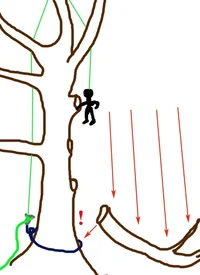
basal anchor safety

When dealing with trees and people, I spend a great deal of time explaining the importance of being proactive not reactive! I would like to see as much serious effort and thought put into making sure an aerial rescue or recovery is not needed. A rescue is a reactive response to something that could have and should have been avoided.
I agree with you, an ounce of prevention is better than a pound of cure
 
When dealing with trees and people, I spend a great deal of time explaining the importance of being proactive not reactive! I would like to see as much serious effort and thought put into making sure an aerial rescue or recovery is not needed. A rescue is a reactive response to something that could have and should have been avoided.
Plan for the best, prepare for the worst.

Training in all respects and more importantly an attitude at the top of safety first.
 
I have put much thought into this for myself. I feel that a rescue base anchor would not work for me in about 95% of the scenarios I've thought about, even with competent people who would know how to lower me. If I'm using a saw I am tied in twice by using my lanyard, even with a handsaw most of the time. So the only situation it would work is if I have the capacity to disconnect the lanyard myself. If I can do that I can most likely descend on my own. If I had a anything swing to hit me, it would be while I'm using a saw therefore tied in twice.

The only cases that I can think of is if I got nailed by a hanger, attacked by bees to the point of passing out, or some non accident injury such as a heart attack.. Then I could be lowered, but not likely if I were in a conifer. If I were in the crown of a conifer you'd have to let me run pretty good to bounce me through the limbs...
I completely agree with your statement. Much of this comes down to real world numbers. Industry wide, very few are climbing SRT, and those with lower-able systems are probably even less.

OR.....climb DSRT and leave the lanyard on the ground inside the gear bag. :) When it's practical, of course. With 2 lines, a rescuer could choose one to climb up to meet the victim.
 
So we can agree that most situations aren't ideal, so I figure I will toss out an idea I had, which may have been brought up before and is very situational and gear-intensive.

With a triple threat system, instead of keeping 2 lines for climbing, use 1 as your main basal anchor, and use the 2nd one on a different tree, ideally further from your work zone where saws wont be used. Your main anchor can be lowerable and the other can be a simple running bowline which can be untied (it can remain slightly slack since it is only back up. (Edit: It would be better to use a trunk wrap before the running bowline to ensure slack even if the other line is cut).

You could do something like this with a single rope if it is long enough by just having it doubled through the ring with a butterfly knot on each side so if one side or the other is cut, it will catch in the ring. This would not be lowerable, but for some, this is not a problem.

Not an efficient idea at all, but I figure I would throw it out there.
 
Last edited:
I don't follow many SRT threads and I skimmed over this one.

As far as basal anchors on SRT, they never made me feel comfortable; if I was dropping stuff or tree removal.

Now, I only use it for ascent because I felt I was likely going to die if I continued SRT basal anchors while working.

Not for the thought that someone might cut my line. (although, giving the ground crew crap, maybe I should worry about that ;)) But because I'm sure that if I dropped a huge limb and the butt of that limb struck the trunk of the tree; it could easily cut that line.

Also, too many years of DRT. I kept forgetting that the other end of my rope was on the backside of the trunk when I was cutting off water sprouts or ivy and such.

SO, I quit. I only use SRT for my wraptor ascent.

The retrievable crown systems my friend Lawrence has shown me look good though.

I might just have too many years in DRT to change though.:aburrido:

Good article Mac Swan! Thanks for your work.

 
That is not a bad idea for certain situations. I will play around with that.
This is my idea of how you can use 2 ropes with 1 climbing line and 2 anchors.
5gcLa2u.jpg
 
Not a bad idea
Rigid metal conduit, reamed and threaded with bushings at both ends to protect the rope, would be very difficult to cut through with a chainsaw, in my opinion. A bit expensive, heavy and possibly dirty (with cutting oil), but probably much harder to cut through than PVC. This all asumes you're trying to prevent someone from "accidently" cutting your rope. Someone intent on murdering you would only have to raise the pipe up and cut the rope with a knife.

I would have been tempted, had I been law enforcement, to charge the guy in New York, I think it was, who cut the girl's climbing line, with attempted homicide.

The problem with trying to make something idiot-proof, is that idiots have endless imagination.
 
Last edited:
My thought was that if you nicked the plastic it'd give you time to say, "Oh Sh!t!" and not hit the rope, but if you were to nick the tensioned rope, the climber is probably screwed. Similar to the wire core lanyard. It's not saw proof but gives an extra measure of safety.

It would need to be tested, but I think the primary way that a PVC pipe could work to provide protection to the rope from cutting is by hopefully spinning in place around the rope, causing the saw to slide up and down the pipe, unable to cut into much of anything. Sorry if these posts seem way out of sequence. I'm reading this thread through start to finish, and posting my thoughts as I reach each post in the thread. Some of what I say here may already been covered by someone else earlier in the thread, but it's just not been reached by me yet. The alternative would be to wait to post until I've finished reading through an entire multi-page thread, but by then I would probably have forgotten most of what I had thought of in the first place.
 
Last edited:
I have put much thought into this for myself. I feel that a rescue base anchor would not work for me in about 95% of the scenarios I've thought about, even with competent people who would know how to lower me. If I'm using a saw I am tied in twice by using my lanyard, even with a handsaw most of the time. So the only situation it would work is if I have the capacity to disconnect the lanyard myself. If I can do that I can most likely descend on my own. If I had a anything swing to hit me, it would be while I'm using a saw therefore tied in twice.

The only cases that I can think of is if I got nailed by a hanger, attacked by bees to the point of passing out, or some non accident injury such as a heart attack.. Then I could be lowered, but not likely if I were in a conifer. If I were in the crown of a conifer you'd have to let me run pretty good to bounce me through the limbs...

Thanks for this post. Well thought out. The "getting stung" scenario is what happened to the female climber, and in her case, having a system capable of being lowered by an idiot really cost her. I'd seen her say somewhere, I think, that she was seriously considering going back to DdRT as a result.

I mostly climb alone, and do use a base-tie lowerable system, primarily in case of it being needed by emergency workers.

I agree that there are many times when it would not work as a result of my being tied in twice. My primary motivation for use of the base tie and SRT is the fact that I don't need to isolate the tie-in point, and the distribution of the forces that makes using smaller branches for support, possible. I feel more comfortable, and safer, knowing that I'm not depending on one single branch for my life support. I like to picture in my mind, "if this branch snaps off, my rope will fall back to this next branch, and then the next one after that." All within a few feet of each other, and all unlikely to fail at all, because each one will carry only a small percentage of my total weight.
 
Ppl
....The "getting stung" scenario is what happened to the female climber, and in her case, having a system capable of being lowered by an idiot really cost her...

Though it was a botched rescue attempt that caused her injuries, it really bothers me that it overshadows what really went wrong that required her to need being rescued. Her climbing system, the way it was set up, failed to function in an emergency situation. I would much prefer that climbers recognise this fact and not make the same mistake.
 
Ppl

Though it was a botched rescue attempt that caused her injuries, it really bothers me that it overshadows what really went wrong that required her to need being rescued. Her climbing system, the way it was set up, failed to function in an emergency situation. I would much prefer that climbers recognise this fact and not make the same mistake.

I know I sound harsh when talking about that guy, but my recollection of the story was that she had already lowered herself about 3/4ths of the way down with no assistance from anyone, and was still making progress when the guy cut her rope without even talking to her about what he was doing to find out what she thought of the idea. Maybe I've got the story wrong; I'll need to go back and find that thread. I feel like that motto for doctors applies here. "First, do no harm."

If I came across an accident on a roadside and decided it was necessary to perform some surgical procedure on a victim for which I had zero qualifications, and I had a cell phone on me with which to call 911, but chose not to, and things went really badly for the victim as a result, I would fully expect to be doing jail time. You can't tell me that nobody in the group had a cell phone. I'm sorry, but I can't apologize for calling the guy an idiot. He should at least be paying civil damages to her for a very long time for the harm he caused her.


I respect you immensely, Dave. I think you have a bigger, more forgiving heart than I do.
 
Last edited:

New threads New posts

Back
Top Bottom