APTA-tude adjustment

The link on post #27 takes me to a valve that looks the same as what came on my APTA. Will watch to see if I am missing something.

Unless your APTA came with a butterfly valve, they are not the same.

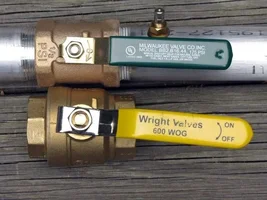
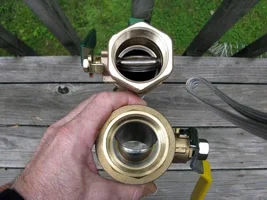
In the photos, the yellow handled ball valve is what came on my APTA and the green handled butterfly valve is the one linked in post #27.

IMG_5232 (Small).webp IMG_5234 (Small).webp

since the link shows a listed Max. Water Pressure: 175 psi and the APTA comes with a max AIR pressure of 200 psi so is there much difference between the water or air pressure when using a butterfly valve?

I have no idea and don't know what the longevity of the 175 psi rated valve will be with occasional use at 200+ psi. I do know that valves are made and rated to be under constant pressure leading me to hope that I'll get by with infrequent use at 15% higher pressure.
 
I installed a 1.5" butterfly valve a week ago and finally got to try it out this evening. WOW ! I have to agree that it is a big improvement over the ball valve for both the reasons you stated.

Yep. For me, it's a no-brainer. I just don't have the arm strength to quickly open the big ball without the barrel jumping all over. But there are a couple of issues with the butterfly ...

Yes, Stihl, the pressure rating drops from 600 to 175 psi. These rating are done under static conditions and, like anything else, they have safety factors. I'm absolutely no valve engineer, but the APTA application is a relatively easy application for a valve: 1) it is controlling air, not water, which weighs a lot less and 2) it only opens. It never has to stop a moving liquid column (think "water hammer" when you quickly close a faucet). So (just me talking not TreeStuf) I'm OK with pushing it a little with a built-in safety.

I've tested my 1-inch butterfly to 240 psi. It behaves flawlessly and holds a perfect bubble test at that pressure. If the valve were to fail, it would not split the brass housing and explode. It would distort the butterfly pivot mechanism and the valve would begin to leak. At worst, there would be an unintentional discharge of the bag at some uncertain velocity. Regardless, proper muzzle management would say ALWAYS keep the barrel pointed in a safe direction.

Even with my testing, I never pressure my chamber above 215 psi That's one 16g cartridge for really high shots 150-170'. Most of the time, I use one 12g. Cheaper, easier on the bag and plenty of height., it gives me 165psi and 140' and the valve isn't even breathing hard.

Additionally, I've installed a poppet relief value at 215-225 psi. So, taken as a system, I'm operating inside a known tested region of safe performance. Again: me talking, not TS.

About the cost, there's a big saving when you drop to 1-inch. But there are issues here too ...

Now the style of shot goes from "rifle" to "bazooka" and/or "mortar". I particularly like the mortar so I can steady brace myself. Also, the ground resists the recoil so all the cartridge energy goes into moving the bag forward, not the APTA backward. Really good for the highest shots. But, if you only need a lower branch, you can shoot quickly and easily as a bazooka, you get a little recoil and it's almost like the APTA was automatically "dialing down" a little for a softer, lower shot.

And, surprisingly, the 1-inch valve is more efficient (higher) for the same volume and pressure on the chamber. The reduction coupling forms a little cup to cradle the bag and form a better seal to the initial air flow. Whodathunkit.

Of course, the best thing about the butterfly is the release torque. Down from 12.5# on the big ball, 3.5# on the small ball, and less the 1# on either butterfly. It's wonderful. But keep telling yourself it's now a TRIGGER not a HANDLE!!! Don't touch it until you're on target and ready to fire You don't pick up your Glock by the trigger, do you?

Sorry to be both long-winded and late with this. I wasn't ignoring the thread, I was gone for a week.

OF

 
well due to extensive testing the outer skin of a lime secretes oil as it is squeezed down the APTA barrel lubricating the projectile and inner of the barrel allowing for a smooth exit of said lime off far away into the distance :foto:

I have taken the APTA to the biggest tree on my block and fired a 14 oz harrison bag with 2mm zing it at maxed out 170 psi - launched the bag over the whole tree approx 100 ft and all the way over to the far side ran out all 200ft of line. tree canopy would be 8o ft across easy.

as to the cow that wandered over from next door last year a 14 oz bag was a good convincing argument for going back the same way it came before I decided to have a impromptu spit roast for all my friends. :asadito:
we have some large blocks up in the hills :D
 
Last edited:
LoL... well, I guess Adelaide isn't quite the wilderness...

I always figured you lived so far out into the outback, that "Tie Me Kangaroo Down, Sport" was considered a love song...

:risas2:
 
Jeff I did live in the out back as a child, grew up amongst the scrub shooting roos , we lived in mining townships .
As to tie me kangaroo down sport , Large mature males can stand more than 1.8 m (5.9 ft) tall, with the largest confirmed one having been around 2.1 m (6.9 ft) tall and weighed 91 kg (201 lb). Accounts of sizes greater than this are not uncommon, with some reportedly reaching a weight of approximately 150 kg (330 lb).
you try and wrassel a mature male western red when he is pissed off because you are rooting the females and see how far you get without any intestines after the bastard claws them out with one swift motion of his hind legs.:(

when I was a kid we were traveling at night approx 120 kms and a male great red jumped over our 4x4 with his toenails and tail touching the roof rack - that bugger comes through the windscreen and survives when he wakes up he will proceed to kick until he gets free or rights him self and anything around him will be gored by the large rear claws.
but if you want to have a crack then sure I guess I could arrange it, you will need a bottle of bundy after that encounter.
:D
 
the 1-inch valve is more efficient (higher) for the same volume and pressure on the chamber. The reduction coupling forms a little cup to cradle the bag and form a better seal to the initial air flow. Whodathunkit.

Of course, the best thing about the butterfly is the release torque. Down from 12.5# on the big ball, 3.5# on the small ball, and less the 1# on either butterfly. It's wonderful. But keep telling yourself it's now a TRIGGER not a HANDLE!!!
thats the only bugbear I have with the APTA is the stiffness on the release can pull you slightly off target so I am def excited to try and change that aspect since I use the bloody thing so often now.
 
I think the butterfly valve looks like a good improvement. But for those of you still using the ball valve, try storing it with the valve in the open position and then open and close it, fast a couple of times before you pressurize it. Ball valves really vary in how hard they are to open.
If you need more hight, try a longer barrel. You will get more hight with a 3' barrel than you will with a 2' barrel when using the higher pressures as it takes time for the bag to reach full velocity.
 
What tools do I need to remove the original valve from the APTA?

(I will get my APTA on a trip, and I will need to break it to fit in my luggage. What tools do I need to bring, and what size? E.g. can it be done with only one adjustable wrench?)
 
Welcome Laroh. I haven't done much with my APTA yet but in preparation to have a carry bag made up for it and a pump, I wrapped a towel around the barrel to protect it and loosened it with a pipe wrench. Now I screw it on and off by hand to put it in its bag.
 
Jeff I did live in the out back as a child, grew up amongst the scrub shooting roos , we lived in mining townships .
As to tie me kangaroo down sport , Large mature males can stand more than 1.8 m (5.9 ft) tall, with the largest confirmed one having been around 2.1 m (6.9 ft) tall and weighed 91 kg (201 lb). Accounts of sizes greater than this are not uncommon, with some reportedly reaching a weight of approximately 150 kg (330 lb).
you try and wrassel a mature male western red when he is pissed off because you are rooting the females and see how far you get without any intestines after the bastard claws them out with one swift motion of his hind legs.:(

when I was a kid we were traveling at night approx 120 kms and a male great red jumped over our 4x4 with his toenails and tail touching the roof rack - that bugger comes through the windscreen and survives when he wakes up he will proceed to kick until he gets free or rights him self and anything around him will be gored by the large rear claws.
but if you want to have a crack then sure I guess I could arrange it, you will need a bottle of bundy after that encounter.
:D

Amazing stuff, Stihlmadd. Thanks for sharing all of that.

Tim
 
What tools do I need to remove the original valve from the APTA?

(I will get my APTA on a trip, and I will need to break it to fit in my luggage. What tools do I need to bring, and what size? E.g. can it be done with only one adjustable wrench?)

I had a glitch with my handheld's web browser that caused the application to crash, and I lost a fairly long post I was almost ready to respond to your question with.

Short story, if you absolutely want to be covered so that you can be certain you'll be able to get the APTA apart out in the field, you'll need to buy two of these, or similar from another manufacturer. Ridgid makes great tools that will last your lifetime, and work beautifully, however. I think they're manufactured here in the US, also.

18" wrenches are what is required, which have a jaw that is capable of opening up to 2&1/2 inches wide. You need this size to get one of the two wrenches around the outside of the valve fitting.

http://www.amazon.com/gp/aw/d/B0000...e+wrenches&dpPl=1&dpID=31oZr0FZa8L&ref=plSrch

The aluminum wrenches (which is not what I gave you a link to) are more expensive, but lighter in weight and therefore probably easier to work with. Here's a link to an aluminum version, just so you can see what it looks like.

http://www.amazon.com/gp/aw/d/B0000...e+wrenches&dpPl=1&dpID=414HFfd1ScL&ref=plSrch

The stuff I started to say in my lost post is that if you are actually going to TreeStuff's brick and morter store, you might be able to save yourself the expense of buying two wrenches by having TreeStuff either use their gear to break an APTA apart for you, or they could possibly just sell it to you with the two halves not yet assembled.

If you decide you must be able to do this on your own out in the field, you'll need two wrenches, because you'll need to prevent the rotatation of one half while you try to cause rotation in the other half of each section.

The red handled Ridgid tools are made of steel, I believe, and are the lowest priced option in their lineup. They also make some that have spring-loaded jaws that automatically adjust themselves as to size, which is really a nice feature, but costs more.

Oh, man! I just found the link to the ultimate combination of features for the wrenches in question. It's made of aluminum for light weight, and uses the spring-loaded RapidGrip design. This pipe wrench accommodates up to a 3" pipe diameter and adjusts or can be opened up with one hand using just your thumb. I own one pipe wrench made of steel that uses this design, for 2" max pipe size, and I absolutely love it. It is probably my favorite wrench because of how smoothly it works. Here's the link to the larger and aluminum version you would need, if you felt like buying what I think is the best tool possible for the job you have in mind. You may not use them often, but when you do, you will just be loving the experience.

http://www.amazon.com/gp/aw/d/B001H...+rapidgrip&dpPl=1&dpID=41vgoN9nx+L&ref=plSrch

I hope some of this is helpful.

Tim
 
Wow! That is a great looking pipe wrench, thanks for that link, Tim. As far as taking the APTA barrel on and off, I just use my climbing gloves. Hand tight is all it needs to work. The air chamber side has sealant on the threads and probably is not worth taking on and off.
 
Yeah, Dave, you are welcome. Really great wrench. I tried finding a specific video that showed how it works, but no luck so far.

I ended up taking my APTA apart on the air chamber side because I didn't like the location of the filler valve, underneath the ball valve handle. I thought I might easily pinch my fingers on it when trying to pull on the handle to fire the APTA. Also, I prefer to leave the bike pump attached after I pump air into the chamber, in order to keep from losing some of those precious PSI's I worked so hard for.

Having the fill valve at the midpoint on the APTA meant I basically had to hold the bike pump up in the air if I wanted to leave it attached. The arrangement just wasn't working for me. So I used the pipe wrenches to turn the chamber side pipe out of the ball valve. Then I removed the bottom metal cap. I then filed the inside of all of the pipe ends that I had access to at that point, as they had not been reamed before assembly.

I flipped the air chamber pipe upside down, so that the air filler valve would be at the bottom of the APTA, near the ground, which is where my bicycle pump rests. I put the end cap back on at the "new" bottom end.

At this point I added two new one foot long sections of inexpensive black pipe of the correct diameter above the original aluminum section, before screwing the new larger air chamber back into the bottom side of the ball valve. I also ended up making the ball valve handle pull back and down rather than back and up, by rotating it to the right a bit if that makes any sense. I reattached the plastic handle so that it's in a spot where it just acts as a way to rest the weight of the APTA against my shoulder.

When shooting, my left hand pulls the topside barrel of the APTA back towards me, and points the barrel, while my right hand pulls back and down on the ball valve handle to fire the APTA.

That about covers all of the changes I made to the original configuration of my APTA. One last thing. The additional two feet of air chamber made it so that I could use twenty pounds less air pressure, and get much more power out of the APTA.

Thanks for listening.

Tim
 

New threads New posts

Kask Stihl NORTHEASTERN Arborists Wesspur TreeStuff.com Teufelberger Westminster X-Rigging Teufelberger
Back
Top Bottom