
Navigation
Install the app
How to install the app on iOS
Follow along with the video below to see how to install our site as a web app on your home screen.
Note: This feature may not be available in some browsers.
More options
You are using an out of date browser. It may not display this or other websites correctly.
You should upgrade or use an alternative browser.
You should upgrade or use an alternative browser.
Adjustable Prusik
- Thread starter tod_k
- Start date


NickfromWI
Participating member
- Location
- Los Angeles, CA
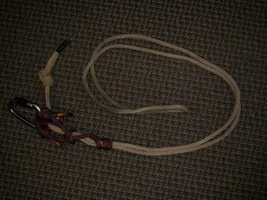
That's a pretty neat idea. Do you basically use it like a flipline?
love
nick
love
nick

- Location
- Home of the New Jersey Devils
Flipline? I use one like that (with Schwabish)just to get closer to my tie in point.

Norm_Hall
New member
- Location
- Wauconda, (Chicago),IL,USA
It's an ascending prusik with an adjustable bridge. Nice, TK.
- Location
- Stockholm, Sweden
Nice idea Tod, haven't seen that one before.
If only I could get more work in trees that make
it worth the effort to set up the footlock system.
/ Oskar
If only I could get more work in trees that make
it worth the effort to set up the footlock system.
/ Oskar
NickfromWI
Participating member
- Location
- Los Angeles, CA
AH-HAH! Now I get it. I was wondering exactly where you use it.
I might have to make me one of those!
love
nick
I might have to make me one of those!
love
nick

NickfromWI
Participating member
- Location
- Los Angeles, CA
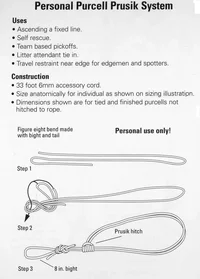
Rescueman, though your system is less gear intensive, it only offers a 1/2 of the adjustability...let me explain.
The prusik loop is just that...a loop. If the whole works is 3 feet long when at it's longest, it can only be 1.5' long when at it's shortest.
Tod's version can be cinched up to almost nothing.
love
nick
The prusik loop is just that...a loop. If the whole works is 3 feet long when at it's longest, it can only be 1.5' long when at it's shortest.
Tod's version can be cinched up to almost nothing.
love
nick
- Location
- San Jose, CA, USA
I like it. I am thinking that is what I can use my footlocker for. I like using a prusik loop for footlocking and hate to have a piece of gear on the truck that I never use.
Thanks for the idea
Brian
Thanks for the idea
Brian

It's just a two-stage rig. The whole thing is used on the main rope. When its friction hitch reaches its limit, there's still the second one available to advance on the first. It's a good idea; I've been taking the time to stick a short one in place as needed.
Glen
Glen
- Location
- Halifax, Nova Scotia
It might to Cory, but it doesn't to me. I'm missing the whole point.
BAB
BAB

- Location
- Retired in Minneapolis
When you choose to footlock into the tree the ascending loop, the one tied onto the access line, is generally left long so that the climber can get a full bite everytime they footlock. There are times when the climber gets to the top of the rope but they're just a little shy of the tie in point. With TK's setup the climber can now move up that last little bit on the ascending loop. Instead of having a candy cane loop the climber will stay supported and reduce the possible fall.
On Rope 1 sells a similar setup called a "Quick Adjust Safety" I put one together and it is useful in certain applications.
On Rope 1 sells a similar setup called a "Quick Adjust Safety" I put one together and it is useful in certain applications.
- Location
- Halifax, Nova Scotia
I get it. Thanks Tom.
BAB
BAB

- Location
- Basel, Switzerland
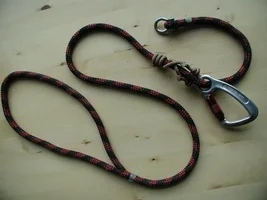
This'd be my contribution to this thread: It's a 10mm FSE Footlock lanyard, with a ISC captive eye karabiner attached to it through the krab's eye with a cord made by New England called "Tech Cord" with a 5000 lbs. breaking strain acting as the adjuster, backed up by a shackle at the end of the lanyard that'll act as a stopper in cade the mini V.T. fails. You could also attach the shackle to the krab.
The adjusting is easy, meaning you can get closter to your TIP, in doing so reducing the risk of high fall factors - as mentioned before in this thread. I think as we use increasingly static materials in access lines (Dyneema, for example!) we should really keep an eye on this possibility! I know from observing my own climbing style, that there are situations in which I'm exposing myself to such situations, hence the idea with this adjustable lanyard.
The adjusting is easy, meaning you can get closter to your TIP, in doing so reducing the risk of high fall factors - as mentioned before in this thread. I think as we use increasingly static materials in access lines (Dyneema, for example!) we should really keep an eye on this possibility! I know from observing my own climbing style, that there are situations in which I'm exposing myself to such situations, hence the idea with this adjustable lanyard.
Attachments
New threads New posts
-
test
-

-
-
 Fruit tree holding on by a thread, client wants to get another year out of it. Thoughts?
- Started by climbingmonkey24
- Replies: 29
-
-

-
