
Navigation
Install the app
How to install the app on iOS
Follow along with the video below to see how to install our site as a web app on your home screen.
Note: This feature may not be available in some browsers.
More options
You are using an out of date browser. It may not display this or other websites correctly.
You should upgrade or use an alternative browser.
You should upgrade or use an alternative browser.
Question about felling technique
- Thread starter samsquatch
- Start date

Daniel
Carpal tunnel level member
- Location
- Suburban Philadelphia (Wayne)
Good for you sweetheart, good for you. Nuttin revolutionary here Daniel..
Maybe not today.... but 8 years ago we were just getting out of the stone age!
Daniel
Carpal tunnel level member
- Location
- Suburban Philadelphia (Wayne)
For the love of god, please go learn how to make a proper slice cut! If not for yourself, then do it for the children.
You got something???? bring it don't sing it!

evo
Been here much more than a while
- Location
- My Island, WA
bull shit, Watched my pop's blow the dust off his ole saw and take care of a hung up tree with a slice cut some time around the third grade. He started workin in the woods when the men were in the second war. full of it..Maybe not today.... but 8 years ago we were just getting out of the stone age!
Daniel
Carpal tunnel level member
- Location
- Suburban Philadelphia (Wayne)
Did he plunge it and leave a top strap or just go over the top with the cut?
evo
Been here much more than a while
- Location
- My Island, WA
plunge.. Dont know about the strap. Doubt it, as this is a great way to ruin a good log. Next time try, top cut. come down the stem ~24", plunge exiting the underside.Did he plunge it and leave a top strap or just go over the top with the cut?
Or top cut, pull out most the way to where you're using just the tip, cut down 10-15%, plunge in and reem if needed, pivot powerhead down and tip up, cutting the 1/3rd on the back side, keep the saw cutting while sweeping downward with the tip, cut out the bottom. You should be left with a circle of wood in the center of the log. This can be tripped with using just the tip, and is less likely to grab your saw, or pinch.
You can buck big wood close to the same, no splintering/no slabbing heartwood/pinched saws or docked logs at the mill.. Been done this way on the wet coast for generations now.. You really aren't doing anything new.
Daniel
Carpal tunnel level member
- Location
- Suburban Philadelphia (Wayne)
Its a much different game when you are getting paid for the logs.. I get paid for putting the wood on the ground... I ALMOST NEVER consider preserving the value of the logs... That goes for pretty much every tree I cut, not just the hung trees.... So it's a much different mind set. There is no such thing as "ruining a log" in my world....
I cut a perfectly good 10' cherry log in half last week, just to get it out of the backyard, because it was too heavy for the skid loader to take in 1. We put a couple guys on the back of the loader for counter-weight and when that didn't work I grabbed the saw without hesitation... Guy who picked the wood up said it was a damn shame to cut that log in half.... If he EVER put any serious $ in my pocket for the wood, then maybe I would give it a second thought...
So I if I only care about getting the tree down, I have a lot more flexibility than when I care about the log's value... If there is a technique faster, more efficient, or less likely to get a saw pinched than the the plunged vertical snap cut I have yet to see it...
The real issue comes when a tree gets so straight (after multiple cuts) that all the wood is under compression, and there is no tension wood. That is when the staggered cut comes in really handy. It still gets mighty tricky not to over-cut and bypass the cuts so far that the tree sits down on the bar. The last one I did like that with a pull line on the loader and notched it to get the but to drop away from the intended lay, which worked Ok since there was a lot of room for error in the DZ...
I cut a perfectly good 10' cherry log in half last week, just to get it out of the backyard, because it was too heavy for the skid loader to take in 1. We put a couple guys on the back of the loader for counter-weight and when that didn't work I grabbed the saw without hesitation... Guy who picked the wood up said it was a damn shame to cut that log in half.... If he EVER put any serious $ in my pocket for the wood, then maybe I would give it a second thought...
So I if I only care about getting the tree down, I have a lot more flexibility than when I care about the log's value... If there is a technique faster, more efficient, or less likely to get a saw pinched than the the plunged vertical snap cut I have yet to see it...
The real issue comes when a tree gets so straight (after multiple cuts) that all the wood is under compression, and there is no tension wood. That is when the staggered cut comes in really handy. It still gets mighty tricky not to over-cut and bypass the cuts so far that the tree sits down on the bar. The last one I did like that with a pull line on the loader and notched it to get the but to drop away from the intended lay, which worked Ok since there was a lot of room for error in the DZ...
Last edited:
Daniel
Carpal tunnel level member
- Location
- Suburban Philadelphia (Wayne)
These guys are highway workers... they weren't raised in the woods by loggers... They just watched my video on youtube and wrote to thank me for making their jobs a whole lot faster, safer and easier. They didn't care about the log value either.. They just wanted the tree on the ground.. 100'+ oak hung up in another tree... No climbing, no crane, no bucket, no muss, no fuss.. Just a sweet little victory for the working man!
evo
Been here much more than a while
- Location
- My Island, WA
Its a much different game when you are getting paid for the logs.. I get paid for putting the wood on the ground... I ALMOST NEVER consider preserving the value of the logs... That goes for pretty much every tree I cut, not just the hung trees.... So it's a much different mind set. There is no such thing as "ruining a log" in my world....
I cut a perfectly good 10' cherry log in half last week, just to get it out of the backyard, because it was too heavy for the skid loader to take in 1. We put a couple guys on the back of the loader for counter-weight and when that didn't work I grabbed the saw without hesitation... Guy who picked the wood up said it was a damn shame to cut that log in half.... If he EVER put any serious $ in my pocket for the wood, then maybe I would give it a second thought...
So I if I only care about getting the tree down, I have a lot more flexibility that when I care about the log's value... If there is a technique faster, more efficient, or less likely to get a saw pinched than the the plunged vertical snap cut I have yet to see it...
The real issue comes when a tree gets so straight (after multiple cuts) that all the wood is under compression, and there is no tension wood. That is when the staggered cut comes in really handy. It still gets mighty tricky not to over-cut and bypass the cuts so far that the tree sits down on the bar. The last one I did like that with a pull line on the loader and notched it to get the but to drop away from the intended lay, which worked Ok since there was a lot of room for error in the DZ...

evo
Been here much more than a while
- Location
- My Island, WA
These guys are highway workers... they weren't raised in the woods by loggers... They just watched my video on youtube and wrote to thank me for making their jobs a whole lot faster, safer and easier. They didn't care about the log value either.. They just wanted the tree on the ground.. 100'+ oak hung up in another tree... No climbing, no crane, no bucket, no muss, no fuss.. Just a sweet little victory for the working man!

I would personally like to thank you for inventing such an mind altering, paradigm shifting, earth shattering cut. Who knew we where in the presence of such greatness?These guys are highway workers... they weren't raised in the woods by loggers... They just watched my video on youtube and wrote to thank me for making their jobs a whole lot faster, safer and easier. They didn't care about the log value either.. They just wanted the tree on the ground.. 100'+ oak hung up in another tree... No climbing, no crane, no bucket, no muss, no fuss.. Just a sweet little victory for the working man!
Daniel
Carpal tunnel level member
- Location
- Suburban Philadelphia (Wayne)
back to this pic Rico.. you called it "fucked up"...
I would like to have an intelligent conversation about it.. maybe someone out there could learn something that will end up saving his life or some property damage.. so beyond all the posturing and ego, can you offer some constructive criticism, instead of just throwing mud?
I would like to have an intelligent conversation about it.. maybe someone out there could learn something that will end up saving his life or some property damage.. so beyond all the posturing and ego, can you offer some constructive criticism, instead of just throwing mud?
Attachments
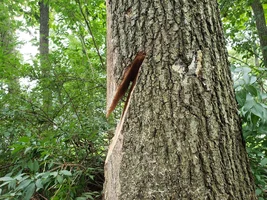
back to this pic Rico.. you called it "fucked up"...
I would like to have an intelligent conversation about it.. maybe someone out there could learn something that will end up saving his life or some property damage.. so beyond all the posturing and ego, can you offer some constructive criticism, instead of just throwing mud?
The point of a slice cut is to have it slide vertically straight down to the ground. For some reason you created some sort of undercut , which has created a space for it to close and hinge. Not what you want in a slice cut. Try that in a large hung up tree and your asking for trouble.
This thing appears to have a small head lean, so simply cut upwards at a steep angle, back cleaning your kerf as you go. This will allow you to cut as deep as possible without it sitting on your saw. With your saw still cutting, you then pull your tip out and in a continues motion finish with your top cut. Upper and lower cut are lines up perfectly, and there is no hinge, fiber pull, or mini barber chair. The process is simply reversed if you are clearing a hung up tree with back tension.
Like knowing how the properly buck a large tree that is under serious tension into millable logs without pulling fibre, breaking valuable wood, or getting your saw stuck, this is a very simple technique that folks who work in the woods learn early on. This is why I'm such an advocate for all aspiring arborists to spend a season or 2 logging. Processing real cutting skills is just as important as the climbing and rigging skills. Combine all 3 and you have Tree-men such as Mr. Beranek, Reg C, August H, Dave Coleman, etc.
Last edited:
Daniel
Carpal tunnel level member
- Location
- Suburban Philadelphia (Wayne)
Thank you for that detailed explanation... there is a lot more to be learned and shared from that post than just labeling it as "fucked up". So again THANK YOU..
I told you that everything I do is intentional, so there is a reason I made that notch just the way it is... I always try to give a poster the benefit of the doubt when I see something I've never seen before, and ask before I judge... EVEN When it looks a bit ugly or cringe worthy... SO please try to keep an open mind.. maybe , just maybe there is a very good reason for that cut.. which is to solve a problem that you don't really face enough to have to come up with yourself.
The thing about you and me Rico is that we're from different worlds.. We both use chainsaws to put trees on the ground so it looks like we do similar work, and in many ways we do, but the differences are huge and mostly transparent (not seen or understood). And those differences give us very different viewpoints.... I AM aware of many of those differences and actually wrote an article about using the Humboldt which points out many of the differences between logging and arboriculture.
That particular cut, that I call the stangle (for steep angled Humboldt) was developed to use from the bucket, not to use on a hung tree. I use it A LOT, and it works really well. When the bucket is maxed out and there is too much top left to lay out in a drop zone, one way to get the top down without leaving the bucket it to use a slide cut. only problem is that if you make it from the bucket, the overhead branches coming off the back side have a good likelihood of sliding down on your head and killing you. SO by cutting a narrow and very steep humboldt, you can get the top to lean forward far enough to get the top out from over your head before the notch closes, the hinge breaks, and the whole top comes spearing straight down into the ground...
A climber with your skills wold NEVER need to use that cut... If there isn't enough room in the DZ for the top, you would simply climb a little higher as needed. So its about useless for you, but is invaluable for me as I don't get out of the bucket, and I can't wear spikes anymore. Giving us far different viewpoints... I've used this cut enough to know its limitations and become confident in its performance. It can also be used with a pull line and tripped from the ground as seen in the below video.
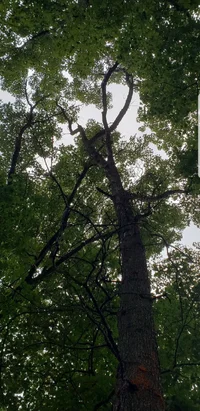
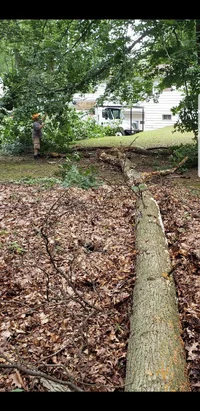
the dry oak tree from that photo was way too tall for the DZ, and long enough dead that no one wold have wanted to climb. there was a big crumbling limb right over my head when I started that cut... by the time the tree leaned out and the notch closed, that dead limb was 20+ feet away... as seen in the attached photo.... At that point the tree was leaning towards another big oak. I wasn't worried about scratching up the second oak because there were no significant lower limbs in the way. I was really concerned about a big beautiful beech tree, which was going to take some impact. Hoping that when the slide cut was triggered the impact on the ground and hitting the second oak simultaneously would be enough to break some portions of the top out, so there would be less damage to the beech.
As it turned out one big lower limb on the beech was pinned to the ground, but did not break and only one or two other very small limbs were broken, Nothing over an inch which was an outcome I quietly celebrated, as it was completely safe and saved at least an hour of having to maneuver the bucket through the back woods in wet weather
I told you that everything I do is intentional, so there is a reason I made that notch just the way it is... I always try to give a poster the benefit of the doubt when I see something I've never seen before, and ask before I judge... EVEN When it looks a bit ugly or cringe worthy... SO please try to keep an open mind.. maybe , just maybe there is a very good reason for that cut.. which is to solve a problem that you don't really face enough to have to come up with yourself.
The thing about you and me Rico is that we're from different worlds.. We both use chainsaws to put trees on the ground so it looks like we do similar work, and in many ways we do, but the differences are huge and mostly transparent (not seen or understood). And those differences give us very different viewpoints.... I AM aware of many of those differences and actually wrote an article about using the Humboldt which points out many of the differences between logging and arboriculture.
That particular cut, that I call the stangle (for steep angled Humboldt) was developed to use from the bucket, not to use on a hung tree. I use it A LOT, and it works really well. When the bucket is maxed out and there is too much top left to lay out in a drop zone, one way to get the top down without leaving the bucket it to use a slide cut. only problem is that if you make it from the bucket, the overhead branches coming off the back side have a good likelihood of sliding down on your head and killing you. SO by cutting a narrow and very steep humboldt, you can get the top to lean forward far enough to get the top out from over your head before the notch closes, the hinge breaks, and the whole top comes spearing straight down into the ground...
A climber with your skills wold NEVER need to use that cut... If there isn't enough room in the DZ for the top, you would simply climb a little higher as needed. So its about useless for you, but is invaluable for me as I don't get out of the bucket, and I can't wear spikes anymore. Giving us far different viewpoints... I've used this cut enough to know its limitations and become confident in its performance. It can also be used with a pull line and tripped from the ground as seen in the below video.
the dry oak tree from that photo was way too tall for the DZ, and long enough dead that no one wold have wanted to climb. there was a big crumbling limb right over my head when I started that cut... by the time the tree leaned out and the notch closed, that dead limb was 20+ feet away... as seen in the attached photo.... At that point the tree was leaning towards another big oak. I wasn't worried about scratching up the second oak because there were no significant lower limbs in the way. I was really concerned about a big beautiful beech tree, which was going to take some impact. Hoping that when the slide cut was triggered the impact on the ground and hitting the second oak simultaneously would be enough to break some portions of the top out, so there would be less damage to the beech.
As it turned out one big lower limb on the beech was pinned to the ground, but did not break and only one or two other very small limbs were broken, Nothing over an inch which was an outcome I quietly celebrated, as it was completely safe and saved at least an hour of having to maneuver the bucket through the back woods in wet weather
Attachments
Last edited:
What I am saying is that the small undercut you are making is unnecessary, and actually counter productive. It is creating space that will allow forward movement, which we don’t want in a slice cut. If you are doing that on something large or with a lot of weight above your cut, you could be staring at a barberchair in the blink of an eye. No Beuno!
I would like to add that I enjoy and value your contributions and input around here Daniel.
I’m just a cranky, combative, smartass little fucker, who can’t resist mixing it up when I see something I disagree with. Please don’t take it personal, and my apologizes if you did.
I’m just a cranky, combative, smartass little fucker, who can’t resist mixing it up when I see something I disagree with. Please don’t take it personal, and my apologizes if you did.
Daniel
Carpal tunnel level member
- Location
- Suburban Philadelphia (Wayne)
Me too and I think the world of your skills and experience and wouldn't bother engaging with you much if I didn't respect you.I would like to add that I enjoy and value your contributions and input around here Daniel.
I’m just a cranky, combative, smartass little fucker, who can’t resist mixing it up when I see something I disagree with. Please don’t take it personal, and my apologizes if you did.
Now that we've got all that love out of the way, can we get back to how my skills and abilities are far superior to anything you have seen or can even imagine...

Daniel
Carpal tunnel level member
- Location
- Suburban Philadelphia (Wayne)
What I am saying is that the small undercut you are making is unnecessary, and actually counter productive. It is creating space that will allow forward movement, which we don’t want in a slice cut. If you are doing that on something large or with a lot of weight above your cut, you could be staring at a barberchair in the blink of an eye. No Beuno!
Stay with me here...
First tree I did this on was a dead maple with a nice full canopy... there is a small hole that the entire top will fit in if I can get it there.... If I try laying out the entire top with a standard notch, it will either lay up into the surrounding trees or damage something on the ground. The hole is right near the tree. So I need to move the top towards that direction about 15-20 feet and then have it drop like a stone. If it lays out completely damage will be done. BUT if it doesn't lay out far enough it drops, the limbs on the back side of the tree will come down on me, which could easily kill me... The tree either has slight front lean to the hole or we put a pull line in it to make sure the tree will go our way. That's what this cut is used for... When you want the top to move before it drops, which of course could never be the case with a hung tree... top isn't going anywhere but straight down!
0% chance of BBC due to species and not enough front lean to split the trunk, and the strength of wood grain due to branch unions and the fact that by the time the tree moves there will be only the tiniest amount of hinge wood holding the top and bottom together. The width of the hinge is adjusted according to how far you want the tree to move before it drops. You need to account for some stretch in the hinge fibers which could be 10 degrees or more additionally after the face closes depending on species, thickness, live vs. dead etc...

Barc Buster
Branched out member
- Location
- The land shaped like a hand
Stay with me here...
First tree I did this on was a dead maple with a nice full canopy... there is a small hole that the entire top will fit in if I can get it there.... If I try laying out the entire top with a standard notch, it will either lay up into the surrounding trees or damage something on the ground. The hole is right near the tree. So I need to move the top towards that direction about 15-20 feet and then have it drop like a stone. If it lays out completely damage will be done. BUT if it doesn't lay out far enough it drops, the limbs on the back side of the tree will come down on me, which could easily kill me... The tree either has slight front lean to the hole or we put a pull line in it to make sure the tree will go our way. That's what this cut is used for... When you want the top to move before it drops, which of course could never be the case with a hung tree... top isn't going anywhere but straight down!
0% chance of BBC due to species and not enough front lean to split the trunk, and the strength of wood grain due to branch unions and the fact that by the time the tree moves there will be only the tiniest amount of hinge wood holding the top and bottom together. The width of the hinge is adjusted according to how far you want the tree to move before it drops. You need to account for some stretch in the hinge fibers which could be 10 degrees or more additionally after the face closes depending on species, thickness, live vs. dead etc...
From a midwest arborist perspective it seems like another nice trick in the bag. If BBC was a concern in species prone to it, a bore back cut could be used.
I understood your concept and explanation of this double slice cut. I could not, and would not get away with making a cut like that with the trees I deal with. It would bite me in the ass hard.Stay with me here...
First tree I did this on was a dead maple with a nice full canopy... there is a small hole that the entire top will fit in if I can get it there.... If I try laying out the entire top with a standard notch, it will either lay up into the surrounding trees or damage something on the ground. The hole is right near the tree. So I need to move the top towards that direction about 15-20 feet and then have it drop like a stone. If it lays out completely damage will be done. BUT if it doesn't lay out far enough it drops, the limbs on the back side of the tree will come down on me, which could easily kill me... The tree either has slight front lean to the hole or we put a pull line in it to make sure the tree will go our way. That's what this cut is used for... When you want the top to move before it drops, which of course could never be the case with a hung tree... top isn't going anywhere but straight down!
0% chance of BBC due to species and not enough front lean to split the trunk, and the strength of wood grain due to branch unions and the fact that by the time the tree moves there will be only the tiniest amount of hinge wood holding the top and bottom together. The width of the hinge is adjusted according to how far you want the tree to move before it drops. You need to account for some stretch in the hinge fibers which could be 10 degrees or more additionally after the face closes depending on species, thickness, live vs. dead etc...


