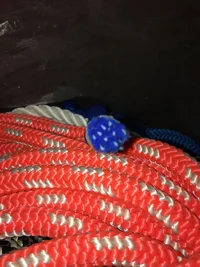
Show off them splices

Very nice dude.. no way those are your first tries..! If they are i am envious!! Haha! Very clean! My first ones would come out filthy looking cuz i had to mess with them to the point my dirty hands ended up just wearing off on the rope.. I swear my hands looked like i was from a leper colony..

Thanks @Jimmycrackcorn. They're definitely not my VERY first splices - I hear ya on messing with then until blisters form - I've managed to fit a lot of splicing in a short amount of time. Looking forward to tackling some hitch cord variations....
 
The rig-n-wrench Is not rated to be used with a basal friction device, so that being said I do not think one person could hold enough weight to ever break the wrench tether. Just remember that it is a light duty rigging tool and it will do just fine. I mostly prefer mine when working over utility lines or other obstacles, because it excels in lifting away from targets.

In answer to your other question I would certainly not want the tether to be a weak point. Should it break while lowering the ground guy will have to control all of the weight without any friction.
Well yeah Jehinten.. obviously you don't want anything to break & i understand how it works... I'm talking about how most rigging systems are designed/setup, whatever fitting word goes there.. You got your line, which, if anything you want to be the weak link.. Then you got the RNW & seeing as there are three parts to it, if one were to break, which of them would i want it to be.. Probably the tether.. right? I mean worse case would be the tree.. next would be, the pully/sling, then tether & wrench..

That's how I'm looking at it.. just trying to go about it intelligently is all, instead of just using whatever floats my boat for the tether.. I'm sure this same thought was applied when they were coming up with the idea.. Or maybe not.. maybe they just used whatever they saw laying on the table that day.. but i doubt that first design made it to the public. Do you not agree?

Or take for example someone using the largest line that will fit & then over loading the crap out of the device.. I've never seen or used a wrench but I'm assuming that line is going to bite pretty hard in there regardless if someone is holding it or not. These things are designed to fail in certain ways.. Are they not? That's all I'm talking about bud.

Sent from my Pixel 2 XL using Tapatalk
 
@treebing may be able to answer this better, but I seriously doubt you could get any of it to break with proper use. With improper use I would suspect the sling or pulley would fail first, as the pulley is seeing double the load. In an older thread a 12mm Sirius rope was broken on a rig without any damage to the rig-n-wrench
 
right, used properly, the person holding the line will break first. If you use it with a portawrap and slam it with a huge load. My guess is that the rope itself will suffer because of the less then ideal bend radius at the wrench. After that, the sling depending on what sort of sling you are using. The tether and the wrench only take a relatively small percentage of the weight compared to the pulley and sling.
 
Hey y'all.. wasn't sure where to post this & didn't want to start a new thread as it's a rather simple question on whipping/whiplock.

Why do i see so many differences in where the whipping goes? From what I've seen, it can vary from right on the throat to all the way down into the taper.. Personally, it seems as though you would naturally want to lock things in place up by the throat where the buried core or cover is not going to be frayed apart or unbraided.

Is this just me or am i having another brain fart as to what's really going on inside that cover... I know direction can differ from construction to construction but when it's down low, isn't it like stuffing a fid through the last inch of Tenex vs a foot from the end. Placing it a foot from the end & pulling it won't go no where whereas an inch from the end it will just unbraid & pull through.

I think y'all get what I'm saying.

Especially on 16 strand, where it's just the cover, isn't it landing that much closer to an area thats unbraided?


Sent from my Pixel 2 XL using Tapatalk
 
For lock-stitching or whiplocking I don't think there is a hard and fast rule. In general I try to put it as close to the throat as possible but down far enough so I can get the needle through without bending or breaking it. For most splices in double-braids or 16-strand that amounts to about 1 short fid from the end of the rope.
 
Oh that's right.. wow.. that one completely slipped my mind.. that shit is typically rock hard where i was suggesting it made sense to whiplock .

I've broken just about every normal sewing needle on the 2nd or 3rd passthrough on a whiplock & that's not even at the throat.

Say.. I'm down to one decent needle out of a "household" needle kit.. anyone know where i can find decent ones that don't cost $8 a peice or a two pack? I have a feeling these are 50 cent items if your buying in the right place.


Side note -
Haven't looked into it very far but I'm trying to find a Crosby Choking Chain Hook & Corresponding opposite side. Doesn't have to be Crosby but i don't know if others are making that style setup. Any suggestions on where to find or alternative brands would be cool.

Sent from my Pixel 2 XL using Tapatalk
 
Oh that's right.. wow.. that one completely slipped my mind.. that shit is typically rock hard where i was suggesting it made sense to whiplock .

I've broken just about every normal sewing needle on the 2nd or 3rd passthrough on a whiplock & that's not even at the throat.

Say.. I'm down to one decent needle out of a "household" needle kit.. anyone know where i can find decent ones that don't cost $8 a peice or a two pack? I have a feeling these are 50 cent items if your buying in the right place.


Side note -
Haven't looked into it very far but I'm trying to find a Crosby Choking Chain Hook & Corresponding opposite side. Doesn't have to be Crosby but i don't know if others are making that style setup. Any suggestions on where to find or alternative brands would be cool.

Sent from my Pixel 2 XL using Tapatalk


On the needles, I finally broke down and bought a sailmakers needle from treestuff, before that I was trying cheaper methods. The sailmaker is much more robust and has flattened sides incase you may need to grip it with pliers to pull it though. I would think the purchase of one of these needles would outlast a package of the cheaper variety. This is the one that I bought, the smaller size. http://www.treestuff.com/store/catalog.asp?category_id=298&item=1868#

On the Crosby conector, let us know if you find a similar brand. I have thought of trying that out, but the price has kept me away since I am not 100% sure I would like it. I typically tie all knots or on occasion I will use a scaffold knot on a carabiner to a nylon sling.
 
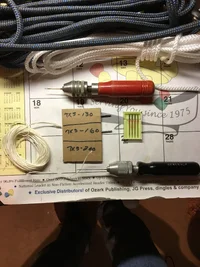
Industrial sewing machine needles in a handle work nice also. Tippmann Industries 7x3-200 needle can be used with whipping twineIMG_2003.webp
 
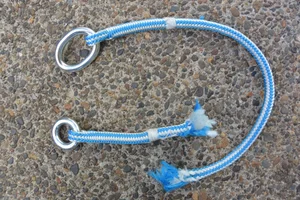
I was curious to see how a spliced 30" Friction Saver in Arbormaster would test, so I sent one to Richard Mumford. In a basket hitch configuration it broke at 11,169 lbs. Check out the big ISC ring. It went from round to oval, but never broke. I removed the core and overlapped the cover tails in this saver by 10".

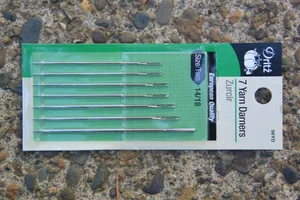
And in regard to needles, I get mine at the local sewing store. I buy Dritz yarn darners in the 7 pack (see below). They have big eyes and are plenty strong for most lockstitching. One of them will last for lots of splices unless you really torque on it. I don't like the big sailmaker's needles because they are too fat and hard to get through a tight splice.

16-strand_R&R_test_1.webp

Needles.webp
 
On the needles, I finally broke down and bought a sailmakers needle from treestuff, before that I was trying cheaper methods. The sailmaker is much more robust and has flattened sides incase you may need to grip it with pliers to pull it though. I would think the purchase of one of these needles would outlast a package of the cheaper variety. This is the one that I bought, the smaller size. http://www.treestuff.com/store/catalog.asp?category_id=298&item=1868#

On the Crosby conector, let us know if you find a similar brand. I have thought of trying that out, but the price has kept me away since I am not 100% sure I would like it. I typically tie all knots or on occasion I will use a scaffold knot on a carabiner to a nylon sling.

Like Arlo was mentioning & like most have probably experienced, is that Sailmaker hard to push through a throat because of its size?

I understand your method with the Strap & Biner.. it's a very valid & useful technique.. There's just something about the Crosby setup that intrigues me.. it's seems very ergonomic & user friendly. I really like how it's weight can be used to whip around a limb & it's only a quick hook & cinch from there & your good to go.. whereas with the strap & biner technique there is the need to girth, cinch, manipulate the gate.. Don't get me wrong the strap is a very good technique.. I'm just looking at it from a perspective of no parts to fumble with, nothing to girth, so your removing a step or two in the tree & as long as it's not landing face down somehow, probably removing a step there too on the ground

You can also still use your strap technique without any drama or extra work by just clipping a biner through the shackle.

Now I've seen the Notch variant & although it's cheaper by about half, i feel the Crosby hook is going to be more fluid. I would like to know why Tree Stuff stopped selling it.


Industrial sewing machine needles in a handle work nice also. Tippmann Industries 7x3-200 needle can be used with whipping twineView attachment 53751

Those handles look useful for sure.. I'm assuming there's a different technique used to pass the thread though the rope? Are you pulling it through, pushing it through, or both?

Push through, thread eye & pull back through, repeat?


I was curious to see how a spliced 30" Friction Saver in Arbormaster would test, so I sent one to Richard Mumford. In a basket hitch configuration it broke at 11,169 lbs. Check out the big ISC ring. It went from round to oval, but never broke. I removed the core and overlapped the cover tails in this saver by 10".

And in regard to needles, I get mine at the local sewing store. I buy Dritz yarn darners in the 7 pack (see below). They have big eyes and are plenty strong for most lockstitching. One of them will last for lots of splices unless you really torque on it. I don't like the big sailmaker's needles because they are too fat and hard to get through a tight splice.

View attachment 53755

View attachment 53756

Oh cool.. was that the same one you showed me a few months ago? It was in response to me asking about using smaller than suggested crossovers?

The shaft of those needless look beefed up enough, but what about the eyes, have you snapped any? That's only the problem i keep having.. it's the eyes that are snapping as im pressing them against the table to push through the splices.

What Brock posted is probably the correct way to pass a needle instead of me using the table, pushing, balancing & hoping my fingers aren't in the way..lol.

I will have to look into these suggestions.. thanks guys..

Sent from my Pixel 2 XL using Tapatalk
 
[QUOTE="Jimmycrackcorn, post: 575672, member: 11627
Oh cool.. was that the same one you showed me a few months ago? It was in response to me asking about using smaller than suggested crossovers?

The shaft of those needless look beefed up enough, but what about the eyes, have you snapped any? That's only the problem i keep having.. it's the eyes that are snapping as im pressing them against the table to push through the splices.

It was a different one that I sent for testing. I made a bunch of these in different lengths and they were all in use so I made a nice new one for the test.

The eyes of the needles hold up pretty well. I mainly used the bench top method of pushing them through, and have bent or broken a few of them when pushing really hard, but for the most part they work fine.
 
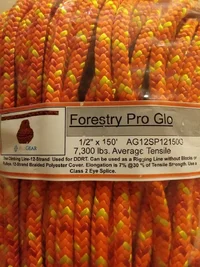
Hey.. Looking for info on splicing All Gears Forestry Pro Glo.. I've heard its construction called a few different things so I'm having a hard time finding the info on the splice.. 12 strand Solid.. 12 strand Single braid..

When i bought it i was under the impression it was not spliceable.. under the impression it was like a True Blue, Buzz line or Orge from tree stuff.. all "not splicable" from what i understand. Also, if you go to Engrope (where i bought it) they only offer it in a sewn option, which makes sense given the above.

However if you look at the label on the actual package it says "use a class 2 splice"..

So what am i missing here..??
1535962654167~2.webp

Sent from my Pixel 2 XL using Tapatalk
 
It's probably just a 12std solid braid. Spliceable, but not easily done.
Hey Brock.. yes i believe it is. It's got 4 strands running as a core.. i believe they were braided together. It's all real slippery & un-braids real easy when cut.

Would you happen to know where i can find direction on that?

I Google "12 strand solid braid eye splice" and am coming up blank.

Is it one of those deals where you have to tuck & or braid?

Sent from my Pixel 2 XL using Tapatalk
 
It's not a solid braid if it has a core. It sounds like it is similar to a 16 strand type construction. Maybe contact Allgear for splicing instructions.
 
Yeah, since the strand count only refers to the cover, not the core, rope has gotten a lot more confusing. There really needs to be more specific terminology to clarify the construction. Technically, any rope with both a cover and a core is a kernmantle... but that terminology has become more specific to static ropes with a high cover strand count of smaller diameter strands very tightly woven around a core that provides most of the strength. 16-strand ropes are usually larger strands woven fairly tightly around parallel core strands, and the cover provides most of the strength. There are solid-braid, 16-strand ropes, but I haven't seen any marketed for aborist use. There are 12-strand ropes that are solid-braid (no core, but very small space in core area) and hollow-braid (large space in core area) and with a core (no specific terminology for them). Double-braid ropes have both a braided cover and core, of course... but the tightness of the cover weave varies a lot (rigging ropes usually quite loose, climbing lines tighter). Diamond-braid ropes have a very cheap construction of a loosely braided cover over parallel core, but are pretty much reserved to hardware/farm store products where cost of construction is the major consideration.

It's all so confusing. I have actually experimented with splicing diamond-braid ropes for haul lines, and it's not hard to do... but I wouldn't trust the splices for anything but pulling stuff up into the tree.

As @Brocky said, the 12-strand ropes with a parallel core should be able to be spliced like a 16-strand climb line, but I haven't seen any specific instructions. These ropes are cover-dependant, like the 16-strand ones, so I think you'd probably only have to fiddle with the 16-strand splice a bit to make it work. Once you got something that looks and feels good, I'd be break testing a few of them before I'd ever consider climbing on them.

I think I'd just send the hanks off and have sewn eyes put on them, myself.

 
So what's this Casanova? Never thought I'd see you flying on sewn cordage? Or is it more flexible this way..? (just suits your needs better)? I've never really gotten into the hitch climber so I'm not sure if it's disadvantages, etc using one splice over another.. flexibility/Cordage taper is the first thing that comes to mind as I'm sure you trust your work.

Sent from my Pixel 2 XL using Tapatalk

I like to splice my own gear whenever possible. For prussiks, I like to keep the eye as small as possible. The stitched eyes tend to work the best for keeping the hitch close to the pulley.
 
It's not a solid braid if it has a core. It sounds like it is similar to a 16 strand type construction. Maybe contact Allgear for splicing instructions.
Yeah, since the strand count only refers to the cover, not the core, rope has gotten a lot more confusing. There really needs to be more specific terminology to clarify the construction. Technically, any rope with both a cover and a core is a kernmantle... but that terminology has become more specific to static ropes with a high cover strand count of smaller diameter strands very tightly woven around a core that provides most of the strength. 16-strand ropes are usually larger strands woven fairly tightly around parallel core strands, and the cover provides most of the strength. There are solid-braid, 16-strand ropes, but I haven't seen any marketed for aborist use. There are 12-strand ropes that are solid-braid (no core, but very small space in core area) and hollow-braid (large space in core area) and with a core (no specific terminology for them). Double-braid ropes have both a braided cover and core, of course... but the tightness of the cover weave varies a lot (rigging ropes usually quite loose, climbing lines tighter). Diamond-braid ropes have a very cheap construction of a loosely braided cover over parallel core, but are pretty much reserved to hardware/farm store products where cost of construction is the major consideration.

It's all so confusing. I have actually experimented with splicing diamond-braid ropes for haul lines, and it's not hard to do... but I wouldn't trust the splices for anything but pulling stuff up into the tree.

As @Brocky said, the 12-strand ropes with a parallel core should be able to be spliced like a 16-strand climb line, but I haven't seen any specific instructions. These ropes are cover-dependant, like the 16-strand ones, so I think you'd probably only have to fiddle with the 16-strand splice a bit to make it work. Once you got something that looks and feels good, I'd be break testing a few of them before I'd ever consider climbing on them.

I think I'd just send the hanks off and have sewn eyes put on them, myself.
Hahaha.. Yes Jeff.. you are definitely correct on that one.. It's so confusing & the terminology is ever "evolving".. I completely agree with rest as well.

& Brock.. Yes.. im deff going to contact them to see what type of Class 2 splice they are referring to...


If i was to guess.. I'd say they are suggesting class 2 just because of how slippery it feels once unbraided a bit...

But yeah Jeff.. that's exactly what i was thinking of when i opened it up.. 16 Strand Splice.. I just don't understand the principles behind why it wouldn't work with this particular rope so I'm hesitant to even waste it... hence the reason I'm going to call.. (God I've wasted so much rope this summer fucking around splicing)

What's bugging me is the fact they don't offer a hand splice at any of the AllGear vendors for this rope. It's nothing or Sewn.. But then you see this lable.. it's just irritating i guess. Just another inconsistency to add to the "evolving" list of rope terminology and do's & don'ts..

So when i bought this rope, i had asked if this stuff was the equivalent of True Blue, which i thought was not splicable.. & "i thought" was considered a 12 Strand Solid Braid.. I was told "YES", it is the equivalent of True Blue.

With that said, What makes this Splicable & the True Blue Un-Spliceable? Does the True Blue not contain the core strands?

Here.. I'll undo a bit of the end & snap a picture.. I should have just done that in the first place, that way yall aren't trying to read my mind as to what it is if you haven't seen it before.
adf98d4c612e44952ed28d23e7d2645a.jpg
b63f29ed6e5d2ab0b1d27591305f8c22.jpg
9d501340b4bcf6164dc861601da29e3b.jpg
fde8deb3b149b138ce92077ab3a2cc4e.jpg

Looks like it's "paralell"inside there?


Side note - Speaking of AllGear.. Does anyone ever buy that 12 Strand Multipro? That stuff is freeeaking outrageously priced.. 1/2" is like $1.61 or something.. & their largest at 7/8" is over $4 per foot? I feel like i cross into the twilight zone when I'm looking at those price points.. and for what? A different color?? Sure it says they use the Premium Polyester in them but the MBS's are all the same. Anyhow.. different discussion for a different day.. was just curious what I'm missing there..

Sent from my Pixel 2 XL using Tapatalk
 
Perhaps the vendor you bought it from meant Safety Blue, not True Blue. There's no core in True, just a very small hollow, as Jeff said earlier. The solid braid splice tucks the strands down the outside, like a three strand. This is more like Safety in its construction, but the AllGear strands don't contain a polypropylene strand as the Samson 16 std have.

A typical 16 std splice might not work because it sounds like it has a lot looser braid. AllGear made a 7/16" dia. 16 std, maybe they still do, that would slip if you used the Samson directions for the splice.
IMG_2026.webp
The the dots of white you see are the undyed center of each strand.
 

New threads New posts

Kask Stihl NORTHEASTERN Arborists Wesspur TreeStuff.com Teufelberger Westminster X-Rigging Teufelberger
Back
Top Bottom