X-rigging rings

David, do not answer this … go hit your Play button.

I’m just going to throw this out there and then back away completely because this is a regime that is way, way beyond anything I'll ever think about using ….

Anyway, I’m thinking these rings are stronger than we might think. Antel lists the SWL of the 28/20 at 6400kg @SF=3. That works out to 42240# mbs. If you use the SF=5 (common to most but not all of the block manufacturers), that’s a working load of 4.2 ton. That’s stronger than either the stable braid or the tenex cordage. That’s great. These puppies are STRONG!

In my video , I pair up your XRR tenex sling (remade into a whoopie) with an inexpensive 25000# mbs block. In that configuration, the combo gives me everything I’ll ever use, and a theoretical SWL of 4.96T at 5:1, limited by the tenex and the block.

HOWEVER, if you dial up the cordage to ¾” Amsteel and pair it with a bigger block, you are looking at numbers that are staggering … over 8 tons SWL(!)

When you get into numbers this big, there are too many things that can go wrong in a “theoretical“ calculation. I wouldn’t trust any of this without serious physical testing. But I’m guessing that you’ve opened up a door to a heavier future.


OF
 
You can have the strongest rigging in the world but that does not make the tree/wood fiber any stronger to handle that load. Just my 2 cents
 
[ QUOTE ]
You can have the strongest rigging in the world but that does not make the tree/wood fiber any stronger to handle that load. Just my 2 cents

[/ QUOTE ]

If you set up multiple rigging points and use the tree's structure smart, you can add significant strength to the tree. yeah, you can't change wood fiber or defects, I agree, but you can set up a system to keep them from getting stressed too much.

I grew up watching my older brother do trees. Old school. He is very good and still at it, but always took stuff big and usually just used one block. I've seen rigging limbs break out and ropes break in his earlier years.

I decided in my career to rig as smart as I knew how and tried to increase my skills by thinking about things.

Pushed for production; I do tend to go big. But with smart rigging, I can make the tree's structure stronger and do things safer.

I have never broken a rigging line at work and I have never broken out a rigging point.

I could not have taken the many huge limbs and full size trees that I have done in my career without setting up smart rigging with multiple points. I definitely would have broken stuff if my rigging ran straight from the LD to the one rigging point.

I appreciate Reg's contribution to this thread and everyone.

I do disagree on the fishing pole technique still, but that's not a big deal.

I will tell a story about that technique.

Going to eat dinner now, later.
 
XXLR
Robinia gonna like this.
laugh.gif
 

Attachments

  • 350419-imagesCAECJPOW.webp
    350419-imagesCAECJPOW.webp
    8.7 KB · Views: 104
[ QUOTE ]
I can imagine two rings might infringe on ken palmers patent. Therefore three might be a way around it?

[/ QUOTE ]

Don't want to be a dick Kevin, but I could care less about Palmers so called patent in this particular situation.

IMO, it's a totally different situation pertaining to rigging and not climbing.
 
Chris, its not really whether you care about Ken Palmers patent so much as whether the Patent Examiner cares! :)

I wonder if that is the issue what they say about the Fimble Saver? THimble thing from DMM..

Tom, at some point it doesnt need to be any stronger. Personally I cant imagine needing to rig a 16,000 lb tree-part with anything other than a very large crane.

I wondered about using Amsteel myself but I imagine it was rejected due to heat concerns?

What about Amsteel 2? Who thinks that would make a good 2 ring setup?
 
Nick, I couldn't agree more!
Those numbers are just too huge to be useful, at least not to this oldfart.

BUT you can take the benefit of stronger rings in other ways:

1) run with a higher safety factor (ie greater than five). That would go directly to the dynamics issue.

or

2) buy a cheaper block than you would otherwise.


Also, it been a very long time since I read that patent but I seem to remember that a central claim was the big/small ring geometery was to achieve remote installation and retrieval. Using the Wedgie is a "disruptive technology" that doesn't rely on that principal at all.


OF
 
[ QUOTE ]
[ QUOTE ]
I can imagine two rings might infringe on ken palmers patent. Therefore three might be a way around it?

[/ QUOTE ]

Don't want to be a dick Kevin, but I could care less about Palmers so called patent in this particular situation.

IMO, it's a totally different situation pertaining to rigging and not climbing. [/quote

Yeah I think Ken has been known to go after anyone pretty hard for selling two different sized rings on a length of rope. I don't know if that's the case here but it seems pretty likely that if eas sold a two ring model, ken would shut him down ASAP. I don't believe the patent differentiates between rigging and climbing. I imagine that these rings would make a very good FS saver for climbing, for those so inclined.
 
[ QUOTE ]
I appreciate Reg's contribution to this thread and everyone.

I do disagree on the fishing pole

[/ QUOTE ]

Thanks David, like I said, really worthy product and an informative thread. I'd just hate to think of the time and effort wasted by a young or less informed climber who might read some of this and assume he has to fish pole everything. I work with lots of guys like that, and its often painful to watch, because they've either misunderstood or been misinformed.

FWiW, its must be 25 years since I used a fishing rod....but from memory I seem to recall they never bowed out in the middle under load, only from the end downwards.... because they're a tapered structure, much like a tree, although not all trees for various reasons. And whats more with a fishing rod you can turn the end u-shaped and it wont break, unlike a lignified spar.

Just putting it out there, thats all. Read each situation for what it is, use stuff when its gonna come into play, as opposed to setting it up to be redundant.

On another note, lots of patents out there that aren't actually valid....they just haven't been challenged.
 
Ah, yes, I see, new climbers might put this on all the time thinking they have to.

It is a rare case that you need to put on this technique on a straight trunk or spar, I agree totally.

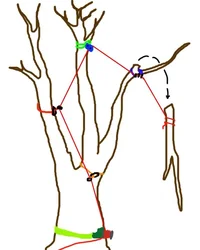
Redirects in a spreading tree is much more important. This keeps from cracking out limbs with weak V-crotches, keeps leaders from bending too far and helps to keep from breaking out your rigging point.

Yes, the fishing pole drawing could have been drawn more accurate in regards to how the bend would look.

If I didn't have this similar setup to this diagram (see below) in that Euc I did, I may have been hit by the central leader when it tried to bend to me under load. Like I said, it was so heavy I mis-judged loads, one time I turned around and that central leader was maybe 10 feet from me, my eyes got big then! I believe since I rigged smart with a XRR sling to give that leader support; it did not bend as far.

350459-smartRiggingSpreadTree.jpg
 

Attachments

  • 350459-smartRiggingSpreadTree.webp
    350459-smartRiggingSpreadTree.webp
    25.7 KB · Views: 64
one time i showed up to see a tree.

most of the tree was gone, a storm broke it out and someone else cleaned up.

it was a red maple i think.

one lower limb was left.

the limb was excessively long and thin, as it grew out from under the crown to get to sunlight.

It was crazy long and thin.

maybe 6" diameter at the largest and maybe 80 feet long.

the customer had gardens under it.

nothing could be dropped.

too thin to go out to tip and do by hand.

plus, i don't like chunking down little stuff, a flaw i have.

anyway, i probably should have walked away from it but i was younger and i have never walked away (another flaw).

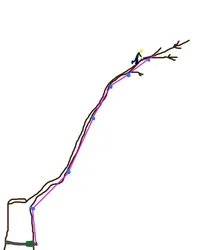
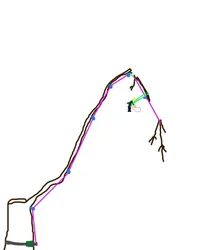
i rigged it with multiple blocks the whole way.

the idea was to give some strength maybe, but mainly as back ups in case the limb broke somewhere.

in case of a break, you need your climbing line under the block sling and lanyard over the block sling.

in a break, the lanyard would likely slip off, the climbing line would stay put.

then slowly decend, because your rope rubbing on the blocks sling.

So, in my opinion, the fishing pole tech can add multiple back ups to keep the peice from going all the way to the ground and also the climber.

if you seriously think something might break, my advice, don't do that job... but some of us feel we must.

I was probably on 3 or 4 inch diameters for my first few cuts.

groundman ran the line to gentle stops and nothing broke.

I liked having the idea of the backups while doing it.

350460-thinLimb1.jpg
 

Attachments

  • 350460-thinLimb1.webp
    350460-thinLimb1.webp
    11 KB · Views: 68
The fishing pole concept can add safety in some extreme cases, in most cases it's nice to keep the rigging line clear of any pieces being rigged down.

X, in that second one, I would have let you run all the way to the ground, you would have been fine.
 
[ QUOTE ]
Chris, its not really whether you care about Ken Palmers patent so much as whether the Patent Examiner cares! :)

[/ QUOTE ]

Palmer's Patent reads for 2 DIFERENT sized rings if I'm not mistaken, David has 2 of the same sized rings, so a good Patent lawyer IMO would be able to defend him. If I'm wrong than you're right, I may be more concerned ;)
 
Well, if David decides to go that route my Father-in-law is a patent attorney and my wife is studying to be one so I could help him out!
 

New threads New posts

Back
Top Bottom