working with, your boss's perspectives

working with, your boss\'s perspectives

after a few years of working for a few different tree care company owners, i have allways found one thing in common. everyone has a different approach to pruning practices and branch selection etc. i wanna hear what your guys, opinions are on the subject of, working with or around the way your boss wants you to prune a tree.
 
Re: working with, your boss\'s perspectives

To add to the issue, the industry seems to change its standards annually. Having said that, I'm all for progress when it comes to the health of trees.

As for the boss; you kinda gotta keep ' em happy to keep your job. Within reason of course.
 
Re: working with, your boss\'s perspectives

[ QUOTE ]
To add to the issue, the industry seems to change its standards annually.

[/ QUOTE ] Time must fly when you're having fun! The pruning standard has not changed since 2008, and won't be anytime soon.

The key is communication. If the boss doesn't tell you the objective, location, size and amount of stuff to prune, it's your job to ask for more info, and his/her problem if anything goes wrong.
mad.gif
 
Re: working with, your boss\'s perspectives

I think first and foremost, know your own skill level. Their is a lot of honor in knowing when something is above your skill level. I have found there is always a way to complete a job. Sometimes that means you you have to come back another day with a new plan, different equipment , different people etc. knowing the difference between skilled work and dangerous work makes all the difference.
As far as pruning standards.... I think everyone knows the proper standards. Weather they choose to practice/agree with those standards is another story. At the end I think it's a personal choice. If you don't like how it's done where you are at, try and gently change/educate the people you work with. There are a lot of tree companies out there. Sometimes it's best to make a move. It's not worth butting heads with your boss or arguing at jobs. If you do things safely and skillfully I guarantee there is a place for you somewhere. Just my opinion
 
Re: working with, your boss\'s perspectives

Where I am everyone doesn't know proper standards. Many are repeating what they learned 20-30 yrs ago and then telling their climbers that's how its to be done. No interest in learning anything new.

There are different approaches but one can't be afraid if they can justify with evidence a technique or methodology that differs from what the boss thinks.
 
Re: working with, your boss\'s perspectives

So many production workers worry about what to take out, when they should be studying what to leave in!

Want to see it from your boss's perspective? Justify what is left, not what is gone.

Tony
 
Re: working with, your boss\'s perspectives

Great point by Tony, but if the boss is not communicating the objective, location, size and amount of stuff to prune, it's your job to ask for more info, and his/her problem if anything goes wrong.

Visualizing and instinctiveness are wonderful, but if the bosses are not communicating in numbers, they are failing, and setting workers up to fail. They SHALL establish a clear objective with the owner, and relate that same objective to the crew, or they are VIOLATING the A300 pruning standard.

If "everyone knows the proper standards." (!?!)then everyone knows all of the above. This can usually be done in 20 words or so, on a 3x5 card for the worker's pocket. Or you can rely on visualization and instinct. Good luck with that!

From the tree in December's A300 article: "The first step in applying this standard is to establish the objective. The client’s goals are not automatically adopted. They are adapted. In the light of the A300, best practices,and site conditions, arborists establish the objectives, and define their own assignments.

A300’s Mission: To develop consensus performance standards based on current research and sound practice for writing specifications to manage trees, shrubs, and other woody plants. With the client agreeing, the second step is to describe specific tasks, or specifications. These “specs” keep everyone literally on the same page.

Simple jobs can be spelled out in 20 words or less, as a proposal to a client, or the brief work order on this post oak: 1. Clear flare 6”. 2. Expose root collar. 3. Measure adventitious roots. 4. Reduce branches south and west 1-9’ using 1-3” cuts, <10% overall.

The A300 Standard helps determine and communicate these details. Brief or long, written specifications connect performance and management toward a common objective. Without this connection, chaos is more likely."

 
Re: working with, your boss\'s perspectives

"If "everyone knows the proper standards."(!?!)then everyone knows all of the above."
I also said,"weather they chose to practice/agree with those standards is another story."
Maybe not everyone, but most people know what the proper standards are. They just choose to ignore/disagree with them. Many people because of training or personal preference choose to trim differently than the standards.
ex. If I choose to go 35mph in a 30mph zone, it doesnt mean I dont know what the speed limit is. I completly agree that the A300 standard helps determine and communicate details of the job. If people took more time to explain standards to the client and why we do certin things, instead of just trying to "get" the job. Our industry would be much better off.
 
Re: working with, your boss\'s perspectives

This is an industry of silos. Separated and apart from each other. There are plenty out there that don't belong to industry associations and have little contact with the standards. Why? They are voluntary. There isn't a body of inspectors that will flag the work as substandard. In other trades you have that. There is an awareness of standards and the risk of not adhering to them is more than a shunning by your industry peers, it legal liability. Within those industries we see what you are pointing to, the ignoring of standards in order to make a buck.
 
Re: working with, your boss\'s perspectives

sherwood, I'm still wondering if most, or even 10% of arborists know what's required (shall) and what's recommended (should) in the A300 Part 1. I sure don't know them all, without looking. Other countries have a digital option for all users, but TCIA only offers the paper version to all but the biggest users.

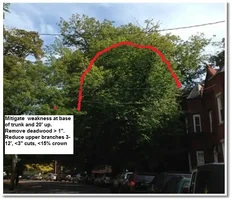
Ok here's some sugar maples. If the bottom text box was on a 3x5 card in a climber's pocket, is that enough guidance for meeting expectations?
 

Attachments

  • 387437-elmspecscropt.webp
    387437-elmspecscropt.webp
    59.7 KB · Views: 77
Re: working with, your boss\'s perspectives

My point about standards changing was directed pretty much at you, Guy. Look through some of your threads and notice the responses you get. These aren't responses by backwoods tree workers. The majority are CA's.

The non-stop crown reductions. The steering away from the rule of 3rds (cutting back to a group of suckers, not necessarily a lateral 1/3 the size of parent). Anyway, you have to admit that you're proposing things that are in the midst of change. No?
 
Re: working with, your boss\'s perspectives

[ QUOTE ]
My point about standards changing was directed pretty much at you, Guy. Look through some of your threads and notice the responses you get. These aren't responses by backwoods tree workers. The majority are CA's.

The non-stop crown reductions. The steering away from the rule of 3rds (cutting back to a group of suckers, not necessarily a lateral 1/3 the size of parent). Anyway, you have to admit that you're proposing things that are in the midst of change. No?

[/ QUOTE ]

It is ON!!!
pbj.gif
 
Re: working with, your boss\'s perspectives

TL maybe my crown reductions seem son-stop, because most of the trees I work with and post about have major structural issues. Many have been condemned by traq or other supposedly qualified assessors.

That rule of 3rds was thrown out by ANSI in 2001 but it's like a zombie, rising from the dead. It was only a Should, but it's got a fanatic following!

I'm not proposing, I'm just pruning. Listen to Dr. gilman--specify the location, cut size, length, and amount. Period. There's huge resistance to a simplifying change in the US, clogging the process with useless notions like 'systems' and 'type of cut'.

Every cut involves metal passing through wood. No need to make up terms and complicate the job. So...What would you add or subtract to make those specs work on that elm? (some might recognize the tree) the silver maple pic did not post for some reason.
 
Re: working with, your boss\'s perspectives

My point is, which I feel was evidenced by your verbose reply, that the industry changes and mostly for the better. If not, why do we need ceu's ?

While I don't necessarily agree with your plea to drag out the life of a declining tree to the point of coppicing, I have learned some things from you. For that I thank you. I do however feel your teaching manner is somewhat pompous and Napoleonic.
 
Re: working with, your boss\'s perspectives

Wow how do you really feel? I'm open to correction, and changes in style, but after 12 years of following standard sources like Harris and Shigo et al and hearing it called revolutionary I'm puzzled.

Apologies for being too hard on the 1/3 deal; way extreme. i follow Harris' version: when cutting to a small lateral, find one with a >2/3 upward angle.

The heart of the A300 standard is writing specs. That's worth talking about.
 
Re: working with, your boss\'s perspectives

the reason i posted this is that, 3 months ago i left working for my friend dan. he is a great climber and nice guy but lacks good leadership skills. i was allways asking him questions and never getting clear answers about the job at hand. my trust with him was lost after a project where i was instructed to reduce a previiously topped fern tree. there were no crotches to drop to within the 1/3 zone. so the top of the tree ended up looking really open and nasty. he also told me to cut up a soursop tree that had blow over in the wind. he communicated to remove it completely, so i did. the homeowner came out at the end of the day and saw her soursop tree gone and the fern tree was pruned like that and started to cry. yes she was a bit of a crazy lady but i still think that customer satisfaction os more important at the end of the day.
one thing that pisses the living shitaki out of me, is when your boss doesnt give you clear instructions and makes you go back up into the same tree to fix it or to prune until hes satisfied. give me clear instructions to begin with cause im a hardworking individual but if you dont give me instruction, ill do my best to my knowledge. i dont like to sit in a tree scratching my head wondering what next to do.
 
Re: working with, your boss\'s perspectives

don't take it personally
the tree will grow and myself have made a few
ladies cry after the prune. before and after can be a -----
boss has got to spell it out, no guess work.
needs to be as descriptive as possible.

I will say it again learn how to train a young tree and those same principle can be applied to a mature tree.
Really key stuff that I am guessing here in Canada is
skimmed over because in my travels from lake huron to the St lawrence seaway I have yet to see a blvd tree/young tree trained correctly.

the rite of passage for arborst should be full comprhension of the young tree training.
Cheers
 

New threads New posts

Back
Top Bottom