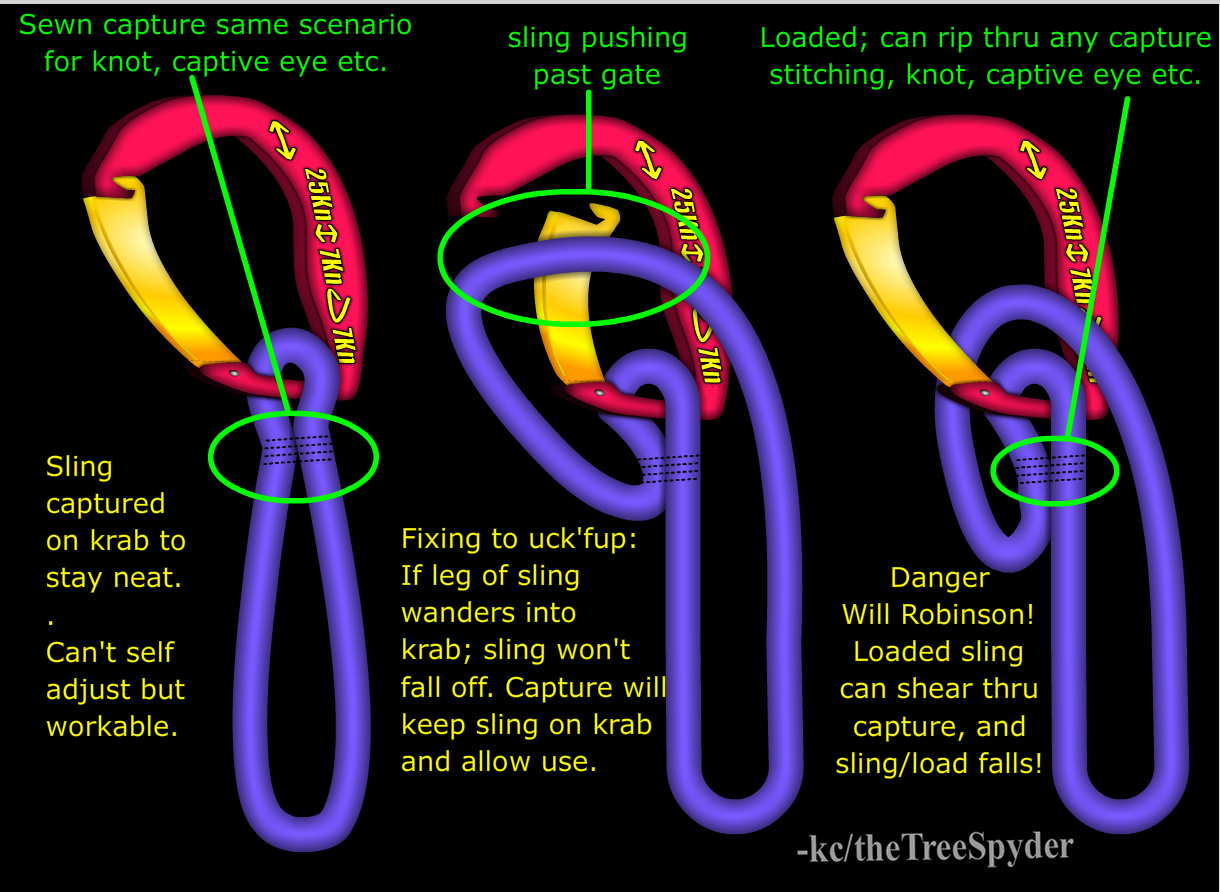
Why tie instead of rigging carabiner?

Captive eyes do present fault of looking like on carabiner correctly when not;
where w/o captive eye would disarm/fall off.
They do allow more self adjusting position to equalize and rotation to even wear;
where tied/sewed on for same approximate captive purpose does not.
Krab_loading_captive.png


This high kick thru gate and still look like on properly can happen in captive eye as well,
and must sharpen eye to guard against i think.
 
Dynamic loading in rigging is the problem with carabiners. There are steps to take to mitigate that issue. Like captive eye carabiners for one.
I see the captive eye only being of use when using a non cinching terminal knot. Aka using a bowline or a fig 8 on a bight/traced. A cinching knot like a scaffold is the equivalent of a captive eye carabiner.
Personally I use a captive eye snap or a steel carabiner (gate out) maybe 5-10% of the time. But I’ve been really enjoying my girthed 3/8 spliced lowering line with a steel oval.
 
choked/girthed to carabiner is nice;
but at a loss of 'free ranging' of natural rotation of sling to even wear,
and self adjusting for evenly loaded support legs as changes angle thru rig movement ;
and then also displacing more easily the stiffer 'seam' of the Standing Part from the 90 degree choke across.
(besides the noted doesn't disarm/fall off if a leg kicks high thru the gate and only looks good like straddles properly but is more 'side sadddled')
Some trade-offs to possibly mitigate as can in traded choices.
.
Another idea played with some time ago Bull, and then some:
Sling_krab_theory2.png
 
wow, "Dan da'Man", again!
Wow, I'm reading (wait, that's not research), er, looking at the pictures (I'm better at that), and thinking "Hey, that looks familiar ... !"
NB : I regard this as a not-ready-for-prime-time structure.
There need to be some practice drops aiming to sus out any untoward behavior --i.p., an initial load on that marl-in-the-bight pulling up away from the chunk! This needs to be found (or found not) in the playground, not in costly circumstances.
But the design goal of a tied-sans-ends is appealing!

*kN*
 
I’ve been using the same steel carabiners for rigging wood and limbs for well over a decade. I try and orient them with the spine taking the load and with a half hitch if taking something large. In all my years of doing this I’ve only had to retire a few carabiners because the gates didn’t function at 100% and zero carabiners break or cease to function completely.

Sometimes I’m thinking to myself “should I be doing this” but other times I find myself thinking “how many rigs have I done in the last 15+ years WITH THE SAME CARABINERS and not had an issue. Years of removals and the number of rigging events I’ve done over that timespan is quite the test. Is it a testament to how conservative I am in my rigging? The religious nature of how I use the half hitch? The quality of the carabiners I use? I can’t answer those questions. What I will say is I have a tremendous amount of faith in the strength of an ISC carabiner improperly loaded while clipped around a limb or log.

 
I like the video but I don’t think it’s relevant to tree work. I just can’t see how rigging down a small diameter limb will generate enough force to break a side loaded biner. A inch and half limb weight what 30-40 pounds maybe 80-100 pounds for a big blue spruce limb and those are often speedlined. Generally as weight goes up so does diameter therefore lessening side loading. Just my observation.
 

New threads New posts

Back
Top Bottom