Why tie instead of rigging carabiner?

Using a steel locking carabiner on the rigging line is my go to for rigging operations. After using this method for more than a decade on thousands of rigs, I have never had significant carabiner deformation from loading or cross loading but I have damaged the gate on a few carabiners from negative rigging wood and smashing the gate between the piece and the bole (which is why I do not recommend this method for negative rigging). The key like others have said is the half hitch. It takes the load. If I am doing a significant rig or I am getting into negative rigging wood, I switch ends on the rigging line and just tie the piece on.

My friend Lawrence Schultz is into using these things instead of carabiners. Minimal risk of cross loading and certainly ridiculously strong. Probably a better idea for all of us who think that knots are a few seconds slower and that seconds matter on a job site.

 
Using a steel locking carabiner on the rigging line is my go to for rigging operations. After using this method for more than a decade on thousands of rigs, I have never had significant carabiner deformation from loading or cross loading but I have damaged the gate on a few carabiners from negative rigging wood and smashing the gate between the piece and the bole (which is why I do not recommend this method for negative rigging). The key like others have said is the half hitch. It takes the load. If I am doing a significant rig or I am getting into negative rigging wood, I switch ends on the rigging line and just tie the piece on.

My friend Lawrence Schultz is into using these things instead of carabiners. Minimal risk of cross loading and certainly ridiculously strong. Probably a better idea for all of us who think that knots are a few seconds slower and that seconds matter on a job site.

Can you post a picture of the carabiner rig? Where is the half hitch?
 
Half hitch typically goes between the tied end or in this case the carabiner and the rigging point (ring, block, or crotch) on the piece being cut/lowered.
 
Heard that half hitch called a “ marl” before too.

Marl is a nickname for Marlin Hitch. The location of the half-hitch in the other video (a couple posts back) is tied as an overhand knot instead of a half-hitch. If it slips off the end of your piece, you get a nice tight overhand knot in your rigging line that you may have to untie with a sharp knife.

Good video on this, and also shows why you might risk the Marline Hitch in some cases.
 
Last edited:
This is an interesting discussion I've been meaning to respond to, and I think a lot of good points have been shared already. One thing I'm curious about, is despite a number of different methods people are using, has anyone actually experienced a failure in their system?

Just to add some visuals to the discussion, here are four different methods of doing this. Pros and cons to each. Discuss.

0 rigging tie.png
 
Last edited:
This is an interesting discussion I've been meaning to respond to, and I think a lot of good points have been shared already. One thing I'm curious about, is despite a number of different methods people are using, has anyone actually experienced a failure in their system?

Just to add some visuals to the discussion, here are four different methods of doing this. Pros and cons to each.

View attachment 78699
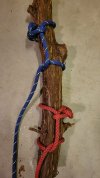
Isn't the arrangement with the blue rope preferred to that with the red rope?20211112_210146.jpg
 
This is an interesting discussion I've been meaning to respond to, and I think a lot of good points have been shared already. One thing I'm curious about, is despite a number of different methods people are using, has anyone actually experienced a failure in their system?

Just to add some visuals to the discussion, here are four different methods of doing this. Pros and cons to each.

View attachment 78699
That’s great visual!

2) & 3) I have watched limbs about that size slip out of the loop on a poorly lowered rig. Never seen it happen with an extra turn (two wraps total.) I can remember someone quoting a sailing book speaking of the round-turn and two half hitches saying “That knot will hold the devil!” It’s what prompted me to start adding a round turn to my rigging with a carabiner. It only takes a second and I haven’t seen it misbehave yet (19 years and counting.)

1) Can be cumbersome with sending loops up and down. Also restricts one to relatively light loads.

4) I still shy away from that configuration in a vertical setting (negative rigging) for several of the reasons already mentioned.

My biggest concern to someone trying this as a new technique is side loading or having the gate in a compromised configuration. For example, If the carabiner is flipped in the pictures above, the load is no longer along the spine and can damage the gate.

I watched a guy use the clevis approach. It seemed to take forever, and the ground guys had to keep pliers on hand all the time. Very strong and secure, just slow.
 
While I haven’t seen a total failure of carabiner use I’ve seen many near failures.
Most have been gates opening when loaded against the stem in a particular manner that rolls all three motions to open the gate. Rigging terminations should minimize links to failure in my eyes. Knots are a easy solution to this, but like all things this and any other attachment is situational on the care of the person rigging the attachment.

For any dynamic loading I nearly always use knots starting with a marl or half hitch. Just a few weeks ago I lowered a rotten snag that fell into another tree, I tied about a dozen half hitch’s for about 15-20’ if the stem to ensure most of would remain tied if it broke.

If a connection link is used I more often reach for a snap.
 
Marl leaves an Overhand Knot in line if slip off end, Half Hitch melts away to nothing like water as @Mike Islander says.
Once induced, Marl would keep a tighter grip purchased i think.
Never had to cut off Marl tho as Mike lends!
.
Shackle i see as a 2 leg support device vs. a carabiner more of a 1 leg of support/hook; with gate instead of mousing as non-strength, but rather keeper, the cotter key to a hitch pin concept mostly. And then Shackle usually thicker bulldawg build, and many times narrower set legs than carabiner, collectively outrunning carabiner. For this discussion , usually also much shorter so are leveraging less leverage-able length cranked around the round host/load, as another tick up the ladder higher than carabiner in this usage.
In carabiner look for the solid leg to carry load, and the gate more to keep hook from stretching open, than outright support. Inline is the strongest on any material. But gate hinge is a very slim pin, pulled laterally/cross-axis/not inline as the Achille's Heel to gate side. So a wire gate is less sturdy, but can rate about same single use/pristine, as solid and wire gate , for same/equal Achille's Heel of gate axle/pin size, strength and errant angle of pull. Chain as strong as that weakest link/fuse STRUCTURALLY. Gate latch is point of usual fail tho as stretches open from misaligning and release even if stronger point/thicker metals pulled inline as mis-aligns. Shackle simply has none of these weak points.
.
As in any material would want the main force, not on the seam/joint, want the seam buffered from the hit ALWAYS. so Half Hitch /Marl pre-fix works for me, and actually several different ways. 3x180 arc, dbl.grab, more inline structure, and the more 2D support concept. Pulling an off balanced log with just fixed eye running noose wants to pull at side, not along length, and can see fight between CoG wanting to align and rope sideways pull.... Pre-Fix that Half Hitch/slip on, and drags much more amicably, going from wildcat tossing from side to side pulling on back of truck to purring kitten walking nice as truck pulls. Total difference visually seen, that carries to many other things that is present but not blaring/expressing so loudly to see as clearly, then catch view of this elusive ninja force in other things.
 
Last edited:
This is an interesting discussion I've been meaning to respond to, and I think a lot of good points have been shared already. One thing I'm curious about, is despite a number of different methods people are using, has anyone actually experienced a failure in their system?

Just to add some visuals to the discussion, here are four different methods of doing this. Pros and cons to each. Discuss.

View attachment 78699
I wouldn’t do #2 or #3 because lack of half hitch, so I can’t report a failure with those methods but I can certainly imagine one. Never have I ever seen an issue with #4.
 
You can easily run two half-hitches before the carabiner. Doesn't stop the biner from getting crunched between work-piece and bole.


Marls down the length of a brittle piece may lock onto individual pieces if the work-piece breaks under impact. Half-hitches just slip out.
 
I was taught #3 and used it for many years without failure. As long as tension is maintained and the choke isn't close to the end of a chunk it always worked. Over time I learned the other options.

If I tallied the amount of wood I've rigged I would say that by cut-count I've done mostly #1. Tallied by poundage, #2 and #4.

There are times where the butt cut of the limb or chunk is close to the rope. The climber pulls a little sag then the piece falls free but the choke doesn't have time to close. adding a hitch to the butt keeps the choke engaged.

My half inch rigging ropes...double braid and 16 strand...all had one end with a tight eye for a steel double locking biner. This gave me so many configurations. Most of the time I'd use a setup like #1 but have the locking steel biner not a bowline or loop. I bought a spool of ⅜" cordage and made up a bunch of slings using the sliding double fisherman's loop. The slings were made in 2', 3', 4' and 6' lengths. To keep track of lengths I'd use colored electrical tape on the ends
 
Last edited:
Have used all 6 as shown as suspect all here have; but here trying to show greatest as best, safest path and thus also perhaps thee outer premium benchmark apex to grade rest against in series as lessers of. Always good to benchmark outer extreme(s) as a slice, then define range within i think for rest i find.
.
Finding the fewest, most pivotal points, reveals what points to groom most/easiest/equitably along the way for higher/cleaner return as can, then catching the next hang nail glaring out where seemed none before, but now evident in even this finer finish etc.(rinse/repeat).
.
The saving grace of #3, is that :
>>carabiner in #3 (rope pulled straight up NOT at 2/1 angle against carabiner)is in BEST position around host, IF going to be a carabiner around round host at all. And then is relieved even more as host to carabiner length ratio increases/carabiner length less relative as a rigid linear disturbance of flow around a radial host, instead of the self maximizing flexible joint at same point/location.
Also, carabiner where we put in this usage as #3 is floating/self adjusting/hinged but unbound carabiner @180 from SPart would be bound/not self adjusting. Another reason where #3 is superior position on round host if carabiner to be used at all.
.
By contrast @180 from benchmark input source DIRECTION of SPart(Standing Part) where gives greatest nip using what would be the 2/1 pressure point in pulley on the other side of host from init SPart: then so a carabiner centered there, with a short tail coming back to Half Hitch or eye around SPart would be WORST carabiner position(more the max type force might see carabiner manufacturers warning against), just as is best nip position(in trade), both for same reason of the radial seating of this 180arc rope part as a geometry. Greater carabiner to host ratio, makes worser/expresses principle more emphatically against carabiner(in ANY position on radial host).
.
As the directional input of the SPart changes, the relevance of a carabiner , nip etc. position changes tho...
Forecast of best nip/worst center of carabiner position are committed by the degrees from the benchmark input direction(SPart), even if in same position but at different angle, but same if different position but same direction. rope/flexibles class have no cross axis resistance, so is totally directional axis, not direction X position like rigids that resist on cross axis of virtual support column against load.
.


The lengthwise pull on ANY simple, single running eye form; sifts to a totally other matter tho. To me not going by the geometries consistent in ABoK chapter_22 lengthwise pulls is working a 1D support framework against a 2D load pattern(grip around host/load 90 degrees from rope pull) and the running eye can teardrop to try to accommodate, lending some virtual inline architecture with the slant. But to me that is more like hope and pray of working engine @redline sometimes fluttering over, instead of staying in power band; and even so ABoK warns miracles not to be expected! After showing many throughout preceding 21 chapters, as this is the worst angle to work rope at he says, and that would be true in ANY material i find, rope simply no different.
.
Basis of support geometry applies here same as for any material i think. rope just easy to form at room temp, to setup for when forges to rigid structure at and against, but only to matching the imposed loading. Otherwise is the same as other support materials used in tension.
.


Optimal bedding of rope in shape(especially apex of loop most extreme/180 from SPart direction) or even direction of taper if not even cylinder, even cutting favorable pockets can help immensely to work the other side of the grip/hold formulae(i call cutting pocket a fair cheat as add to oxymoron collection).
 
I use steel biners often. Generally always with either a half hitch or extra wrap

I have only seen one issue many years ago using a petzl oxan which had a very grippy kinda gate (no longer use). I had A longer piece about midtied with no half hitch.

Flipped opposite direction causing contact with rope and gate and must have made all the appropriate actions to open.

Load was still secure yet gate was slightly open when it reached the ground


Definitely use half hitch or extra wrap, especially if limb or wood is tied around its balancing point
 
I had a plastic gate cover blow off a Kong steel triple action biner during slide line use. The gate was open, but the biner was still on the slide line.
 

New threads New posts

Back
Top Bottom