Where are most feeder roots?

[ QUOTE ]
This all started when I was talkng to another arborist about mulching under a tree for several feet around it, but not all the way to the drip line. This other arborist asked why would I want to do that when the majority of the feeder roots were at the drip line, implying that it was useless to mulch inside the dripline because the majority of nutrient, water, and air were taken in at the drip line so if you really wanted to mulch for the health of the tree do a mulch ring under the drip line.

[/ QUOTE ]

There are many things that we can do to ensure success and enhance the health and beauty for our trees. Then there is the real world in which you operate under the constraints of what you are allowed to do. We use the guidelines of "CTFM" = Client's Tolerance for Mulch. Obviously a forest litter layer beyond the drip line filled with companion plants and forest perennials would be wonderful for most trees.

Many clients don't agree. If you are only allowed to do a 4 ft ring around an 8" dbh tree, so be it. At least you will have protected the trunk and root flare from mechanical injury.

It's all good. Just keep trying.

Dave
 
[ QUOTE ]


Soil resources are not static to be sure, but closer to the tree stem past growth and exploitation of those resources will have reduced both avaliable volume of soil and the concentrations of resource there.


[/ QUOTE ]Wnen trees are in groves or groups, the roots of one adjacent tree will expand outward toward other trees in areas that you wrote as being exploited of resources. It may be as simple as that roots grow outward because the direction is available.

187835-By_Sc_Tr_600.jpg
 

Attachments

  • 187835-By_Sc_Tr_600.webp
    187835-By_Sc_Tr_600.webp
    203.2 KB · Views: 49
Mario, you are right to raise the importance of copses or communities of trees. There is no doubt that our (mine included) over simplistic concepts of the interactions going on between plants and their environment can cause us to misinterpret what is going on.

I suspect I should have embolded the 'sliding scale' phrase.

Tree root growth has to happen if the tree as a whole is to continue to grow and survive in the long term, ther are many factors driving that growth, both internally and externally.

The capacity to take up nutrients (soil borne elements) and moisture is greatly enhanced by any symbiotic relationships that the plant may establish with mycorrhizal fungi or other plants of the same species.

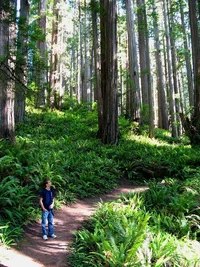
When you walk over the almost inpenetratble combined root mass of adjacent trees in old growth forest such as in the picture you posted do you conceptulise that these roots represetn the majority of the absorbative roots of those trees, or do you think that they are like the roots of the figs growing over the ruins at Angkor wat, supplying and supporting fine root mass in close where conditions allow but more likely having enormous volumes of fine root mass and fungal hyphae much further away?

Tree roots (like all plant roots) are remarkable demonstrations of the importance of adaptive resiliance in the ultimate success of an organism to exploit whatever environmental niches may be presented to it.
 
In school we were also told that they are at the very end of the roots and also right below the trunk to catch all the water that runs down the tree
 
Wow, lots of good responses. I think one of the best comments was the 'If you build it they will come' theory. I remember hearing or reading that feeder roots will develop or die wherever they are needed or where they are able to contribute, and that this process can be a rapidly changing one, meaning that the feeder root system is constantly in flux.

-Tom
 
[ QUOTE ]


When you walk over the almost inpenetratble combined root mass of adjacent trees in old growth forest such as in the picture you posted do you conceptulise that these roots represetn the majority of the absorbative roots of those trees, or do you think that they are like the roots of the figs growing over the ruins at Angkor wat, supplying and supporting fine root mass in close where conditions allow but more likely having enormous volumes of fine root mass and fungal hyphae much further away?


[/ QUOTE ]

The surface roots in plain sight on the surface look woody. Sometimes the roots so completely blanket the surface that it seems like the smaller roots could be virtually anywhere beneath.

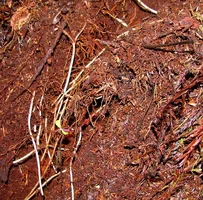
The photo below is about 3 feet from the base of one of the largest coast redwoods. In the winter, I moved a few inches of composted needles and found these newly developed roots. In the photo, similar shriveled roots are easy to spot too. Probably dry out on the surface in summer, and resprout every autumn and winter. Something similar must be happening throughout the huge mat of roots, with variability.

In landscaping, the presence of roots too, must depend on the season and soil type. Mulch and moisture must make a big difference. Locally, it's pretty apparent that when conifers like Douglas fir are not irrigated, they tend to root deeper and endure storms far better. Naturally, the soil around them dries most of the summer. We have little summer rain. I grew up with dozens of these, and the soil dried quite thoroughly in the top 6" to 12" from July to September. The surface layer was not a ripe zone for fine roots in summer.

187909-El_Viejo_600.jpg
 

Attachments

  • 187909-El_Viejo_600.webp
    187909-El_Viejo_600.webp
    168.2 KB · Views: 52
Same argument i have with my new boss every year. He belongs to a franchise and trues to interpret corporate methods incorrectly. The basic method for fertilizing a tree is with a 6 to 6 1/2 inch probe that injects fert into root system. The feeder roots are around drip line. The tree leaves shed rain and disperse it around drip line of tree where the feeder roots are located. In most new landscapes the drip line of deciduous trees under 16 feet the drip line is less than two feet from tree trunk. You want to fertilize 2 to 3 feet from trunk otherwise all the fert drufts next to trunk and will be unuseable to tree. So basic math you fert st drip line to 2 feet outside of drip line to hit feeder roots. In mature landscapes the drip line and feeder roots of the tree are in neighbors yard or under your house, so your national franchise company is scamming you if they say they can fertilize your 30 or more year old tree (in 15,000 sqaure foot or less landscapes). In orchards feeder roots are all over you can be off and maybe hit feeder roots of another tree.
 
Basal fertilization can be wonderfully effective and an efficient use of time and resources. Thats why basal applications of pesticedes work as well. Plenty of absorbing roots near the trunk and under the canopies of many trees.

Depends on what's actually lacking and what else you can do from a cultural standpoint to improve rooting, soil conditions, and nutrient availability/ uptake as well.
 

New threads New posts

Back
Top Bottom