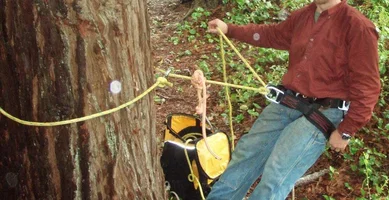
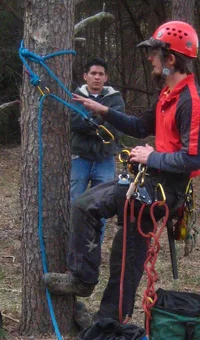
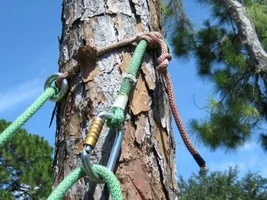
when riging off of Spar

finally got some pics burned to a disc...

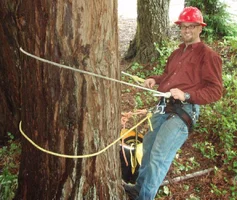
this is a down-and-dirty simple way to rappel from a bare pole or spar. It assumes a certain level of familiarity and comfort, and is not meant to address every situation that can possibly be dreamed up.
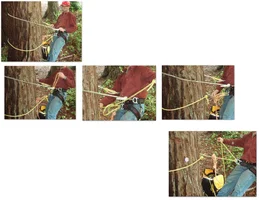
the attached pic shows the steps...
 

Attachments

  • 230228-tbcol.webp
    230228-tbcol.webp
    200.1 KB · Views: 266
pic 1
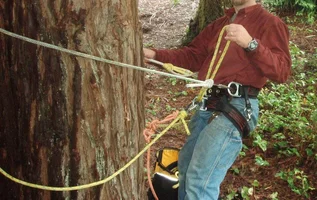
this is some average random dude using average random equipment. Doubled ended lanyard, 4-dee saddle, Ddrt climbline and split-tail. The technique works fine with other types of saddles, but you may have to hang a carabiner on your bridge if you don't have dee rings...
 

Attachments

  • 230229-tb1.webp
    230229-tb1.webp
    136.9 KB · Views: 165
pic 2
so you decide you want to get down from where you are and you're on a bare pole.

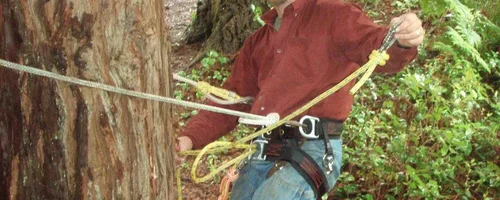
pull up some rope from beneath your friction hitch, and pass the bight through your dees or a locking 'biner. If you're using a split-tail, you don't need to untie or unclip anything, this is good... you don't have to worry about dropping your rope.
 

Attachments

  • 230230-tb2.webp
    230230-tb2.webp
    104.8 KB · Views: 133
pic 3
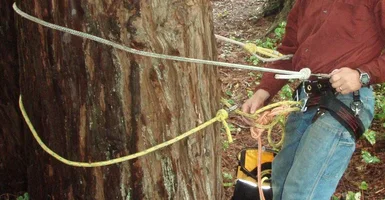
unclip the terminal end of your climbline, and pass it through the bight of rope, and then throw it back around the spar and clip it to itself, to form a choker. I try to orient the gate up...
 

Attachments

  • 230231-tb3.webp
    230231-tb3.webp
    69.2 KB · Views: 134
pic 4
shows the climbline passed around and clipped to itself. Next, you unclip your split-tail and push it through the bight that forms the Munter hitch, and push it up close enough to the tree that it will not interfere with your descent. Take up all the slack out of the sytem and unclip your lanyard.
 

Attachments

  • 230232-tb4.webp
    230232-tb4.webp
    81.4 KB · Views: 111
pic 5
shows the climber ready to descend. With a little practice, you can do this extremely quickly, and it requires little or no additional equipment. It can be done with rope snaps or carabiners, and any harness I've ever used with dee rings. Without a dee ring, you'd need a carabiner to reduce friction on the bridge of your saddle.
It's not self-locking, it's not self-belaying, and it's certainly not meant to address every situation a climber encounters.

It's most useful when you decide you're quitting, or when those Buffalo Wings and PBR's pass through at a bad time, or when you've been struck by lightning and need to change into an un-charred shirt.

if somebody knows how to imbed the pics into the text, I'd sure appreciate it.
 

Attachments

  • 230233-tb5.webp
    230233-tb5.webp
    85.9 KB · Views: 113
[ QUOTE ]
if somebody knows how to imbed the pics into the text, I'd sure appreciate it.

[/ QUOTE ]

Here ya go ... Just click "QUOTE" to see the code.
(BTW, nice tip! Thanks, Jack)

230233-tb5.jpg

shows the climber ready to descend. With a little practice, you can do this extremely quickly, and it requires little or no additional equipment. It can be done with rope snaps or carabiners, and any harness I've ever used with dee rings. Without a dee ring, you'd need a carabiner to reduce friction on the bridge of your saddle.
It's not self-locking, it's not self-belaying, and it's certainly not meant to address every situation a climber encounters.

It's most useful when you decide you're quitting, or when those Buffalo Wings and PBR's pass through at a bad time, or when you've been struck by lightning and need to change into an un-charred shirt.
 
SRT Spar Tie-in System. For work positioning, descent and easy retrieval. The lead of the rope is choked onto the spar with a running bowline with Yosemite tie-off. Keep the tail short, enough to tie a termination knot on a carabiner or to expose the eye splice. This backs up the bowline and during the retrieval process pulls the knot from the top instead of the center. To work on a leaning spar load the standing part into bight of bowline. The eye of the lead becomes the retrieval point by reinstalling the carabiner. The rope exits the gri-gri then passes back through the lead carabiner. This feeds the rope correctly into the gri-gri allowing for a smooth descent. If loaded against the bight the fall of rope can pulled utilizing the system to ascend back up the spar. When time to retrieve, lanyard in, then pull a bit of slack through the gri-gri. After the slack is obtained pull both parts of rope that pass through the lead carabiner. Even if there are stubs the system will travel down the spar. At that time the a loop of rope can be whipped around the sub or the bowline can be untied. After retrieved drop the fall out of the lead carabiner pull out all the slack then continue.
Yes, this is a single rope system. This system works and retrieves just like the monkey tail, except there are no additional components. It fits around any size spar. You can descend all the way to the ground if there is a emergency (if you have enough line to single rope down). There is not any hardware free falling toward your face during retrieval. This system is really smooth for spar rescue, with proper training.
 

Attachments

  • 230281-SRTSpar.webp
    230281-SRTSpar.webp
    287.9 KB · Views: 242
[ QUOTE ]
SRT Spar Tie-in System. For work positioning, descent and easy retrieval. The lead of the rope is choked onto the spar with <font color="red">a running bowline with Yosemite tie-off</font>.
...


[/ QUOTE ]

Nice system!!! Would a Bowline-On-A-Bite or a Butterfly also work? ... just looking at alternatives.
 
I would never want to have a climber face the challenge of setting up or transfering into a descent system on a spar. There are too many possibilities for the climber to be wounded and not functioning with enough mental/physical capabilities to make the transfer.

The one that Odis illustrated is very similar to a RADS but the upper is static. That's a clever setup. It solves some shortcomings of the Monkey Tail.
 
[ QUOTE ]
I would never want to have a climber face the challenge of setting up or transfering into a descent system on a spar. There are too many possibilities for the climber to be wounded and not functioning with enough mental/physical capabilities to make the transfer.

The one that Odis illustrated is very similar to a RADS but the upper is static. That's a clever setup. It solves some shortcomings of the Monkey Tail.

[/ QUOTE ]

I have been using a hybrid of both NATS and the monkey tail, for a little while now. I set up the monkey tail, with the splice close to the monkey tail, leave the termination biner in the end and do the same thing as NATS. I like the RIG in place of the GriGri but its basically the same.
Tom, one way to solve the transfer on a bare pole is to train your guys transfer before the top is blown out, then its all set. There are several other benifits to doing this as well, such as the pole is girthed when the top is dropped preventing your ropes from coming over the top if there is a shock (rigging).
 
I was n't clear.

What I meant was that I wouldn't want to see any sort of system transfer after the cut is made. Climbers must always be attached to a system that will allow them to descend to the ground.

Some climbers use two lanyards and then think that they'll be able to changeover to a descent system if things go bad. Not a good plan!

Also, I would rather see some sort of camming/locking descent tool instead of a friction device like a figure 8. If the climber is incapacitated they might not have enough physical ability to do a proper rapell.
 
Tom,
What exactly are the short comings of the Monkey Tail? The SRT spar tie-in and the Monkey Tail are almost the same. The difference is the Monkey Tail is terminated with a Blakes Hitch and the SRT system is terminated with a Bowline with Yosemite tie-off. I have been using both for well over 4 years now, I spend many hours each week attached to the side of a spar. All Spar descent/working systems should be installed before the top is removed from the tree. This can help prevent the climber from being ejected from the spar.At some point in time while working on a spar even if using a dynamic or static system the climber will be only on a lanyard. This will occur while transitioning the anchor system from location to location, during the retrieval process. As a climber having the knowledge of both dynamic and static system Spar Systems is very important. The SRT system is just another option. As with an adjustable friction saver you are limited by the size of the spar and you always have rope on tree friction. A lot of times here in Georgia the diameter of the top being removed is smaller than 4 inch diameter. The SRT and Monkey tail will adjust to 3 to 4 inch diameter spar.

The SRT and Monkey Tail systems both work for climbers of all sizes for AR. The 90 hands-on Rescues we did in Feb with theses systems went flawless. It is very difficult to by-pass the injured climber on a spar. By utilizing both a lanyard and (Open) dynamic climbing system the transition can be achieved. There may be as many as 5 or 6 transfers to just by-pass the injured climber. Then after the by-pass is achieved you may have only 4 inches to place a climbing system. We had a spar in the Louisville, Kentucky AR course that was over 40 inch DBH. All rescue climbers did a great job and the rescues went extremely smooth.
 
Odis,

Your post covered the tiny details that I was thinking about the MT
smile.gif


Less gear=less fumblies
Adjustment is easier
Easy retrieval without having to use a pull-down tail

Using the RADS aspect makes it a nice system!
 
The Monkey Tail is the device name not the retrieval system. There is no need for a long retrieval tail. That is just one of the MT configurations. The photo shows the lead carabiner being loaded with the fall of the rope. This is a 3 year old picture. The MT is really easy to adjust all the way to the eye. The MT is a little easier to install because it doesn’t bend the bury of the eye-splice. Some people may not have a MT that is why we show this technique as well. We are trying to give climbers more options with the equipment they already have. Cost effective, safe and efficient is the goal.
 

Attachments

  • 230328-076.webp
    230328-076.webp
    47 KB · Views: 203
[ QUOTE ]
I would never want to have a climber face the challenge of setting up or transfering into a descent system on a spar. There are too many possibilities for the climber to be wounded and not functioning with enough mental/physical capabilities to make the transfer.

The one that Odis illustrated is very similar to a RADS but the upper is static. That's a clever setup. It solves some shortcomings of the Monkey Tail.

[/ QUOTE ]


Tom,

were you referring to the Aluminum Friction Saver Prusik setup that I posted in particular or just the general idea of making such a transfer - ?

peace,

Matthew
 

New threads New posts

Back
Top Bottom