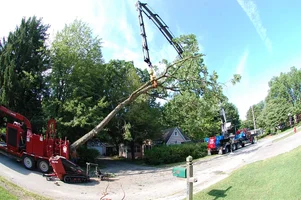
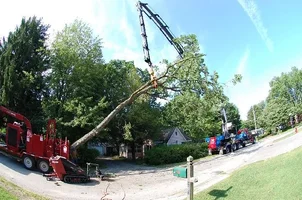
What the Bleep do we know about crane work?

I thought that would be a fun one.
beerchug.gif


But, I think this idea would be the force in my area. We have cytospora canker killing Aspens & hybrid Cottonwoods all over. When a customer needs a quote for a tree removal, 90% of the calls are related to those trees.

Since those trees have excurrent growth(which is less complex compared to a mature American Elm with random decurret growth) my "beer pourer" mounted Kboom approach would be like shooting fish in a barrel.

Probably not a good idea to mix beer and guns though.
grin.gif
 
[ QUOTE ]
For the sake of the conversation. That's not truly a feller buncher head. It's a single grip harvester head, too small to actually bunch trees together. These types of heads are usually found in the cut-to-length type of logging operation.

Buncher heads are a lot bigger than that and around here have a large circular saw head. They have a accumulator arm that holds the cut trees in place while they cut another one. Once the capacity of the head is reached, the machine place the "bunched" wood on the ground for forwarding to the processing site, hence the name "feller buncher".

Pretty cool application of unit.

[/ QUOTE ]

I disagree, a feller buncher simply falls trees. The bunching can be done on the ground 1 at a time. A harvester cuts to length as well as felling. They are generally bigger and run circular saws (Hot saws) but I have seen bar saws as well.
 
[ QUOTE ]
I've been thinking of a grapple mounted on a Kboom for years now. Not a conventional grapple, which hangs with gravity, but one that sticking out (inline) with the boom. However, it could rotate to accomodate different angled limbs.

Therefore, the climber would fly into the tree the initally, then the climber would only have to navigate to the next cut. A groundsman could move the boom into position while the climber is getting ready.

I pieced out two photos to grossly illustrate what I'm saying. I think it is easy to understand.

Here is where the Kboom owners could spike my idea (since they have hands on experience with a Kboom. I'm merely dreaming of scenarios).

***With the help of a jib, couldn't the loads be placed into a horizontal position, to the ground? Would this create torsion to the boom? Would this fixed grapple create added leverage on the boom?

306936-Kboom%26grapple.jpg


[/ QUOTE ]

I like your idea but man I'd be nervous cutting under a grapple like that!
 
I agree most do cut muliple stems I just don't believe that defines them.

Best definition I could find ;
Feller-buncher
A piece of forestry equipment that cuts a tree by first mechanically grabbing and holding the tree and cutting it with a high-speed circular or bar saw. Once the tree is cut, the machine picks the cut tree up off of the stump and places it with other cut trees in a bunch, or pile, where the bunch can be retrieved by a skidder and removed from the woods.
 
[ QUOTE ]


I disagree, a feller buncher simply falls trees. The bunching can be done on the ground 1 at a time. A harvester cuts to length as well as felling. They are generally bigger and run circular saws (Hot saws) but I have seen bar saws as well.

[/ QUOTE ]

most cut to length systems run chainsaw style bars for cutting. almost every feller buncher i have ever seen has had a circular saw cutting head and are intended for multiple trees given that they are equiped with and accumulator arm.
 
[ QUOTE ]
[ QUOTE ]


I disagree, a feller buncher simply falls trees. The bunching can be done on the ground 1 at a time. A harvester cuts to length as well as felling. They are generally bigger and run circular saws (Hot saws) but I have seen bar saws as well.

[/ QUOTE ]

most cut to length systems run chainsaw style bars for cutting. almost every feller buncher i have ever seen has had a circular saw cutting head and are intended for multiple trees given that they are equiped with and accumulator arm.

[/ QUOTE ]

I have never seen nor heard of anything but a bar saw on cut to length machines. Most these days have a top and bottom saw. I would say that around 90% of bunchers run a fixed circular saw that cuts the stem off as it's being grabbed. The other 10% percent are split between a retracteable circular saw and bar saws. I have even seen one that shears the tree off but know nothing of them.
I normally don't like to argue much but growing up in the PNW my Grandpa owned a cutting company, Dad owns a logging company, and I started a tree service that does small logging projects, so bunchers are one area I have a very strong background with. I just wanted it to be clear that the machines in this thread are indeed basically a long reach feller buncher.
Back to learning my passion of climbing and rigging. You boys have a wonderful day!!!
 
There is a rely big disadvantage of putting a cutting head at the end of a crane apparatus that sort of outweighs ( or should I say outweighs?) the cool advantages...

The weight of the additional hydraulics and grapples necessary to control the cutting and rotational movent of the wood is large, all the weight is at the end of the boom, and the weight cannot be adjusted for trees of different sizes. Worse, the grapple/saw transmits rotational loads to the boom as well as gravitational loads. All of this boils down to a situation where loads have to constantly minimized either by increasing crane size or reducing the size of the pick. And since it's intrinsic to the idea there's no way to effectively mitigate the effect through design. The question arises: if my capacity is reduced to the point where I need a bigger crane to operate the grapple/saw, would I not be better off with just a bigger crane alone? If I bought a bigger crane and used it conventionally I would have way more capacity, allowing greater picks, etc.

I am pretty sure that the crane mounted grapple saw idea is too inherently low on capacity...
 
Jamin,

Any grapple that would give you rotational control of cut wood, wheather or not it had a saw, would transmit the rotational load to the crane on top of the gravitational load, so you would be looking at a factor, (depending on the angle of the tree section before it was cut, the wind, and any limbs protruding from the cut, etc.) that you would need to multiply your weight by the reach your actual load. In practice, you would increase your safety factor by a certain amomunt, and you would be prohibited from picking pieces that leaned away from the crane by more than a certain amount (say 15 degrees...)

I would estimate that factor in low-wind situations to be around 1.6. That's just off-the-cuff guess work, you know. But if you add in the weight of the grapple itself (probably you could get away with 1000 pounds of rotation-controlling grapple for every 5000 pounds of wood) you're talking about a serious reduction in capacity.

I think it would be cool for very limited situations, like where you're removing numerous extrmely dead trees of a constant, small diameter, with relatively close crane reach.

But for most tree work, in a competetive market, I see it as a less effciient overall way of getting the work done...but I am a little prejudiced since I am a huge RigEm&Roll fan, for some reason...
smile.gif
 
[ QUOTE ]
...I think it would be cool for very limited situations, like where you're removing numerous extrmely dead trees of a constant, small diameter, with relatively close crane reach.

But for most tree work, in a competetive market, I see it as a less effciient overall way of getting the work done...but I am a little prejudiced since I am a huge RigEm&Roll fan, for some reason...
smile.gif


[/ QUOTE ]

You've got an engineering background don't you? Good insight. You explained it in a way I was a thinking, but I couldn't put the words out there.

And yes, I've more or less thought of it for small plucks. Say no more than 800lbs. Out here it is common to do front yard or side yard Aspen tree removals. It would be sweet to do these small jobs in 15 minutes and still charge the 1 hr. minimum.

The beer pouring mounted grapple wouldn't be a huge money maker, but it is something.

And if we eliminated the need to rotate, but plucking stuff that is vertical, it would make a little more sense to have that tool on hand.

And the Rig'Em & Roll does rock!
jamminz.gif
 
RRRRrrrrr.

Alright.

The saw and grapple combo head I have is only 234 lbs.

Maximum butt diameter of limb recommended to take: 9.84 inches.

Minimum butt diameter 2.36 inches.

chain speed 98 to 115 ft/second.

chain is lubricated by the hydraulic oil.

It rotates 360 degrees constantly and also has tilt function like Jamin wanted. to around 90 degrees.

danger is that if you took a very long heavy pick and it rotated to the side, horizontal, you could twist your boom.

Mine is still in the box it originally came in from overseas.

I haven't had time.
 
The closer to automation we can get, the more profitable we would be. And the R&R creates a huge advantage on effeciency (whether it's a stick boom or a Kboom).

A fixed grapple would be right in certain situations as would the R&R be right in certain situation.

I'd just like to see it done to validate that.
bangtard.gif
 
I don't know.....increase gross definitely.....but huge expenses can cut into your profit. Remember just because it's 100% deductible still means you are paying for aprox 2/3 of it and two thirds of the interest etc. My profits were pretty good when I climbed everything as fast as I could (some trees I probably should've climbed) pushing logs out of back yards on a dolly, going the extra mile on pruning,etc Now my back and shoulders are almost gone......so.
 
[ QUOTE ]
I don't know.....increase gross definitely.....but huge expenses can cut into your profit. Remember just because it's 100% deductible still means you are paying for aprox 2/3 of it and two thirds of the interest etc. My profits were pretty good when I climbed everything as fast as I could (some trees I probably should've climbed) pushing logs out of back yards on a dolly, going the extra mile on pruning,etc Now my back and shoulders are almost gone......so.

[/ QUOTE ]

So, it sounds like a trade off. A trade for a healthier body in the future, if one were to invest in a crane as soon as possible. It's a form of health insurance!
pbj.gif


Let's all tell our spouses, we want to buy a crane to give us better long term health insurance.
icon10.gif
icon14.gif
 

New threads New posts

Back
Top Bottom