Using an Air Knife to dig small trees

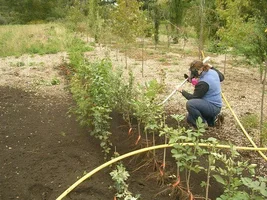
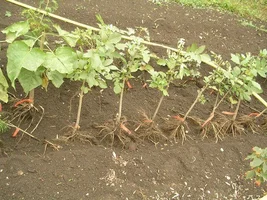
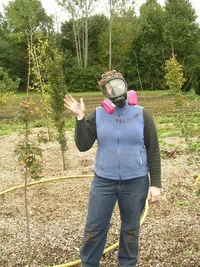
I've spent a lot of time utilizing Air Spades, mostly for root collar excavations and the sort, but today I got to use an Air Knife to dig a couple hundred small (0.5-1.5") trees for a study we're working on. It's really great because there's minimal damage to the roots and doesn't use as much energy as shoveling. And yes, I wear a full face mask for two reasons 1) I have incredibly touchy sinuses and having soil blasted in my face results in sinus infections and 2) you don't have the problem of particles going up and over your safety glasses into your eyes.
 

Attachments

  • 197990-10134_152235853612_631538612_2730979_4631148_n.webp
    197990-10134_152235853612_631538612_2730979_4631148_n.webp
    114.9 KB · Views: 244
Sounds like "labmate" should have been getting soil in their orifices!
grin.gif
 
I was using the Supersonic Air Knife X-LT yesterday and in the past I've used the Air Spade 2000.

We do have the vacuum feature for the Air Knife, but I haven't had the chance to use it yet. When I do I'll report back.

In my opinion I think both tools do the same great quality of work, my pros and cons stem mostly from the ergonomics of them both.

Air Spade 2000:

Pros: I really really like the wide-angle of the handle and the 45 degree tip (optional feature). I usually didn't screw the tip on all the way so it would pivot, this makes clean-up a lot easier when you have to blow dirt back in the hole and you can angle it into difficult areas. I like that the fiberglass barrel does not get hot, although the couplings and hardware do.

Cons: Having to pull the trigger using my fingers resulted in carpel tunnel syndrome in myself and my coworkers who were also using it everyday.

Air Knife X-LT:

Pros: I like that the trigger is compressed by the palm of my hand rather than my fingers. After using it for 7 hours yesterday my hands did not fall asleep (for clarification, with my carpel tunnel (CT) my hands sometimes fall asleep when I climb due to the grabbing and pulling, so not having my hands fall asleep was pretty surprising to me). For me, this is a HUGE pro.

Cons: Every part is aluminum, so it gets really hot. If you've ever touched the couplings of the Air Spade, it's about that hot. In the summer I had to wear leather gloves and hold it with a towel. I admit that we don't have the handle, which would have saved me some grief, but having another piece hanging off of it doesn't seem appealing when trying to maneuver in tight areas. I don't like the 90 degree angle of the handle, but maybe this also helped me with my CT, I'm not sure. And I really wish it had the 45 degree tip.

For both tools:

I like that they have a 3, 4 and 5 foot barrel length options. I never got to use the different barrel lengths because we only had the 5', but when you're underneath a spruce, pine or fir the 3' option would have been nice. Plus, the options are nice for taller or shorter people.

I think they both should have trigger locks both for application and CT purposes. I ended up bungee cording the trigger on the air spade so I could hold it differently, or choke up on the barrel if needed.

I think the dirt guards are a burden. The X-LT has a sliding guard and yesterday I ended up tying it to the handle so it would stay out of my way. The 2000 has an adjustable guard, which was a little better, but eventually it ripped off and we never bothered to replace it.

I highly recommend getting at least 10' of the light weight hose for maneuverability purposes.

Both have the problem that after a few hours of work that the valve assembly (VA) will have to be repaired because they wear down and start to leak. Sooner or later you wont need a trigger at all. I haven't had to repair the VA on the X-LT so I cannot compare the two. But from April to October 2008 I had to replace the 2000's VA about a half dozen times.

We never put them back in the cases, so I think those are overrated.

I think that's everything.

 
I just wanted to add something to my review. I said previously that the air knife did not aggravate my CT, but a day or two after I wrote the review the numbness came back. So, as with all tools that we use I think it all comes down to how much you use them and what effect that has on previous injuries. But I still think they're both very useful tools.
 
Any problems with the hose tearing at the crimp site? What is the best hose for running these? We have had two blow outs in two weeks. The factory hose (300 psi). We have been running it at 120 psi.Thanks
 
On the airspade we had the 10' of comfort hose that comes with the kit and then had that attached to air compressor hose (250-300 psi). The comfort hose did frey a little, but we never blew it even after thousands of hours of work.

With the air knife we only have 100' of the light weight hose that they have advertised on their website. Again, I haven't had any problems with it, but it's not used daily either.

I know when we broke the 45 degree angle nozzle on the air spade Guardair wanted us to send in the broken pieces to see what went wrong. I imagine to make improvements, you might want to call them to see what they've seen or heard back.

Sorry I can't help out more.
 
Nice review. Great application. I've seen 8" dia crepe myrtles bare rooted using this tool.

I wear a Tyvec painter's suit with the feet cut out. Amazing how that stuff permeates everywhere. Ear plugs inside a set of muffs, too.

I have a chipping helmet, with the face shield. My cheeks get a fine peppering of our clay soil through the screen which can help the complextion.

The different length tubes are great. First thing I wanted to comment on when saw on your first pict.

As far as handles, the pneumatic soil displacement tools I've made have a handle 8-10 inches in front of the valve that comes out in a tee. Used an old trampoline spring with a carriage bolt through the center and welded this to the plug. Wrapped them in 1" thick closed cell foam insulation. The handle balances the unit, and is angled. Sometimes I hold it like a console shift knob, which is so much more ergonomic.

We stuff a length of insulating foam to keep the
I'd be more inclined to have a short length of the expensive lightweight hose, since its probably more prone to wear and damage. I recall its a little more difficult to attach the couplers to it, but 10 feet keeps you from wrangling that heavy hose.

Keep the rubber seals on the couplers fresh. They rob power. Keep the hose length short and minimize couplers. All this robs power at surprising and very noticeable rates.
 
Did you notice any wilting of the plants that were air knifed? I was just thinking that the pressure might destroy the fine root hairs used for absorption. They are quite sensitive. What did you notice?
 

New threads New posts

Back
Top Bottom