Trees and Climate Change

Wow! Interesting. Any chance you remember where you read that?

Such a good point. Also it was brought to my attention that the angle of the sun does not change in anything we do so there are certain limitations there as well, as far as how many growing days a region is going to have. Pecan, for example, is still going to have a tough time being a good food production tree in my region for that reason, even though it will grow here.
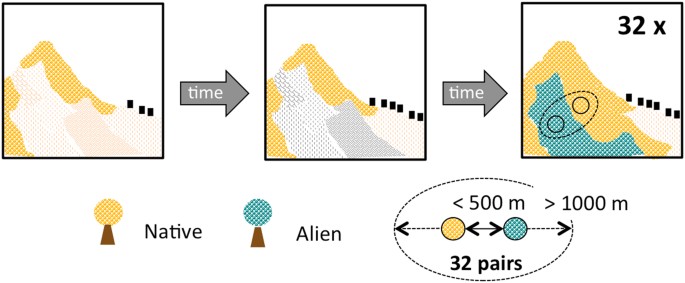
Here are some. Not exactly the same situation, but does seem to indicate these change the environment in novel ways.


My region is getting absolutely destroyed by climate change. As a science-minded person I know even the decade I've been here and observing is hardly a large enough sample size to determine major trends, but man I've see the world change around me in just that short amount of time and it is speeding up.

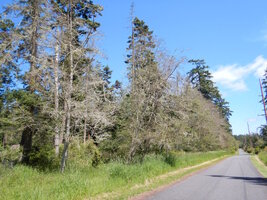
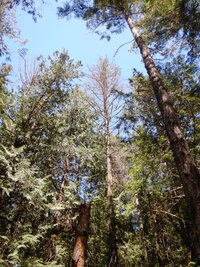
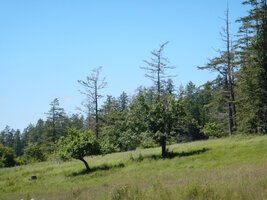
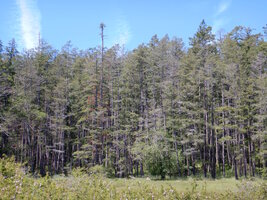
Western red cedars are dying en mass, grand firs are dying en mass, doug firs are dying en mass, red alders are dying en mass. All of our native trees. I'll try and keep this thread in mind and get a few photos, but southern facing tree-lines that have been established for decades are completely dying in just the last 2-3 years due to longer and hotter summers.
 
My region is getting absolutely destroyed by climate change. As a science-minded person I know even the decade I've been here and observing is hardly a large enough sample size to determine major trends, but man I've see the world change around me in just that short amount of time and it is speeding up.

Western red cedars are dying en mass, grand firs are dying en mass, doug firs are dying en mass, red alders are dying en mass. All of our native trees. I'll try and keep this thread in mind and get a few photos, but southern facing tree-lines that have been established for decades are completely dying in just the last 2-3 years due to longer and hotter summers.
Yea, I worry we may lose half of the sycamores in the region in the next year or two. The fires have burnt hotter than ever before too, so there are some enournous areas where the forest has to grow back from scratch. I am certain it won't grow back to be the kind of forest it once was.
 
hotter wildfires make me think of another unintended risk of invasive species, specifically altered makeup of canopy responding differently to fire regimes. i read this article a few years ago about blue gum eucalyptus in the bay area:

Twenty-five years after the Oakland Hills fire, people still disagree about whether blue gum eucalyptus is a fire threat

blue gum eucalyptus was introduced to california in the 1850s as a fast-growing timber tree during the gold rush, but fell out of favour because it proved unsuitable for railway ties. after that it found use as a widely-planted windbreak. then in the early 20th century the forest service was concerned the eastern timber industry would tap out essentially. this prompted speculative investors to plant thousands of acres of blue gum across california to flip for sale when america ran out of wood. the eastern timber-pocalypse never materialized because steel and concrete took over as large-scale building materials and 40,000 acres of blue gum plantations across the state, no longer having any value, were abandoned.

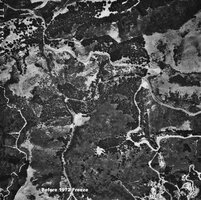
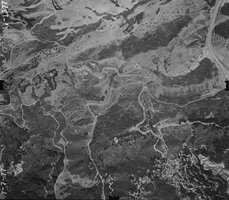
eucalyptus in the bay area suffered a major dieback from a freak 11-day-long freeze in 1972, and thousands of trees were cut back to the ground.
Claremont+Canyon+before+1972+Freeze.jpg
Claremont+Canyon+after+1972+Freeze+Logging.jpg
but the stumps were never treated with herbicides, and blue gum eucalyptus resprouts from epicormic buds in the lignotuber. essentially coppicing the forests caused them to regrow at greatly increased density, which was pointed to as a major factor in the 1991 Tunnel Fire.

it took decades of legal wrangling by UC to get the eucalyptus planted around their campus cut down and they were only able to begin the process in 2021:
UC Berkeley removes hundreds of trees in the Oakland hills to ensure fire evacuation route
John Radke is a UC Berkeley associate professor who specializes in fire modeling. As part of his coursework, he likes to lead students into the winding thickets of Claremont Canyon in the Oakland hills, where the underbrush can reach chest-high, to show them the likely site of one of the next major East Bay fires.
“I was up there one day in the fall and you could hear the leaves cracking they were so dry,” Radke said. “Going in, my students said they were doing great – this is wonderful, we’re out in nature. Then after describing how the fire would burn, I asked them, ‘How do you guys feel?’ They said, ‘We can’t wait to get out of here. Because it’s a fire trap.’”
 
Tree dieback I have observed in my area of Boston is from pestilence not climate change. Keep in mind that weather is constantly changing due to cyclic ice ages for example. Species will come and go as they adapt.

Diebacks I have seen and their causes:
American Chestnut - a fungi imported from Japan
Elm - Dutch Elm Disease - a fungi spread by beetles, imported from Netherlands
Ash - Emerald Ash Borer a beetle
Hemlock - Hemlock Wooley Adelgid a tiny mite imported from Japan
Sugar Maple - Asian Longhorn Beetle imported from Asia, some eradication success by quarantine/removal

The common root cause is trade globalization (or the hand of man). We have gotten smarter in control as demonstrated by the Asian Longhorn Beetle, but is that a trend or just luck. Control of pestilence is an age old problem and seems like shoveling against the tide.

When considering what can we do, we must have an objective and for an objective we must decide what is desirable. A garden or park has its place, as does natural wilderness. What we do has to do with the area of interest. Intervening for the good of the earth frightens me. Intervening for the good of a park or garden calms me.
 
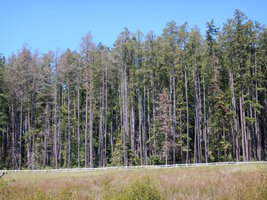
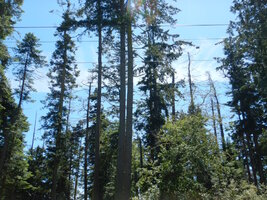
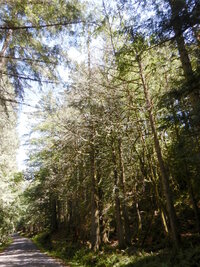
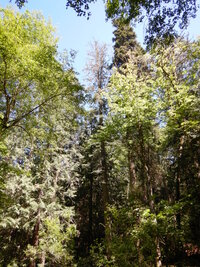
Here is what our woods are looking like, both small and large groupings of trees thinning, yellowing and pretty quickly dying. Mostly found in southern facing tree lines that are getting a lot hotter than they used to, but shaded, inland, north facing and mature trees within the forest are dying as well at increasing rates. I've been here a bit over a decade now and it looked nothing like this when I arrived, in fact most of this change I've seen has been in the last 2-3 years. This is all in about 10 minutes of driving around just now, and most of these trees pictured below were green 2 years ago.

The amount of trees dying around here is staggering.

000 climate 01.jpg

000 climate 02.jpg

000 climate 03.jpg

000 climate 04.jpg

000 climate 05.jpg

000 climate 06.jpg

000 climate 07.jpg

000 climate 08.jpg
 
Here is what our woods are looking like, both small and large groupings of trees thinning, yellowing and pretty quickly dying. Mostly found in southern facing tree lines that are getting a lot hotter than they used to, but shaded, inland, north facing and mature trees within the forest are dying as well at increasing rates. I've been here a bit over a decade now and it looked nothing like this when I arrived, in fact most of this change I've seen has been in the last 2-3 years. This is all in about 10 minutes of driving around just now, and most of these trees pictured below were green 2 years ago.

The amount of trees dying around here is staggering.

View attachment 94185

View attachment 94186

View attachment 94187

View attachment 94188

View attachment 94189

View attachment 94190

View attachment 94191

View attachment 94192
Yup, some areas are like that here but not quite as bad as what you have. We are a little less rainshadow and more 50/50 convergence zone.
Still I use to be able to spot a laminated root rot pocket by the density of shade, now not so much every thing looks thin.
You are also way more rock, here the more sun hits the understory the more the brush grows. Aka fuel for when the fires break out. ‘If’ is no longer the question.
We have a patch here that was logged by DNR back in the day, kinda an experimental thing they seed bombed from aircraft for replanting. It worked a bit too well, and it’s a dog hair stand, but the land converted and was parcled out. Never thinned. Super dense white pine, hemlock and some Doug fir. Thin soils and crazy fuel loads.
 
Yup, some areas are like that here but not quite as bad as what you have. We are a little less rainshadow and more 50/50 convergence zone.
Still I use to be able to spot a laminated root rot pocket by the density of shade, now not so much every thing looks thin.
You are also way more rock, here the more sun hits the understory the more the brush grows. Aka fuel for when the fires break out. ‘If’ is no longer the question.
We have a patch here that was logged by DNR back in the day, kinda an experimental thing they seed bombed from aircraft for replanting. It worked a bit too well, and it’s a dog hair stand, but the land converted and was parcled out. Never thinned. Super dense white pine, hemlock and some Doug fir. Thin soils and crazy fuel loads.

100%. Laminated root rot tends to be in distinct clusters fairly unrelated to sun exposure in my experience, and I've dealt with a lot of it. Now you see large zones that have very similar characteristics of the thinning and yellowing canopy, but are clearly heat related, and happen MUCH quicker and over a wider area, instead of a localized patch with root-to-root contact. Such as the tree-line photos above.

Here in the San Juans we are certainly in much more marginal conditions than your island, shallow and low nutrient soil over bedrock. Still, before climate change and logging around 100 years ago this area had wildly spaced old growth trees since it was created by a more (but not totally) natural forest succession. As the old timers used to say, "you could turn a wagon around in the woods." 300 year old firs 20-40 feet apart. I've seen the stumps with spring board notches, they are still around. Since the clear cutting (often twice) trees are regularly 100' tall and 5' from each other, struggling to survive in the changing environment.

And yah, I've said it before but as a volunteer fire fighter, the fuel load now and going forward scares me.
 
Last edited:

New threads New posts

Back
Top Bottom