Tree forks - codominant stems

Hi.
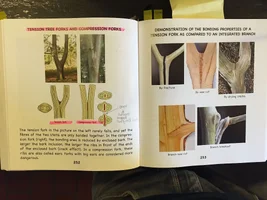
We are very frequently involved in projects concerning tree forks with included bark. But HOW bad are they. Over the years, we have seen quite a few collapsed forks and try to learn as much as we can from that - but does anyone know about some research that particularly deals with tree forks with included bark and "ears" (see attached image from Claus Mattecks latest book).

I hope you guys have some information / experience to share! :-)
 

Attachments

  • Billede 08-08-15 08.10.59.webp
    Billede 08-08-15 08.10.59.webp
    308 KB · Views: 77
Check out the last issue of Arborculture and Urban forestry... There was a study done on co-doms in filberts.. It may be the issue before last.
 
Thanks for this reference. This is a master's thesis here that tends to support a lot of anecdotal experience about relative stability of red maples, pears, vs. oak codominant stem crotches. The study was limited to younger age trees, though, and didn't make any claims about mature trees, let alone "veteran trees". With the enthusiasm for thin shell walls these days, I wonder how this complicates things. Hard to see pear trees grow into monsters with large cavities and thin (<30% shell wall), but sometimes maples. In fact, I see a lot of tearout branches on the thin shell walled Bigleaf Maples or even reiterations on older Doug firs with inner decomposition due to, e.g. Phellinus pini. It would be good to know more about the stability of codominants above a deeply cavitied tree, e.g., a previously topped tree, of an older age class.
 
Ed Gilman has done some great research on younger trees with very aggressive pruning back or suppression on the weaker co-dominate stems and has also done work on larger trees on his campus. Here in Colorado we have been working on co-dominate suppression of young and medium trees with aggressive pruning techniques with success. larger trees it is much tougher no doubt about it but can still be done but to a lesser degree. Our spring and fall storms can create havoc but breakage is not always what one would assume. I don't think complete removal is co-dominates is a good practice and even leaving the remaining stem of a co-dominate that has ripped out often results in future breakage of the that remaining weakened stem (half a pipe).
 
... leaving the remaining stem of a co-dominate that has ripped out often results in future breakage of the that remaining weakened stem (half a pipe).
If the remaining half is not reduced, sure. If it is brought back, woundwood can often catch up in support and avoid more breakage.

MarkC posted a pic from a job with a codom tearout; wonder how that one came out?

Agree that subordination is typically sufficient; removal of codoms >4" should be reconsidered, per the European standards. And they've been at this a much longer time than US. :guitarra:
 
cabling the big co-doms works well too... the higher the better IMO....
I;ve had great siuccess.. probably 99% with 1/4 steel cables and either 5/8" j-lags on wood under 10", or thru bolts on bigger....
Generally just keep going up til I hit6-8" wood and cable there...
Its about mitigating risk, while preserving the benefits of the tree.

One important issue is the weight and lean of the co-doms... must be taken into consideration when judging wether to cable or not. Putting the right $ on cables is important too.. gotta make it worthwhile to do it right.. Generally when the customer understands the problem and effectiveness of the solution, price isn't a concern.. I just put 2 cables in a big tulip with a real badbranch union for 600...
good for the client and worth it for me.. pretty sure those cables are over 75' high, on thru bolts.. that tree is GOOD for another 20 years...
 
Thanks for the replies :-)

Anyone with an opinion about “ears”, like Matteck describes in my attachment from “Body language of trees 2015”?

I think they might be a good indicator for a very week fork, but I still haven’t found some solid research to support that assumption.

It’s a shame the thesis is done on small trees. I work a lot with old / veteran European beech trees and they often tend to have problems with weak codominant stems, with included bark etc.
 
Great point about cables. I was speaking with a municipal arborist recently about the issue of cities and municipalities not using cables because of the possibility of taking on liability. Sometimes a cable in a multistemmed mess of a tree might be sketchy, but cabling a two stem, symmetrical linden fixes the issue, no doubt, and for a very long time. If the linden fails couldn't we blame a town for not cabling? If a cable fails and damage is done, can't the town say they tried their best? We have all seen cables fail but not when installed properly. And when failure occurs when installed properly, the blame can be put on the tree or Mother Nature?
The point is that I think we have come to a point where urban trees deserve and require a health record, a tag of some sort. Im sure this is happening somewhere and I don't mean reports or inventories, I mean cables installed with records and plans for revisits.
out of a hundred cabled urban trees, say 10 will fail without a cable. So if 90 cables are then installed for no reason does it matter? Better than removing 10 and risking the other 90. Remembering that you didn't cable the ten that actually needed it, you only cabled six as four looked like they had good narrow crotches but didn't and four had good crotches that just looked really bad.
As for generally speaking, identify weak crotches as best you can and cable and or reduce. Reduction severity is based on how bad the crotch is. The other option is risk it. Maybe No target, and the tree is not important as there is many others right close by.
When a crotch has stems that are corkscrewed then cabling may not be in line with the direction of probable failure. In this case reduction or in extreme cases including extensive decay, retrenchment might be best to avoid failure long term. Remember the biggest thing with both reduction and retrenchment is that the job is never done. You need to assess the tree response and reapply reduction or even thinning, often frequently depending on species and response. Risk grows back. Of the trees I've reduced once, a few have failed. Of the trees I've reduced more than once, none to my knowledge have failed but I'm sure time will change that. The point is once we regain control of a tree by regular FULL CROWN reduction and thinning, then the tree becomes almost storm proof.
Some trees need only cuts up to 1" and some need cuts up to no size limit. I'd say reduction is up to 3" or so then upward of that (retrenchment) you better have a good reason to make a wound that big. I often look at the decay wound in question. If it has consumed 18" of the cambium of a 70" circumference (22" diameter stem roughly) then you might want to make a few cuts up to 14" or so. On the other hand if the crotch is free of decay, a detailed and thorough application of reduction up to 1.5" cuts should be plenty, especially if applied two or three times in the first ten years of the intervention. Think of it as growth intervention. You want to disturb the natural growth. To avoid failure the natural leverage properties and taper can be manipulated. Not because we are better than nature, but because we want to reduce the tree before Mother Nature does. Silver maples grow fast, up and out to compete. We need them to grow more like sugar maples. More upright, quick but not too quick. Fast at first but then slower as they pass rooflines. We can project the better growth patterns from one species onto another.
Reduction is the future (and present to some degree) of good arboriculture. Trees will live longer, stronger, and will fail big stems less by the wind of the storm, as they are cut sensitively yet thouroughly by the hand of the arborist.
Don't thin out, thin in.
You can stare at a crotch all day and wonder and wander but if you reduce it sensitively, no harm is done and the tree is capable of more than it was before.
I just noticed what I said. Be careful not to get slapped when you stare at a crotch all day.

 
Last edited:

New threads New posts

Back
Top Bottom