From an article on TBzz:
[ QUOTE ]
OSHA or ANSI?
The majority of workplaces in the
United States are covered by the
Occupational Safety and Health Act (OSH
Act) of 1970. For many industries there are
specific standards within the OSH Act that
govern workplace practices, procedures
and equipment. For other industries there is
no specific standard within the OSH Act,
but those industries are still required to
abide by what is commonly called the
General Duty Clause. The General Duty
Clause states that each employer must:
“…furnish to each of his employees
employment and a place of employment
which are free from recognized hazards
that are causing or are likely to cause
death or serious physical harm to his
employees.”
The tree care industry is one of the
industries for which there is no specific
OSHA standard. To identify ‘recognized
hazards,’ OSHA will typically look to
industry consensus standards and for the
tree care industry; those consensus standards
are the ANSI Z133.1-2006. Through
this rather circuitous route arborists are
bound to follow the ANSI Z133.1-2006.
State, local or company regulations may be
stricter than ANSI Z133.1-2006 and, if so,
they supersede the ANSI Z133.1-2006.
[/ QUOTE ]
Jman, 1926 is for construction:
http://www.osha.gov/pls/oshaweb/owadisp.show_document?p_table=STANDARDS&p_id=10593
Note too:
[ QUOTE ]
1926.502 Fall protection systems criteria and practices.
[/ QUOTE ]
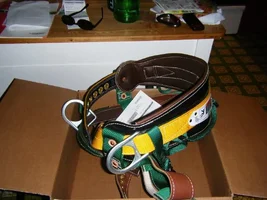
Our systems are for work positioning.
[ QUOTE ]
If I can show that osha allows this saddle as a work positioning harness. I would think it would override ANSI ...
[/ QUOTE ]
I understand why you want to do this, but attempting to use an incorrect OSHA standard to override ANSI would reverse the hard, and often times thankless, behind the scenes work that people have done for years to get OSHA to recognize the Z. Your time and energy would be of much better benefit to the industry if you'd encourage and educate ANSI to widen its view of acceptable equipment. The concept of 'fit for purpose' would be a great place to start.