Tips for Climbing a Tulip Poplar

Climbed my tallest set in the yard this morning (90' or so), but mainly for the exercise and view. No experimentation yet, with setting canopy anchor.

Adjacent to the pine I climbed, there is a tall sweet gum that I'd love to try setting one in! Examining the tree though, it seems like the obstructions from surrounding trees are possibly going to be prohibitive in getting a 'clean' wrap around the stem with the throw bag (for drawing up the cinch without ending up with a 20' loop around multiple spread out branches - but maybe this isn't a negative). I was imagining shooting front-to-back, then back-to-front to try and get the throw line 'around' the stem. However, in a situation where I'm going to be shooting more vertically than horizontally, this is going to be tough to wrap the stem.

As a total last resort - meaning, I can't get a clean and high stem-cinch from the ground, and there aren't enough limbs to get an intermediate set and then double-lanyard up the rest of the way - does anyone ever alternate stem-cinching between what basically amounts to two stem-cinched climb lines? In other words, how painfully slow would it be to set the main climb line cinched around the stem as high as you can reach, climb up until the SRT device is at the cinch, set lanyard or secondary climb line in the same way as high as you can reach, ascend on it, etc., etc., etc.?

Again, this is all theoretical at this point, still, as I've not taken opportunity to see if I can set a simple spar-cinch from the ground. I'm simply trying to draw up primary, secondary, and tertiary plans of attack before I get out there, try one unsuccessfully, and am left mucking around on the phone or otherwise trying to find an idea.

I imagine that whenever I start working around folks on the ground having cutting implements, I'm definitely going to want the (mental) security of having a canopy anchor, or at least starting with a basal and converting to a canobase or pure canopy anchor prior to cutting.
 
Pics!!
Need pics.
Drawings.

Seems easy enough to go from base-tie to retrievable-from-ground canopy anchor, if you don't mind leaving the base-tie on the tree.

Generally, my groundman just unclips my base-tie when I change.


The throwline on the canopy-choke's running bowline not only lets you pull it back down, it lets you keep tension on your rope, giving more manipulation-ability.


A 20' loop in the choke of the RB is fine. When you get up there, the knot will be at the bottom most branch....
Just get settled, lanyard in if necessary, and slack the climbing rope enough to spin the whole loop, putting the knot of the RB at the top. You can proceed to the high-point of the TIP's RB circle, just by getting the knot the top, and having the standing end bend 180* on the Bowline of the RB.
 
A comment on all the theoreticals around different types of anchors and cutting branches/limbs etc.:

I highly recommend you spend a bunch of hours in your yard trees pruning with a handsaw. Always tied in twice before the handsaw comes out of the scabboard. Learn light rigging techniques. I'll post up some vid of the most common "catch it with a sling runner" rigging technique. You'll learn all the characteristics of any tree species and individual trees (every tree is different no matter what species it is) with a handsaw: hinge characteristics, wood weight, strength, deadwood vs. live wood characteristics. It's an education just waiting for you. Everything you'll learn is scalable to the next level, smaller wood with a chain saw. It's been said a million times, when you're learning how to cut and rig wood in a tree on rope, go small. Scale up as you learn how wood behaves. If you don't know what's 99% most likely to happen before you make the cut you aren't ready to make the cut. When you go small you have wiggle room to make mistakes. Been there done that and still making mistakes that don't cause much trouble ;-)
-AJ
 
Last edited:
Solid gold. Everything. Thank you guys.

I have a bunch of tulip poplar trimmings waiting to be reduced for the fire bowl that I can use the handsaw on some more! Thanks @moss.

@southsoundtree: awesome tip on the long running loop. Can't wait to try this.

The next complication to leaving the base tie on the tree after converting to a canopy anchor was advancing the canopy anchor beyond arm's reach. I was trying to work this out on paper yesterday; you got any clever tricks for that, man?
 
Do my eye's deceive me, or are you doing a removal without spurs AJ?

Lower part would theoretically be done on spurs, but...was contract climbing and after I finished cleaning out the crown the "customer" told the guy who hired me "Tree looks great you're done". Faaaaahk. I hate when that happens, someone will have to deal with a lot of rotten big wood over a shit ton of targets, it will cost sooo much more than me being allowed to finish it now. I was in a bad mood for two days over it ;-) It's not the money, it's the stupidity. Back to climbing for myself and doing jobs the right way.
-AJ
 
I just done a complete removal of a 165 ft one last week. Very fun. Base was about 5ft thick. First limb at about 70ft. Straight. I do them pretty regular here in southern Wv. I always tip around the main stem. You can swing branches if you bore heavy with the direction of the swing. If I'm falling a leaner, I always use a wide open thick hinge with a pull line.
 
I just done a complete removal of a 165 ft one last week. Very fun. Base was about 5ft thick. First limb at about 70ft. Straight. I do them pretty regular here in southern Wv. I always tip around the main stem. You can swing branches if you bore heavy with the direction of the swing. If I'm falling a leaner, I always use a wide open thick hinge with a pull line.

Do you start out with your PSP at ~70' then? That is, at the lowest limbs?

@southsoundtree, thinking a little more about the scenario you described, where your are choking the tree with an enormous loop encompassing more than one limb, there are some interesting forces at play right? With the knot situated at the lowest point on the loop (the lowest branch encompassed), the topmost branch that the loop hangs on sees a 1x load. Once you ascend to the knot/bight, lanyard in, and spin it around to position the knot/bight at the topmost branch, there is still 1x loading on the PSP (topmost branch), but

1) friction from rope in the loop against the trunk is what is keeping your PSP (in this case, the bight) positioned at the top branch (that is, if there were no friction, with any tension applied to the rope, the knot/bight would just spin around and back down) - does this at all present a potential issue, like on smooth bark possibly? And,

2) again, totally discounting the helpful effects of friction in this arrangement, the loop now has 2x the climber's weight applied at the bight, or 1x the climber's weight per leg of the loop. Not a negative, that I can see at least, and not realistic of course either since one leg of the loop will likely be pinched between trunk and bight, preventing the full 2x climber's weight (Edit: Full!? Ha! How about hardly any more than 1x?) from being transmitted to the knot and rest of the loop.

This is super simplistic and not reality, but just doing the thought experiment.

Watching moss' rigging vid now...
 
Solid gold. Everything. Thank you guys.

I have a bunch of tulip poplar trimmings waiting to be reduced for the fire bowl that I can use the handsaw on some more! Thanks @moss.

@southsoundtree: awesome tip on the long running loop. Can't wait to try this.

The next complication to leaving the base tie on the tree after converting to a canopy anchor was advancing the canopy anchor beyond arm's reach. I was trying to work this out on paper yesterday; you got any clever tricks for that, man?
Make the old standing end, the new working end by removing and flipping your SRT device.
 
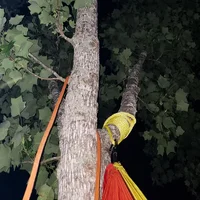
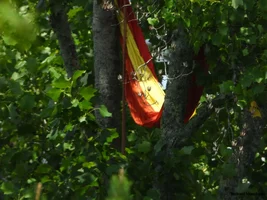
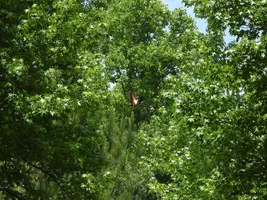
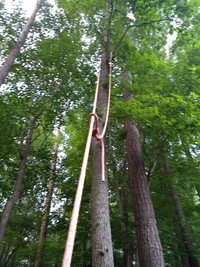
To satisfy the people's clamoring for pictures...

Lots of firsts this morning. First climb on a canopy anchor. First use of throw bag in tree. First advancing of canopy anchor. First climb on any sweet gum, much less this particular sweet gum (maybe ~10" or so at the base).

First PSP was set at about 25', and I ended up going up about an additional 25'-30' in two advances. Connected throw bag on my saddle (short ~50' throw line) before coming down.

1) Using a throw bag in the tree really IS the way to advance, at least for the tree I was in today). I was amazed at how far I could set the bag both times. I'm sure I looked like Obama throwing the first pitch, but still it went surprisingly well. I threw 2-3 separate throws for each advance to get the line exactly where I wanted it, and each stem cinch went right up snug, almost straight around the stem. I didn't have-to/get-to test the large loop idea that @southsoundtree expounded on.

2) Procedure for advancing was that I would ascend to my PSP, choke my lanyard SRT style above the PSP and connect it to my bridge (alloy carabiner at arm's reach, gate facing up/out). I would then set the throw bag, unweight the main line, and transfer weight to lanyard, pull slack into main line above SRT device, pull main line up into new PSP, remove slack (test new PSP), disconnect lanyard, and ascend again to the new PSP.

3) The first set from the ground, I tied a running bow and just sent it up. After untying that for the first advance, I quickly realized the err of not using a quickie. Corrected with quickie+AB.

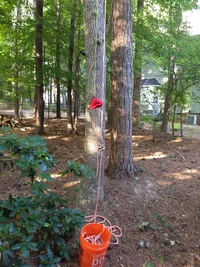
4) Should have (and will) connected long throw line I used to get the initial set to the running loop, like whoever it was in this thread said I should do, as I allllllmost ran out of retrieval line on the way down. It's a 50' or so throw line that I have on my saddle with the end connected to that red Weaver ditty bag that is hanging above the ground in one of the pictures.

Worked great. Ended up bookmarking the the with paracord, but debated doing that because of the great practice setting that initial anchor point was. But, I figure I'll just find another tree to practice on, and I can go back up this one and advance some more. I'm trying to gain confidence in the strength of smaller trees like that, as I noticed that about everything I'm climbing is a monster (100'ish) pine.

Thank you, all.

IMG_20190531_063951589.webp IMG_20190531_073558336.webp IMG_20190531_075036577.webp IMG_20190531_074321029.webp
 

Attachments

  • IMG_20190531_063951589.webp
    IMG_20190531_063951589.webp
    727.2 KB · Views: 35
To satisfy the people's clamoring for pictures...

Lots of firsts this morning. First climb on a canopy anchor. First use of throw bag in tree. First advancing of canopy anchor. First climb on any sweet gum, much less this particular sweet gum (maybe ~10" or so at the base).

First PSP was set at about 25', and I ended up going up about an additional 25'-30' in two advances. Connected throw bag on my saddle (short ~50' throw line) before coming down.

1) Using a throw bag in the tree really IS the way to advance, at least for the tree I was in today). I was amazed at how far I could set the bag both times. I'm sure I looked like Obama throwing the first pitch, but still it went surprisingly well. I threw 2-3 separate throws for each advance to get the line exactly where I wanted it, and each stem cinch went right up snug, almost straight around the stem. I didn't have-to/get-to test the large loop idea that @southsoundtree expounded on.

2) Procedure for advancing was that I would ascend to my PSP, choke my lanyard SRT style above the PSP and connect it to my bridge (alloy carabiner at arm's reach, gate facing up/out). I would then set the throw bag, unweight the main line, and transfer weight to lanyard, pull slack into main line above SRT device, pull main line up into new PSP, remove slack (test new PSP), disconnect lanyard, and ascend again to the new PSP.

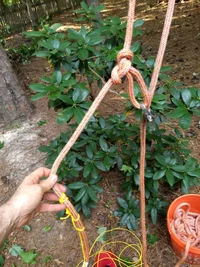
3) The first set from the ground, I tied a running bow and just sent it up. After untying that for the first advance, I quickly realized the err of not using a quickie. Corrected with quickie+AB.

4) Should have (and will) connected long throw line I used to get the initial set to the running loop, like whoever it was in this thread said I should do, as I allllllmost ran out of retrieval line on the way down. It's a 50' or so throw line that I have on my saddle with the end connected to that red Weaver ditty bag that is hanging above the ground in one of the pictures.

Worked great. Ended up bookmarking the the with paracord, but debated doing that because of the great practice setting that initial anchor point was. But, I figure I'll just find another tree to practice on, and I can go back up this one and advance some more. I'm trying to gain confidence in the strength of smaller trees like that, as I noticed that about everything I'm climbing is a monster (100'ish) pine.

Thank you, all.

View attachment 60066View attachment 60065View attachment 60067View attachment 60064
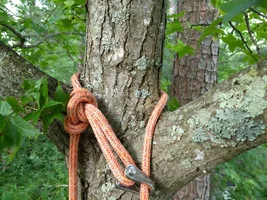
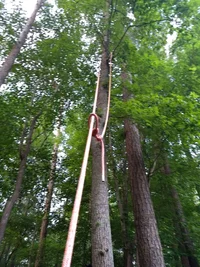
Make sure you have the quickie facing the right way I think in your second photo you have the pin against the tree which will apply pressure on the plungers
 
Thank you. I had intended to position it as shown in the fourth picture - with the head of the pin towards the tree and the pin on the running side of the line, like a pulley to reduce friction - but for a couple of these, it got spun around :(

Is that a total no-go, pressure being applied to the plungers?
 
Thank you. I had intended to position it as shown in the fourth picture - with the head of the pin towards the tree and the pin on the running side of the line, like a pulley to reduce friction - but for a couple of these, it got spun around :(

Is that a total no-go, pressure being applied to the plungers?
Yes, no no and no go. If there's any doubts of it staying oriented I use a running Alpine butterfly or a screw link.
 
I was using the quickie all over the place, but whipping that cinch as it goes up the trunk could easily result in it getting mucked on the way up, which I then wouldn't be able to fix unless I already had a retrieval line in position.
 

New threads New posts

Back
Top Bottom