Tips and Tricks

For wood that's on the ground, I think the trick of sticking a piece of small diameter pvc pipe with a rare earth magnet glued in the end onto the chainsaw bar looks pretty cool. (Pvc sticks out 90 degrees to the bar to serve as your measuring stick.) Stick it on, scribe for your cuts, then take it off and go to bucking.
 
  • Like
Reactions: CTS
I've been thinking a 16" measuring stick with a magnet, stuck in the bar, would make it easy to mark out a log, then move on to cutting.


I have these

for backing up a narrow trailer on my own, sticking off sideways.

Also, makes for a magnetic picker-upper.


I think marking firewood will be a good, additional purpose for the tool.
You can also just put a mark on your bar 16" from the tip(when using a big enough bar) and turn it vertical to get a quick reference point. That's free if you have a Sharpie and you can do it to every bar you own.
 
I've been thinking a 16" measuring stick with a magnet, stuck in the bar, would make it easy to mark out a log, then move on to cutting.


I have these

for backing up a narrow trailer on my own, sticking off sideways.

Also, makes for a magnetic picker-upper.


I think marking firewood will be a good, additional purpose for the tool.
I've pre-drilled and screwed one of these to a 1/2" Dowell rod. It works well to scribe, then remove to buck through the log.

Alternatively, the owner of eastonmade splitters has a few videos of him bucking wood. He has what appears to be a snowplow marker bolted to his bar stud of his saw. It bends out for measurements, and bends back out of the way when not needed. I think this would be nice for a dedicated firewood saw
 

Attachments

  • Screenshot_20210211-171620_Chrome.jpg
    Screenshot_20210211-171620_Chrome.jpg
    136.8 KB · Views: 14
  • Screenshot_20210211-172017_Chrome.jpg
    Screenshot_20210211-172017_Chrome.jpg
    53.5 KB · Views: 14
You can also just put a mark on your bar 16" from the tip(when using a big enough bar) and turn it vertical to get a quick reference point. That's free if you have a Sharpie and you can do it to every bar you own.
Pistol grip to forward bar-nut is 16"... lots of extra motions and bending, though.

Also, from bar tip to a point on the name printed on the side of the bar works, like the marker idea, but similarly, extra motions, and possibly easier to get sloppy.
 
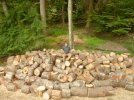
So just to be more clear, when I do firewood I go through and mark everything first. It's easy to just walk down a log and make that one quick swipe with the handsaw against the marking stick the whole way down, with perfect accuracy. Then grab the saw and just cut on the lines. It removes all the body twisting of having to turn your chainsaw 90 to measure with your bar in some way, and you don't have to have some weird stick hanging off your bar getting in the way of cutting. That's my preference at least.

00 wood pile 01.jpg
 
Last edited:
With practice, on a vertical or near vertical stem, snap/bypass cuts can be just as accurate as perfect face-cuts on trees that don't require rigging, and WAY faster and easier:

Edit: Making your cuts in a knot-free section is critical, the lower cut is towards the fall direction of course, understand and control log rotation.

0 snap cuts.jpg
 
Last edited:
With practice, on a vertical or near vertical stems, snap/bypass cuts can be just as accurate as perfect face-cuts on trees that don't require rigging, and WAY faster and easier:

Edit: Making your cuts in a knot-free section is critical, the lower cut is towards the fall direction of course, understand and control log rotation.

View attachment 73489
In a vertical stem, do you make your cuts with the bar perpendicular to the intended lay?
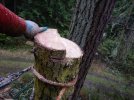
 
In a vertical stem, do you make your cuts with the bar perpendicular to the intended lay?
Yes, I aim the bypass cuts (upper and lower) with the sight on the saw just like you would while aiming your face. The height between the cuts and the depth of overlap have general rules, but it all varies depending on the length of the piece, angle, weight, diameter, species, etc. That is where the 'practice' part comes in: start small and learn every piece in a low consequence situations first. On doug and grand fir, I've gotten comfortable doing 10-12' sections, up to about 18" this way. Even on our tall trees, it makes for a pretty fast removal once you get the hang of it. Set the snap cut, hang your saw, take your ear protection out so you have full auditory awareness of when and how it is breaking. Be prepared for some on the fly adjustments by hand as you push because each piece may still break off a little different. You also need your hands on it to control rotation so it lands flat. By making the top cut opposite the fall direction, you have a reliable pivot point to work with once the piece has broken free and begins to move (although most of the pivot does happen on the flat bottom cut).

DSCN6465 (Custom).JPG
 
Last edited:
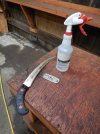
Even a small amount of build-up on your handsaw blade can seriously hurt cutting performance by adding a lot of extra friction when the blade is in the cut. The way I clean mine is a spray bottle of denatured alcohol, let it soak for 30-60 seconds and scrape the gunk off with a razor in a handle, then blow any additional debris with my air nozzle.

DSCN7334 (Custom).JPG
 
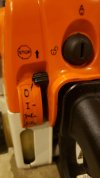
I got tired of trying to remember the recommended number of times to push the primer bulbs on my various equipment so I just put labels by the primer bulbs. For controls "labels" that are just molded in plastic, highlighting them with a sharpie makes them easy to read when your vision is crappy. Not really needed for stuff I use all the time, but nice for equipment I don't use that often. And I like the way it looks.

Chainsaw
20210228_215625.jpg
Blower
20210228_215709.jpg
Gunning sight
20210228_215807.jpg
 
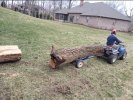
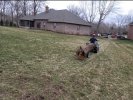
If your pulling an arbor trolley by hand, your doing it wrong.


Benefits of the 4 wheeler:
Less labor
Fast travel time
Less tracks in the soft yard than the mini
Allows the mini to stage the next log while one is in transit
 

Attachments

  • Screenshot_20210310-231917_Gallery.jpg
    Screenshot_20210310-231917_Gallery.jpg
    285.6 KB · Views: 44
  • Screenshot_20210310-231907_Gallery.jpg
    Screenshot_20210310-231907_Gallery.jpg
    294.7 KB · Views: 43
Pretty slick!

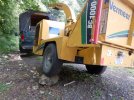
Along the same line of thought, I have a smaller chipper and have trouble filling the top corners in front of the chip box, so if I need to squeeze in those extra few feet of chips, I’ll unhook the chipper and crank the trailer jack as high as it goes.
 
Last edited:

New threads New posts

Kask Stihl NORTHEASTERN Arborists Wesspur TreeStuff.com Teufelberger Westminster X-Rigging Teufelberger
Back
Top Bottom