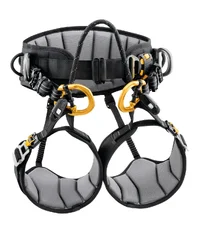
Time for a tested, trusted, non-proprietary harness bridge cordage


I have have no criticism of Teufleberger. They make great products and it's their call how they manage safety and potential legal issues. I simply think there's an opening for a rope manufacturer to build an awesome high-strength bridge in a few different diameters.

As far as Dyneema core bridges go, yes, super slippery fiber. Stitching on the tails of a stopper knot anchored bridge make huge sense. From a practical point of view, if the stopper is well set and sufficient tail is left on the outside of the stopper, a core is not going to have a chance to slip through the stopper, UNLESS the cover fails. The cover is obviously very easy to inspect. Stitching adds a second layer of security.

Let's not underestimate the intelligence and concern for safety that the vast majority of professional tree climbers possess. We all know the activities in arboriculture that have the greatest probabilities of causing injury to climbers: running chain saws, rigging gone bad, using hand saws, TIP failures, and the list goes on. Climbers have a near sacred attitude about their harnesses and climbing ropes. No one needs to tell a climber that their life is at stake every time they get off the ground. It is condescending to claim climbers need gear manufacturers to protect us from ourselves. We expect gear manufacturers to make well-tested quality gear. We know how to tie the knots. When we install rope bridges on our harnesses, it is not a casual activity, we understand what's at stake.
-AJ
 
Last edited:
Just a couple question is the cover stitched to the core necessary with globe 3000? Are they worried about the cover slipping? Wouldn’t that be prevented with the two scaffold knots?
Some high mod fibers are very slippery. It’s not exactly the knot spilling being the problem (of course it can if not tied properly), but it’s the slippery core pulling through the knot and leaving only the cover knotted. Some of these tech cords now call for a triple overhand or fisherman’s to prevent this.
Now in my personal opinion this is entirely bullshit and overkill, but there hundreds (if not thousands) of folks flying this gear on a daily basis. You can’t idiot proof every thing, but if you only allow x,y,z and document it, the lawyers are happy. I’m sure it would take a metric f-ton of force to cause any of this to happen, unless your stupid and don’t dress your shit out.
 
Some high mod fibers are very slippery. It’s not exactly the knot spilling being the problem (of course it can if not tied properly), but it’s the slippery core pulling through the knot and leaving only the cover knotted. Some of these tech cords now call for a triple overhand or fisherman’s to prevent this.
Now in my personal opinion this is entirely bullshit and overkill, but there hundreds (if not thousands) of folks flying this gear on a daily basis. You can’t idiot proof every thing, but if you only allow x,y,z and document it, the lawyers are happy. I’m sure it would take a metric f-ton of force to cause any of this to happen, unless your stupid and don’t dress your shit out.

Yep. It's really interesting to read analysis of small diameter cordage with high modulus fiber cores from the Caver community. Take New England Ropes 5mm Tech Cord for example, triple fisherman's is a wise choice. The chance of failing the cover in a dynamic loading scenario on a prussik made with 5mm NE Ropes tech cord is real. Once the cover fails you better have a very well set double overhand, or more smartly a triple overhand. For 10mm cordage with a high mod core used on a rope bridge, it is much less likely you're going to blow out the cover on an unexpected drop. No one is calling for triple overhand stoppers on arb harness bridges. If there was a need for them they'd be the default on the Tree Motion. Apples and oranges, we have to be careful not to assume that a "rule" for one type of cordage and use will therfore apply across all similar contruction cordage and uses. This is how myths are made that have no actual basis.
-AJ
 
But it's not like strength is "more is better", there is a point of diminishing returns, and then a point of pure absurdity also. A 5600lb rope can cut you in half, or break your back. I don't need a 10,000lb rope for a bridge. I don't even understand you wanting one. I did however, make a backup rope bridge on my sequoia. It gives me a feeling of assurance, as the loose stitching in the oem bridge made me uneasy.

Yes, the Petzl OEM bridge stitching used to be uninspiring, haven't seen what they offer these days, if it's better or the same.

I hear you about diminishing returns but the Tree Motion stock bridge meets those extraordinary specs. I'm fine with that and I'd like to see something available from other sources that meets those same specs. I'm really talking about climber demand and a market opportunity.
-AJ
 
Would the simplest answer be for manufacturers to just require double braid class 1 climbing lines that meet relevant standards (ANSI, CE) be used as bridge, and replaced upon first signs of wear or within 6 months whichever comes first? If manufacturers are not comfortable selling HMPE kernmantle lines without stitching, then it would be impossible to sell a rope bridge line by the foot (unless they sold twine with instructions to whiplock, like when vectran core beeline is sold in bulk).

I agree there is certainly a market opportunity, but i'm sure it is very complicated trying to create a rope bridge that would be compatible with all of the varying harnesses; size requirements, termination points, etc.
 
Just thinking of something I have read in another thread...I believe Kevin Bingham @treebing said he used core-less 16 strand for his home made rope saddle. Possibly even his bridge. Might fit the 10 mm requirement and is completely cover defendant.
 
I wonder if we'll see more manufacturers shift to a proprietary means of attaching rope bridges in the near future?

Don't know if it's a trend. Both Petzl and Teufleberger have introduced a kind of stitched eye stopper, Petzl is taking advantage of their "open ring" design and created an open D so that a bridge with pre-sewn terminations can be installed.
58466
 
I just spoke to a guy at Iron Street (Wesspur's splicing service), asking if they can stitch the ends of Platinum 10.5, the same way TreeMotion does on their green ropes used on their bridges to stop milking. For liability purposes, they don't presently do this kind of custom stitching, but Wesspur does sell replacement rope bridges for TM and other saddles.
 
Last edited:
Let's not underestimate the intelligence and concern for safety that the vast majority of professional tree climbers possess. We all know the activities in arboriculture that have the greatest probabilities of causing injury to climbers: running chain saws, rigging gone bad, using hand saws, TIP failures, and the list goes on. Climbers have a near sacred attitude about their harnesses and climbing ropes. No one needs to tell a climber that their life is at stake every time they get off the ground. It is condescending to claim climbers need gear manufacturers to protect us from ourselves. We expect gear manufacturers to make well-tested quality gear. We know how to tie the knots. When we install rope bridges on our harnesses, it is not a casual activity, we understand what's at stake.
-AJ

Moss, I think you and the people on here are the 1%. It is far from representative of every person on earth that had the bright idea yesterday that they could buy some gear, climb a tree, and make some money tomorrow.

As a seller of gear, I come across this all the time. There is no shortage of those who are oblivious to almost every aspect of safety - no clue. They saw someone do it once, they got an estimate for some work at home and figured how hard can it be. I get this every single day.

I also come across those who have climbed as a full time job for 15 years and still have no clue. They know how to do it, but don't understand any of their equipment. They've never read a thing about it, just learned on the job from someone who is also self-taught on the job. If you untied their VT they wouldn't know how to retie it. They don't know how or what anything is made of, or it's limitations.

Those people are why manufacturers have to cater to the lowest common denominator.

 
I just spoke to a guy at Iron Street (Wesspur's splicing service), asking if they can stitch the ends of KMIII Max 10.5, the same way TreeMotion does on their green ropes used on their bridges to stop milking. For liability purposes, they don't presently do this kind of custom stitching, but Wesspur does sell replacement rope bridges for TM and other saddles.

My current “outburst” started a couple weeks back because it’s time to retire my current OEM Tree Motion bridge. I went online to order and Wesspur, treeStuff and a couple other retailers had the bridges on back order. Fired me back up again on the issue.

Back when Globe 3000 was available by the foot I’d build my own. Sometimes I locked the core after the stopper with stitching, sometimes not. A well set stopper, sufficient tail, and I never had the slightest problem. I know many other climbers installed their own Globe 3000 bridges. I’ve never heard of a tree climber accident because the tail or core slipped through on a Globe 3000 climber installed bridge. If anyone knows of such an incident please chime in.
-AJ
 
Moss, I think you and the people on here are the 1%. It is far from representative of every person on earth that had the bright idea yesterday that they could buy some gear, climb a tree, and make some money tomorrow.

As a seller of gear, I come across this all the time. There is no shortage of those who are oblivious to almost every aspect of safety - no clue. They saw someone do it once, they got an estimate for some work at home and figured how hard can it be. I get this every single day.

I also come across those who have climbed as a full time job for 15 years and still have no clue. They know how to do it, but don't understand any of their equipment. They've never read a thing about it, just learned on the job from someone who is also self-taught on the job. If you untied their VT they wouldn't know how to retie it. They don't know how or what anything is made of, or it's limitations.

Those people are why manufacturers have to cater to the lowest common denominator.

I hear you. Then again I don’t think people who can’t tie their climbing hitch are trying to install rope bridges on their harnesses. I must be meeting the wrong arborists, the majority that I run into are savvy and pay attention to safety.
-AJ
 
My current “outburst” started a couple weeks back because it’s time to retire my current OEM Tree Motion bridge. I went online to order and Wesspur, treeStuff and a couple other retailers had the bridges on back order. Fired me back up again on the issue.

Back when Globe 3000 was available by the foot I’d build my own. Sometimes I locked the core after the stopper with stitching, sometimes not. A well set stopper, sufficient tail, and I never had the slightest problem. I know many other climbers installed their own Globe 3000 bridges. I’ve never heard of a tree climber accident because the tail or core slipped through on a Globe 3000 climber installed bridge. If anyone knows of such an incident please chime in.
-AJ
Totally understand this.

I'm still nervous at TCCs as there are only a few MB or Onyx saddles down here and almost everyone else flys a TM. I carry my saddle manual with me showing the manufacturers replacement bridge instructions and rope spec.

If Newtribe can do this, I can't see why others can't.

That said, or major TM supplier brings space Bridges to the comps and I doubt would ever let stock go so low so to run out.

Is Teufelberger stuffing up? If so, that's really really poor.
 
Totally understand this.

I'm still nervous at TCCs as there are only a few MB or Onyx saddles down here and almost everyone else flys a TM. I carry my saddle manual with me showing the manufacturers replacement bridge instructions and rope spec.

If Newtribe can do this, I can't see why others can't.

That said, or major TM supplier brings space Bridges to the comps and I doubt would ever let stock go so low so to run out.

Is Teufelberger stuffing up? If so, that's really really poor.
I just glanced at the onyx user guide, but didn’t see anything about bridge replacement. What does the full manual say?
 
I just glanced at the onyx user guide, but didn’t see anything about bridge replacement. What does the full manual say?
Manual has rope type and stopper knot including instructional pictures.

I think the full manual is online in PDF format.
 
Totally understand this.

I'm still nervous at TCCs as there are only a few MB or Onyx saddles down here and almost everyone else flys a TM. I carry my saddle manual with me showing the manufacturers replacement bridge instructions and rope spec.

If Newtribe can do this, I can't see why others can't.

That said, or major TM supplier brings space Bridges to the comps and I doubt would ever let stock go so low so to run out.

Is Teufelberger stuffing up? If so, that's really really poor.
I just glanced at the onyx user guide, but didn’t see anything about bridge replacement. What does the full manual say
Manual has rope type and stopper knot including instructional pictures.

I think the full manual is online in PDF format.
Hmmm, I just looked at two guides, one linked to treestuff and one on New Tribes website. The one linked to treestuff has a heaving line knot, the one on new tribe has a double overhand. Neither of them list what rope to use, unless I’m missing something. I know wespur lists that it comes with 10.5mm Teufelberger platinum, but you would think the user guide should have replacement suggestion.
 

New threads New posts

Back
Top Bottom