monkeylove
Been here much more than a while
- Location
- Roslyn, Pa.
That's it John I'm unfriending you on facebook. Oh wait I don't have facebook. Wow are you lucky, I guess we can still be friends then. 

Follow along with the video below to see how to install our site as a web app on your home screen.
Note: This feature may not be available in some browsers.

Oh I've dreamed of the Akimbo, it gives me super powers... I don't think I'll be let down either.Oh, bummer, because for a second there I was thinking I wasn't the only one.


Mmmm...... Gear Porn!!Hey, no gear porn... this a family channel... kids could be watching, and the price of Xmas would skyrocket.


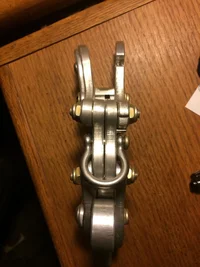
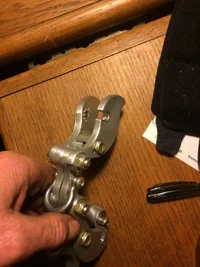
So. First destructive test results are in. Just one unit tested and broken so far but very informative. First it was pulled to slipping, then it was rigged with a biner in the bottom and a biner around the top eccentric pin and pulled to breaking. It slipped around 500-700lbs and it broke around 3500lbs. the way it broke was the machine screw head popped off of the eccentric pin on the slot side, allowing the pin to bend out of the slot and ultimately break. easy fix for that is to machine the pins with an integrated head rather than a screw. im also thinking another test is in order with a different setup. im thinking another setup might be to set the Akimbo on a rope and spike the rope beneath the upper arms. that would come closest to realistically loading the unit. thoughts?
oh man...it's even pretty when it is broken. ...so, what are the broken ones going for...

Do you feel it inside, deep in your heart, when it broke? I can't even imagine. Good on you.So. First destructive test results are in. Just one unit tested and broken so far but very informative. First it was pulled to slipping, then it was rigged with a biner in the bottom and a biner around the top eccentric pin and pulled to breaking. It slipped around 500-700lbs and it broke around 3500lbs. the way it broke was the machine screw head popped off of the eccentric pin on the slot side, allowing the pin to bend out of the slot and ultimately break. easy fix for that is to machine the pins with an integrated head rather than a screw. im also thinking another test is in order with a different setup. im thinking another setup might be to set the Akimbo on a rope and spike the rope beneath the upper arms. that would come closest to realistically loading the unit. thoughts?
I think there are a few important tests. You need to know the strength of the attachment point. In order to do that, you need to spike below the unit and pull to failure. Something will break...maybe the rope.So....thoughts?
That's great. Might be a lengthy measure, but it sounds like it may be a good idea to write diameter ranges into the device so the user has a visual while adjusting during a climb. That would take a bunch of testing with various ropes, but I feel it's a realistic effort, and worth while.some drop testing has been done as well and it behaves just as you would hope. it slips some distance and slows to a stop. distance depending on rope and setting.

That's what I was getting at. I just think the climber needs a bit of clarity in one way or another. I don't know what the Akimbo is like to hold and adjust. I'm speculating.There will be some sort of notation on the adjustments. I shy away from printing numbers there as DSmc says, it is impossible to predict settings for all of the ropes out there. Some system of symbols or pictograph communicating increased or decreased friction/holding power seems appropriate. My ultimate plan is to partner with a rope company and come up with some tested combinations that can be relied on for consistent and repeatable results. Not unlike treemagineers ce systems. It wouldn't mean that you couldn't use any rope you want, but it woul give the option of a certifiable and tested system.