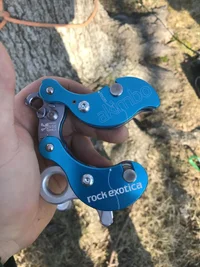
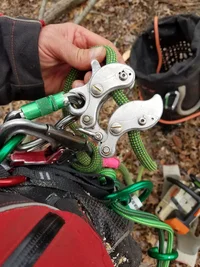
I was not part of the GoFundMe process, but I ordered an Akimbo from TreeStuff on November 8, and it arrived late yesterday. It is an impressive looking piece of gear. It's elegant, cleverly designed, well made and downright pretty. It took me a little while to figure out how to open it. It must be stretched out in a straight line before the double-scissors action will allow it to open, so it can't possibly open during use. I love how small and compact it is.
I spent about an hour or so with it this morning going up and down about 20 feet many times to get it dialed in to my well-worn, fuzzy Yale Tropical Ivy 11.7 rope. I set the friction on the lower arm to the max at first but could not stuff my rope into position between the bollard and the cam without using lots of force. So, I loosened it a bit until I could get it into position more easily and ended up staying with that setting.
On the upper arm, I had more trouble. No matter which friction setting I used, the arm would not hold on to the rope after I would stop my ascent, so the entire Akimbo would want to fall freely down the rope. Not a big deal since I can easily pull up on the upper arm slightly or simply lean back a little and let the tending point pull it back slightly and cause it to hold. But still, not what I wanted. Later, I learned that the upper cam, which is spring loaded, was stuck. I believe it was evo who also mentioned having that problem. The cam was working fine on arrival, but after just a little use, it was sticking badly. I gave it some graphite lubricant and loosened it back up, but I don't know if I can trust it not to get stuck again. Hopefully someone will correct me if I am wrong, but I believe the only effect of a sticky upper cam is that it will make it less likely that the Akimbo will automatically grab the rope when you stop your ascent. The spring simply puts the cam closer to the rope so that the upper arm will engage the rope. That is easily remedied, and descent should not be affected at all.
Generally, the higher the friction setting on the upper arm, the harder it is to pull the upper arm down for descent. And the higher the friction setting on the lower arm, the less room you will have available to pull down the upper arm without hitting the lower arm. My first instinct was to hold the Akimbo for descent with my fingers in line with the upper arm and palm facing toward it, but I quickly found the palm of my glove getting pulled up into the lower arm. So, I turned my hand 90 degrees to the side and used my fingers across the upper arm. Maybe other users have better suggestions.
The most serious problem I had with it today was simply seeing which friction setting I was on. This is a problem that has no effect on the functionality, but I found it very annoying for initial setup and was glad that this should not need to be adjusted often. I needed reading glasses and strong lighting to see exactly where the registration pins of the bollard were. Plus, unless you hold the bollard in position when you remove the lock arm, it will fall out of position. So I struggled mightily and often trying to make adjustments to the friction. I can feel it well enough to very carefully pull it out and turn it slightly until the pins fall into the next holes, but one slip, and I don't know where I am anymore. What I would like is for the tops of the registration pins to be white so I can see them in their dark holes without glasses and strong lighting.
Other than those problems, it worked very well. It tends easily and descends smoothly and in control. I love how compact it is and how easily and quickly it goes on and off the rope. Overall, it's a winner.