The Seesaw System

Watched Richard's video and also have followed John's descriptions. Aside from any considerations of actual (and perhaps questionable!) practical use, there does seem to be the possibility of some considerable mechanical advantage as long as the fulcrum of the seesaw is fixed and if the rope is affixed near the fulcrum and not out at the ends where the guys are sitting on it. If the rope is affixed, for instance, one foot out from the fulcrum on each side, and each side of the seesaw is ten feet long, with a 200 pound climber each seesaw guy would have to push up with his legs only approx. with 20 pounds of force, not considering complexities like friction over a limb, etc, some of which can be somewhat eliminated by using a ball bearing pulley shiv of sufficient diameter at the TIP. The concept is interesting to examine but I think the guys would have to seesaw pretty fast for this to be of any practical use other than simply fun at an event or the like. One limitation that I can see is that the rope would have to be tight throughout the whole system, with no slack in play while the seesawing is going on, and this would make the ascenders rather difficult to disengage from the rope once the climber was at height and also the system itself not available or usable for any moving around in the canopy. One would need to carry up another system to use at height. Right, let's say the seesaw system was mechanized somehow, as you suggested, John. Maybe a portable engine driving an eccentric to reciprocate a smaller, more compact and faster seesaw that could be affixed to the tree. Then, a series of climbers could be sent up all at one time, one after another. Although the rope is moving back and forth, it is essentially staying largely in place and you would not be limited to only one climber ascending at a time as you are with other power ascending systems. You could have any number going up at the same time, one right above the other, assuming enough power in the drive to the seesaw. The system however, comes to a stop as soon as the highest climber's ascender hits the TIP and that device (or pair of devices) would have to be removed so the next climber below him (or her) could come all the way to the TIP. Seems like a rather curious idea but fun to contemplate. Actually might have some use in sending a team up a really long ascent like one of those 300 footers in California or Australia, where you wanted to send them up quickly all together without waiting for each climber to get all the way up to the TIP before the next guy could use the power ascender. Now, we need yet another new acronym for this of course!!!!!
 
Watched Richard's video and also have followed John's descriptions. Aside from any considerations of actual (and perhaps questionable!) practical use, there does seem to be the possibility of some considerable mechanical advantage as long as the fulcrum of the seesaw is fixed and if the rope is affixed near the fulcrum and not out at the ends where the guys are sitting on it. If the rope is affixed, for instance, one foot out from the fulcrum on each side, and each side of the seesaw is ten feet long, with a 200 pound climber each seesaw guy would have to push up with his legs only approx. with 20 pounds of force, not considering complexities like friction over a limb, etc, some of which can be somewhat eliminated by using a ball bearing pulley shiv of sufficient diameter at the TIP. The concept is interesting to examine but I think the guys would have to seesaw pretty fast for this to be of any practical use other than simply fun at an event or the like. One limitation that I can see is that the rope would have to be tight throughout the whole system, with no slack in play while the seesawing is going on, and this would make the ascenders rather difficult to disengage from the rope once the climber was at height and also the system itself not available or usable for any moving around in the canopy. One would need to carry up another system to use at height. Right, let's say the seesaw system was mechanized somehow, as you suggested, John. Maybe a portable engine driving an eccentric to reciprocate a smaller, more compact and faster seesaw that could be affixed to the tree. Then, a series of climbers could be sent up all at one time, one after another. Although the rope is moving back and forth, it is essentially staying largely in place and you would not be limited to only one climber ascending at a time as you are with other power ascending systems. You could have any number going up at the same time, one right above the other, assuming enough power in the drive to the seesaw. The system however, comes to a stop as soon as the highest climber's ascender hits the TIP and that device (or pair of devices) would have to be removed so the next climber below him (or her) could come all the way to the TIP. Seems like a rather curious idea but fun to contemplate. Actually might have some use in sending a team up a really long ascent like one of those 300 footers in California or Australia, where you wanted to send them up quickly all together without waiting for each climber to get all the way up to the TIP before the next guy could use the power ascender. Now, we need yet another new acronym for this of course!!!!!
AC/DC

So, anyone going to be at Charlotte comp? We can make this system (I have the gear) with 2 ZigZags and a good pulley, pull the whole system into the tree with a lower-able base anchor, (Rig), lift a small kid into the tree using two people on the ground with foot ascenders on the ends of the rope taking turns.
You are right, one rope that does not really leave the ground and although the ZZ are not mid-line detachable a Uni would be.
Sorry John, we will have to work out the SeeSaw later.
 
Richard, you have an eye on each end of that rope in the photo. How do you get the ZZ's on and off? Do they simply live on that rope permanently?
 
AC/DC

So, anyone going to be at Charlotte comp? We can make this system (I have the gear) with 2 ZigZags and a good pulley, pull the whole system into the tree with a lower-able base anchor, (Rig), lift a small kid into the tree using two people on the ground with foot ascenders on the ends of the rope taking turns.
You are right, one rope that does not really leave the ground and although the ZZ are not mid-line detachable a Uni would be.
Sorry John, we will have to work out the SeeSaw later.
I'm not completely sold on the seesaw idea anyway, but the idea of some sort of carbon-neutral fuel source, powered by an augmented human, using levers, pulleys and stuff to create a ground-based MA sounds great.

While the next best thing is probably an electric drill powered or hand powered GRCS, using a rigging line to haul climbers while they remain attached and backed up onto their primary climbing line, I don't know any rec climbers that have an extra GRCS laying around, with the drill and the custom GRCS drill bit.
 
Last edited:
If this system were to work, one would be taking advantage of dynamic force. Consider all three parties are of equal weight and the teeter totter perfect balanced and no friction. The height of the load drop would dynamically pull the climber up and push the opposite load up a wee bit. Not a true MA system by any means but a dynamic load system.. now we just need some acronyms to simplify everything
 
yuUGtc0.jpg


I think there is no question that a double sided ascender would work. wether it would be practical is another thing. There is only one way to find out, so here is a double sided ascender concept underway (incomplete). This one is more of an inline multicender, rather than the side by side ascenders in my movie.

This would work too, but the device is not bi-directional.

asc189-500.gif
 
At the Charolotte meet, here's a good technique for the groundies as they haul the climber up on a doubled seesawing moving rope (That's a "DdSMR") ! Would two people jumping up and down on a trampoline work well too?
 
Last edited:
It seems like every scenario so far, minus an electric motor has been a group effort to get the climber in the tree. If you have a group of guys you may be best off working together to hoist a counterweight to the tie in point with a rigging rope, preferably 20 or so pounds lighter than the climber, then attaching that to the climber. The climber then only has to climb with 20lbs of resistance instead of the full body weight.

You'd likely be able to pull yourself into the tree 10 feet or more at a time using just arm strength by grabbing the rope or tree. Essentially you can move vertically as far as you can throw 20 pounds. (In theory, I haven't tried this, but it sounds fun)
 
You'd likely be able to pull yourself into the tree 10 feet or more at a time using just arm strength by grabbing the rope or tree. Essentially you can move vertically as far as you can throw 20 pounds. (In theory, I haven't tried this, but it sounds fun)
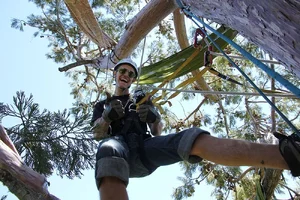
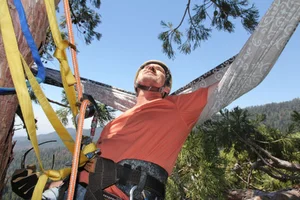
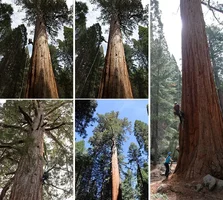
I've had the opportunity to climb a Redwood with a human counterbalance. I sailed up the 275' Sequoia with ease, with the aid of my instructor, at times using a one handed ascent, as you described. I had thrown out my back just days earlier, so the assisted climb was a rare and special gift I'll never forget and always be grateful for.
 
Well now yo yo needs to make a super light fold away teeter totter to travel with...my grandfather was an inventer and builder, rip. wish I could bring u guys in his old shop.
Anyways the seesaww he built for us kids 35 years ago and its been left outside in all weather and the wood you sit on has ZERO rot and anything metal has zero rust. I assume he must have use the best material and coated the shit out of it with weather proofing stuff but I cannot believe how well it looks today...I was just there days ago trimming grandmas white pines, she's 92. He died in his 60s and had alcohol issues real bad for the last 30-20 years alive so I really wish I could have been around to learn from him and his builds....
 
Wrapping my head around this discussion. How I may potently develop it into my climbing craft, should the opportunity ever present it's self. I'm failing to see any major advantages thus far, but I like learning things like this just to learn them.

@John@TreeXP How did he counter weight you? That sounds dreamy.


On a some what perhaps relatable note.

With a srt system tail temporally basal tied, so I have zero tending. I have had used a rigging line on a block, attached to my bridge, with a few dudes pulling. To zip me up trees after lunch. They have nothing to do with my climbing system, there can be no slack. So even if they let go, I simply stop and load my climbing system.

I have to yell at them to stop as I approach the TIP, they love seeing how fast they can make me fly up. I love being lazy and having fun. I feel totally safe. Depends on the tree and climb / rigging points, if it is reasonable. Trusting the ground people and including them makes everyone feel connected. It takes them very little effort, judging by how fast I go and how eager they are. It is a 1:1 system. But if I'm 180 geared and there is three guys pulling. With their feet on the ground using their legs, leaning forward on the rope. They only have to over come ~60lbs of force. I have encouraged other climbers to try it when I'm groundy. No takers thus far.
 
With a srt system tail temporally basal tied, so I have zero tending. I have had used a rigging line on a block, attached to my bridge, with a few dudes pulling. To zip me up trees after lunch

Works great with a mini skid too, instead of multiple guys. If you wanted to go faster, or didn't have the travel room it wouldn't be hard to create a 2:1 disadvantage for the mini to pull you. For every foot the mini drives, the climber goes up two.
 
@John@TreeXP How did he counter weight you? That sounds dreamy.
The instructor was using a secondary rope, attached by pulley to the tip near the top of the Redwood. He was connected to one end and I the other. As he descended, I used his weight and being heavier than him by about 75 lbs, I was able to make the aided ascent with far less effort. We both had our own primary climbing system, so neither of us were jeopardizing our safety if anything went wrong with the counterbalance line. From the ground, it took me about 30 minutes to reach the TIP at about 270.

Mark, with the beard, was my instructor doing the counterbalance, and Brian greeted me at the TIP.
 

Attachments

  • IMG_0885.webp
    IMG_0885.webp
    210.5 KB · Views: 17
  • IMG_0732.webp
    IMG_0732.webp
    425.7 KB · Views: 17
  • IMG_0865.webp
    IMG_0865.webp
    312.6 KB · Views: 18
  • IMG_0963.webp
    IMG_0963.webp
    503.6 KB · Views: 17
  • 14 - Copy.webp
    14 - Copy.webp
    236 KB · Views: 15
Last edited:

New threads New posts

Back
Top Bottom