The Seesaw System

Still haven't even told me how the guys on the ground are moving both those ascenders upwards while one end of the rope goes up and the other end goes downward. I'm assuming the climber assists but please give me a better explanation or I'm thinking this isn't ever going to work or be even close to the standard srt and dbrt systems already in use
Here's an example using RE's dual ascender. It's not a dual-multicender, but it illustrates how the rope moving back and forth can propel a climber upward. Using two foot ascenders can have the same effect, as well.
 
You said something to the gist of , on the ground is where the MA is realized....I think yo yo was right when he said you lose that advantage on the ground when you are hauling a climber as opposed to the climber hauling himself... Do u understand what he meant?
 
You said something to the gist of , on the ground is where the MA is realized....I think yo yo was right when he said you lose that advantage on the ground when you are hauling a climber as opposed to the climber hauling himself... Do u understand what he meant?
I may be wrong here, but I think if both sides of the seesaw each use a 3:1 or a 5:1 pulley system, the MA is reacquired at the base ... theoretically speaking.
 
Very tricky and gear intensive way to ascend but that's cool...I don't think I can add much to make it work but glad to see folks are trying...
 
I can picture something like this at a rec climbing event, an amusement park or a children's science museum. It can teach physics in a really engaging and fun way, or be set up as a way to get physically challenged people aloft. From a practical standpoint, I don't think your average tree crew would find this method practical, by any means. The design is scalable, as well, so it could even be packaged as an interactive educational children's toy, or perhaps digitized into a graphical computer game. It reminds me of a monkey climbing toy I never had when I was growing up.
 
Last edited:
I may be wrong here, but I think if both sides of the seesaw each use a 3:1 or a 5:1 pulley system, the MA is reacquired at the base ... theoretically speaking.
How do you figure this? Each groundie when pulling on the up leg is seeing the full weight of the climber. If the climber is doing all the work they get a 2:1. Sure all folks in the system can share the load, but having 100 groundies pulling on a rope isn’t 100:1 ma
 
How do you figure this? Each groundie when pulling on the up leg is seeing the full weight of the climber. If the climber is doing all the work they get a 2:1. Sure all folks in the system can share the load, but having 100 groundies pulling on a rope isn’t 100:1 ma
The counterbalanced weight of the seesaw, together with a MA, can offset the climber's weight and do the heavy lifting, but the weight of the climber would have to be proportionately less than the underlying support system, in order to work effectively. Another way is to imagine two people pulling on a rope to ring a bell suspended in a bell tower, each time one person pulls down the other is pulled up.
 
Last edited:
Another way is to imagine two people pulling on a rope to ring a bell suspended in a bell tower, each time one person pulls down the other is pulled up.
That is exactly what I'm seeing in your drawing, however it's not a MA.. Now if each groundie is pulling a z rig, that's a MA but it would take quite the effort with a bunch of resetting... There are some counter weight systems out there, but it still requires lifting a load...
 
That is exactly what I'm seeing in your drawing, however it's not a MA.. Now if each groundie is pulling a z rig, that's a MA but it would take quite the effort with a bunch of resetting... There are some counter weight systems out there, but it still requires lifting a load...
I suppose the next logical step is to build a small but scalable prototype to get everything dialed in. Everything is theoretical at this point.

I don't envision the seesaw rider/groundies having to lift anything or anyone. They simply use their legs to move the seesaw down to up, and the seesaw does the actual pulling of the rope, back and forth. The climber's weight would effect the downward motion of the seesaw, but the augmented weight of the seesaw's counterbalance being sufficient enough to support the climbers weight, would create the lift. The counterbalance weight could be adjustable, enough so to support the weight of each respective climber and the more I think about it, the counterbalanced weight may need to shift from one side of the seesaw to the other, as it rises and falls.
 
Last edited:
I suppose the next logical step is to build a small but scalable prototype to get everything dialed in. Everything is theoretical at this point.

I don't envision the seesaw rider/groundies having to lift anything or anyone. They simply use their legs to move the seesaw down to up, and the seesaw does the actual pulling of the rope, back and forth. The climber's weight would effect the downward motion of the seesaw, but the augmented weight of the seesaw's counterbalance being sufficient enough to support the climbers weight, would create the lift. The counterbalance weight could be adjustable, enough so to support the weight of each respective climber and the more I think about it, the counterbalanced weight may need to shift from one side of the seesaw to the other, as it rises and falls.
So your really putting people ona teeter totter!
 
Hate to say it but I feel you have unrealistic expectations. The teeter totter will not provide any free energy.

That is to say that the amount of work will still be the same, if you are lifting 200 lbs up the tree each person on the teeter totter will have to do half of the work plus frictional losses.

A teeter totter is only effortless because the two users weight offsets and no real work is being done.
 
Hate to say it but I feel you have unrealistic expectations. The teeter totter will not provide any free energy.

That is to say that the amount of work will still be the same, if you are lifting 200 lbs up the tree each person on the teeter totter will have to do half of the work plus frictional losses.

A teeter totter is only effortless because the two users weight offsets and no real work is being done.
I disagree. The purpose of the seesaw is to simply move the rope forward and back, or up and down in small increments. The weight of the seesaw's ends, including the rider's weight, being in excess of the climber's weight enables the lift. The rope's movement goes from one extreme to the other, with the leveled (center point) being zero (unweighted). As one side rises, one side of the rope moves up, the other down, in an alternating way.

Until I prove or disprove my theory with a functioning mock up design, it's hard to say if it will fail, or not, but whether it's a seesaw or some other means by which the rope is moved up and down, once that occurs, the climber's dual multicenders will enable ascension to occur.

 
I disagree. .... The weight of the seesaw's ends, including the rider's weight, being in excess of the climber's weight enables the lift. .... As one side rises, one side of the rope moves up, the other down, in an alternating way......
I think you are on the path of trying to prove the illusive perpetual motion machine.
If the weight of the rider is in excess of the climber, that might provide for one pull but then the recovery to do it again is where the work must be done. Again, there is no free lunch. Maybe I'll do a short vid to try to explain.
 
I think you are on the path of trying to prove the illusive perpetual motion machine.
If the weight of the rider is in excess of the climber, that might provide for one pull but then the recovery to do it again is where the work must be done. Again, there is no free lunch. Maybe I'll do a short vid to try to explain.
I understand your point and thats why a moving weight that shifts from one side to the other appears to be abundantly necessary, in order to provide the counterbalance needed to offset the climber's weight. The same principle applies when person on a swing shifts forward and back to increase the swing's arc. The not so free lunch occurs when the rider uses their legs and pushes up on the seesaw, aided by the shifting counterbalance weight.
 
.... The not so free lunch occurs when the rider uses their legs and pushes up on the seesaw, aided by the shifting counterbalance weight.
but actually, that pushing up on the legs IS the work being done. On a seesaw or swing set there is lots of movement but in reality very little work being done, just overcome some friction on the fulcrum or suspension point. What your talking about doing is lots of work, the work-energy principle, no way around that when we are fighting gravity.
 
Last edited:
yuUGtc0.jpg


I think there is no question that a double sided ascender would work. wether it would be practical is another thing. There is only one way to find out, so here is a double sided ascender concept underway (incomplete). This one is more of an inline multicender, rather than the side by side ascenders in my movie.
 
Richard, Thank you for the detailed analysis and I am in complete agreement with you. In my vague and ambiguous drawing, and in my mind, the fuel source is the two seesaw rider's sets of legs, taking turns alternating on the upward push needed to haul the climber up the two lines. How much or little of the climber's weight is mitigated when being hauled up by each of the two lines is something we can address in the way of adding ground based MA's using pulleys and levers, or other augmentations that would lessen the load on the respective rider who is pushing off the ground. I understand there are no free lunches and there might be a better way to skin the cat or to achieve the necessary pulling and pushing force needed to haul the climber up the doubled moving rope, possibly using a large rotating wheel with each leg of rope connected to opposing sides to create a peddling like motion, operated either electronically or manually, but ultimately powered by a fuel source of some sort.

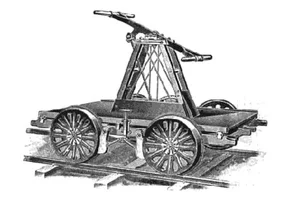
Your cartoon, in fact, illustrates how energy and gravity or centrifugal forces are obtained by a human fuel source, thereby enabling the push car to roll along the train track. I too prefer a carbon-neutral approach and my idea uses a similar principle, but relies more on gravity and counterbalance weights to assist with the required hauling force generated by a push-me-pull-me system.

Another workaround might be to enable four riders to use the seesaw system, two on each side while playing tug-of-war.
 
Last edited:
I disagree. The purpose of the seesaw is to simply move the rope forward and back, or up and down in small increments. The weight of the seesaw's ends, including the rider's weight, being in excess of the climber's weight enables the lift. The rope's movement goes from one extreme to the other, with the leveled (center point) being zero (unweighted). As one side rises, one side of the rope moves up, the other down, in an alternating way.

Until I prove or disprove my theory with a functioning mock up design, it's hard to say if it will fail, or not, but whether it's a seesaw or some other means by which the rope is moved up and down, once that occurs, the climber's dual multicenders will enable ascension to occur.

I scored in the 99 percentile in physics on my SATs so I am pretty solid on this stuff.
 

New threads New posts

Back
Top Bottom