The Neighborhood Super Swing

FreeFallin

Branched out member
Location
Wisconsin
Looking for advise from the group. I have hung swings, built tree houses and zip lines all my life for myself and now my kids, I have an opportunity to hang an amazing swing in a healthy oak tree in front of my home.

The branch I have my eye on is about 5 inches in diametet at about 50 feet up with lots of clearance for swinging over the lawn below. My idea is to hang 2 lines (redundant) from a single point and hang a lightweight round rope web platform at the bottom for 1-2 people to lay on.

My questions:
1. Can this be done in a semi-permanent way that will not endanger the tree?
2. How would you attach? Tie around in a way that allows growth, or bolt through?
3. What rope would you choose? Must consider UV and the weather extremes of Minnesota, with the goal of a rope that will swing for 4-5 years.

Also please feel free to mock and then shun me, if you think this should never be done.
 
A strategy I've used to get excellent 360° swing range is to use a single rope through the upper part of the tree, then anchored at the base of the tree. I placed rope sleeves at the friction points were the rope contacts limbs/branches in the tree. This allowed me to redirect the rope above the swing location through a fork in a strong horizontal limb, as opposed to putting all the load on the limb. With a base anchor it's very easy to move up and down to adjust the height of the swing platform per weight of riders or to account for rope stretch. No need for any hard attachment to the tree. For your use I would use a static kernmantle rope like KMIII, 13 mm/1/2". It's very easy to release the base anchor, put a throwline on the end and lower the rope for periodic inspection. I had a 11mm New England Ropes Dragonfly semi-static set up this way for a single rope swing for a year. I recently took it down and inspected the rope, it is in excellent condition. Let me know if you want to see a sketch of the setup.

As far is UV degradation goes, if the rope is somewhat shaded by your oak during the spring/summer months when the sun is high, I believe the rate of damage will be fairly slow, at least judging by the rope I hung for a year in a similar situation. When you inspect the rope for UV damage run it through your hands, look for stiffness (compared to the feel of the rope new) in the cover fibers. You'll get more life from a kernmantle rope, the strength is in the core, the cover should be polyester, it will wage the fight against the UV.
-AJ
 
Last edited:
Hmmmm, hard to give advice without seeing the tree in question. Maybe find a local arborist to check it out with you and come up with a solid plan, I think there are some in your area ;)

I have used Yale Guardian for semi-permanent tree swings with great success. I like the KMIII idea also.

It's a good idea to take the thing down during the cold and wet winter when people are less likely to be playing outside anyway, it will help the gear last longer and be a good excuse to inspect everything, and you're sure to have an idea to make better next year anyway.

Inspections are the key to longevity and safety. My wife is afraid of tree swings because as a youngster she had a rope break just when she and her brother were at the top of the arc (max force), due to poor planning and subpar materials and possible overloading. Both kids were injured AND traumatized - not what you ever want to happen.

Oh, and welcome aboard matey!:club:
 
A strategy I've used to get excellent 360° swing range is to use a single rope through the upper part of the tree, then anchored at the base of the tree. I placed rope sleeves at the friction points were the rope contacts limbs/branches in the tree. This allowed me to redirect the rope above the swing location through a fork in a strong horizontal limb, as opposed to putting all the load on the limb. With a base anchor it's very easy to move up and down to adjust the height of the swing platform per weight of riders or to account for rope stretch. No need for any hard attachment to the tree. For your use I would use a static kernmantle rope like KMIII, 13 mm/1/2". It's very easy to release the base anchor, put a throwline on the end and lower the rope for periodic inspection. I had a 11mm New England Ropes Dragonfly semi-static set up this way for a single rope swing for a year. I recently took it down and inspected the rope, it is in excellent condition. Let me know if you want to see a sketch of the setup.

As far is UV degradation goes, if the rope is somewhat shaded by your oak during the spring/summer months when the sun is high, I believe the rate of damage will be fairly slow, at least judging by the rope I hung for a year in a similar situation. When you inspect the rope for UV damage run it through your hands, look for stiffness (compared to the feel of the rope new) in the cover fibers. You'll get more life from a kernmantle rope, the strength is in the core, the cover should be polyester, it will wage the fight against the UV.
-AJ

@moss love the base anchor idea, and using the swing limb like a redirect point, this tree is solid, but I still like the idea of shifting some of the load closer to the trunk. No need for a picture it's already in my head. This setup would not only make inspections easier but if we were to sell the house next year, the next guy won't need to shimmy up there to take it down. Thanks!
 
New England Ropes makes a special UV resistant version of KMIII.
It's black with small yellow specks in a spiral.

I like that, I have smaller swings up on 1" spiral poly now (yes, hardware store, don't judge) but they are only good for a couple of years before they start to flake from exposure and have to come down.
 
Hmmmm, hard to give advice without seeing the tree in question. Maybe find a local arborist to check it out with you and come up with a solid plan, I think there are some in your area ;)

I have used Yale Guardian for semi-permanent tree swings with great success. I like the KMIII idea also.

It's a good idea to take the thing down during the cold and wet winter when people are less likely to be playing outside anyway, it will help the gear last longer and be a good excuse to inspect everything, and you're sure to have an idea to make better next year anyway.

Inspections are the key to longevity and safety. My wife is afraid of tree swings because as a youngster she had a rope break just when she and her brother were at the top of the arc (max force), due to poor planning and subpar materials and possible overloading. Both kids were injured AND traumatized - not what you ever want to happen.

Oh, and welcome aboard matey!:club:

I agree, my kids will already need enough therapy as it is, no need to add fear of tree swings in there ;^). Using moss' base anchor configuration, taking it down in the winter is completely viable, no one wants to go for a swing in 40 below. I have hooks in the basement for that.
 
If you want redundancy go for 2 anchor points or some type of base tie like moss said.

If I can do regular inspections and even change the contact point between the rope and the tree, I might do without the redundant line, my thought was if someone couldn't get up there to inspect, and one line snapped it could save some bones.
 
Multiline II is also a great outdoor line with a cool aesthetic and good grip profile. I like the idea of a redirect for a 5" diameter branch. Two people swinging on the outside of that could provide a fair amount of force. It's something that has several factors involved, including the branch attachment, length of the limb, location of the rope installation, tree species profile, the way the rope is pull-tested, time of year, etc. Only a local arborist can really have a sense for the whole situation, imho.
 
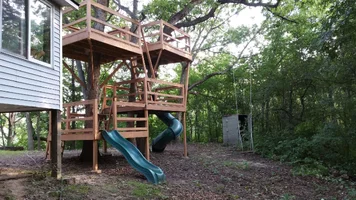
Thought I would share the last swing I hung a couple years ago, this one is only 20 feet, also in an oak. You can also see part of our 4 tier tree house and my youngest who desperately needed a push.
 
@moss love the base anchor idea, and using the swing limb like a redirect point, this tree is solid, but I still like the idea of shifting some of the load closer to the trunk. No need for a picture it's already in my head. This setup would not only make inspections easier but if we were to sell the house next year, the next guy won't need to shimmy up there to take it down. Thanks!
Base anchor sounds way too "iffy" for me ! ! !
Too many people are going to want to "inspect", play with it, undo backup knots or carabiners, or be just plain malicious !
You can't inspect it every time before someone gets on the swing.
 
Base anchor sounds way too "iffy" for me ! ! !
Too many people are going to want to "inspect", play with it, undo backup knots or carabiners, or be just plain malicious !
You can't inspect it every time before someone gets on the swing.

Hadn't considered that, I'm not too worried about anything malicious, we live at the end of a fairly secluded cul-de-sac with a few young kids and a lot if retirees so there will not be teenagers romping around on it randomly. But I do think it might be a good idea to keep the base anchor high, say 8 feet or so. That way I can inspect with a step ladder, but it will be out of reach for younger kids that want to do their own adjusting.
 
Hadn't considered that, I'm not too worried about anything malicious, we live at the end of a fairly secluded cul-de-sac with a few young kids and a lot if retirees so there will not be teenagers romping around on it randomly. But I do think it might be a good idea to keep the base anchor high, say 8 feet or so. That way I can inspect with a step ladder, but it will be out of reach for younger kids that want to do their own adjusting.

Yep, if you want the anchor out of reach but available to you for adjustments, just set the "base anchor" off the ground as you mentioned, you can always reach it with a short ladder when needed.

The tree I used had a heavy-duty gray squirrel presence, was a mast year for acorn production, I mean crawling with squirrels! People are often paranoid about leaving ropes set in trees because "rodents could chew the rope where you can't see it". My theory is that rodents love to chew on anything including rope that has had a lot of handling, salts from sweat embed in the rope, herbivores are constantly on the hunt for salts and minerals, the veggie diet doesn't provide much. Key is don't use a rope that's been climbed on alot. Rope without salt in it has a very low chance of being chewed.
-AJ
 
I completely agree with the squirrel concern.
Now, I know the swing is only a few feet off the ground, but then you may have "infants" on it.

In my area ( NE Ohio), I would not leave a life-support rope in a tree over-nite.
In the spring the squirrels chew through, and drop, LOTS of tender tree branches (mostly maples).
They have also chewed multi-sq-in holes in numerous Aluminum baffles for bird feeders ! ! !

Years ago, when I was practice climbing on my trees, I would remove the rope & just leave a throw line to easily reinstall the rope.
 
Last edited:
Trick is don't put your rope in the way of a squirrel and its food ;-) If the rope has nothing in it the squirrel wants to eat, it will not chew the rope, they have nothing to gain from polyester fibers. Squirrels eat tender cambium in the early spring because they're desperate for food after the winter. Likewise the aluminum bird feeder baffles, getting in the way of squirrel food!
 

New threads New posts

Back
Top Bottom