Tapered Hinge: Diar(y)rhea of a thread gone wrong and left un-moderated

Use Tapered Hinge against Side Lean?

  • Huh?

    Votes: 0 0.0%
  • Never

    Votes: 0 0.0%
  • Hardly

    Votes: 1 3.7%
  • Sometimes

    Votes: 15 55.6%
  • Preferably

    Votes: 7 25.9%
  • Religiously

    Votes: 4 14.8%

  • Total voters
    27
  • Poll closed .
......
The only physics involved here is the face cut, back cut and gravity. This discussion is so much deeper than just the tapered hinge. You are experienced, you know. Wood characteristics are not being taken into account....
.
i think we see like physics in similar articles.
>>and show similar compression/blue, nominal:yellow, tensions:red in rope.
>>to the logic if there is compression, fading to tension must have nominals/neutrals in the shifting gradient, to get from 1 side to the other.
.
in last pic have:
"*note: Dutch kerfs perpendicular to grain, bypassing 'slanted cut'"
because i think this is all physics and find the perpendicular cut to grain bypass leaves the fiber columns slam together to make inline column gives push,but if bypass is of a slanted cut, more likely to flex across close. If both cuts slanted, bypass both with straight cut perpendicular to grain incites push in face,more than extending either slanted. Just like always pointing to rope column, theories directly translate to fiber column etc.
.
Thus i think all these raw physics are applicable, in all trees, and things that can resist and bear these forces produced.
.
Species certainly is a factor, a limiting factor; but should always map the potential range first i think; then actuals, and why reduced within that range.
So all trees would have these forces, some species are simply overcome by them at some points and don't go the full travel.
.
Just as unintended full face kerf Dutchman overloads to become separate parts, by over ruling the constitution of the container internally. The separate parts are no longer a monolith of consistent flow but separate fighting 'plates' inside, that can jam rather than work harmoniously together as one. Otherwise full potential range of forces could play out, past this stopping point.
.
i think these tree forces are just normal forces that happen all around us daily, only put under a magnifying glass in this larger view of size and force. This better front seat view is part of the gift of fighting all this so long; then understanding other things thru it to then bring back to it in cycles. i think physics is involved in anything that moves etc.
.
These are the consistent forces, seen in all else, i claim trees are no exception; but actually more expressive, as more loaded. They might overload and blow out at different limiting points (like smaller fuse) that are good to know, but i believe the potential range of flow is as described as same circuitry logic forces race thru these systems.
.
Conditions of deadwood, temperature, brittle species etc. are other factors in mix, with similar limiting factors within the potential range; but each has explanation; and with similar physics of fail have pattern of their own within the domain of potential range.
.
"Simply shaping hinge towards triangular pointing at side force gives (some)directional offset ballast against a sideLean unless tree container overloaded so not monolith anymore" might be better title. Titled focus is simply Tapered Hinge, no one is saying this elixir will cure all ills, but it is a serious player in these scenarios.
.
Simply can be confusing, as is so consistent to even be exactly the same but different!
>>Hiding in plain sight!
.
In this bar of full grown bulls that pit themselves daily against the largest species and their forces, attitudes are better checked at the door. Might not be much left of some of us;but we all full grown, and to should be treated as such.
 
Last edited:
Perhaps there somebody here that would care to intelligently comment on the physics involved, specifically do you need the far corner of a hinge on the compression side when making a tapered hinge if the tree is not going to be big enough to compress that now missing corner
.
i think physics will be the amount of and intensity of tension fibers X leveraged distance/angle from compressed fibers as central pivot that has tree CoG leveraged on other side. Tension passively adjusts as long as can against load in balance of this 1st class lever(compressed pivot is BETWEEN load CoG and control tension fibers thus 1st class).
.
Seems to have played out okay here. But less leverage i'd think against sideLean than full breadth tapered across, or perhaps closer to this would be a center punched tapered.
>>If massive sideLean then pulled the face closed further than tapered hinge could be a Dutchman push from that heavy side across face, in concert with the tapered pull.
>>With not even a wisp of hinge fibers to extreme compression side as an anti-swing could even become /twist to swing Dutchman (?)
If the close was hard enough to become the most loaded point, and not jsut push in side, would claim that close as new pivot made mid-stream, with tension fibers previously formed by less leveraged suddenly has more. Increasing chance of swing function i'd think. Especially if tiered faces to true step dutchman.
.
But this isn't massive to draw in these parameters etc.; but that is what i see as potential; just not within this range.... Similarly can say again, a strip hinge can handle some light sideloading within it's framework, but could easily over load potential here, and tapered gives more range against side forces.
 
Last edited:
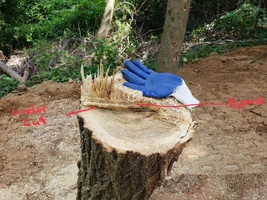
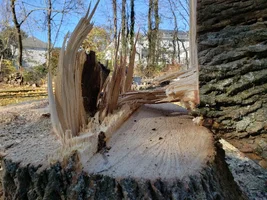
Those locust hinges are ugly. Ok maybe not the hinge as much as the bypasses on the face cut. If it was all that important why not fix it? You can see the flat marks the saw left behind and the hinge breaking behind it. I call it angry beaver syndrome, see it all the time with young guys. They attack the tree with the saw like it said a dirty joke about their mom. :X3:

The only physics involved here is the face cut, back cut and gravity. This discussion is so much deeper than just the tapered hinge. You are experienced, you know. Wood characteristics are not being taken into account. You show an ash tree... it was alive... do the same with a dead one. I don’t care how tapered you make it, compression, tension... its GONNA fail. Fell a tulip poplar today in this cold! Tell me how that goes for ya. Every single tree we fell is a one off success or one off failure. Only because there are no two alike. We gain experience with every one, so the next time we see something that looks similar, maybe we can make a similar cut and have a similar out come (or hopefully different if the last one failed).


There is no bypass on the face cuts my brother

Are you familiar with the plate cut I've shown it many times. .

That's what you're seeing not an angry beaver cut..

There are 2 locust hinges shown in my picture so not exactly sure which one you're talking about but none of them are sloppy all of my completely intentional exactly the way I wanted to hinge to look

And yes all those cuts include an understanding of wood characteristics species based which actually is why that ash and which held so well surprised me I've seen many ash hinges fail when I thought they would hold

this one held when I thought it would fail
 
There is no bypass on the face cuts my brother

Are you familiar with the plate cut I've shown it many times. .

That's what you're seeing not an angry beaver cut..

There are 2 locust hinges shown in my picture so not exactly sure which one you're talking about but none of them are sloppy all of my completely intentional exactly the way I wanted to hinge to look

And yes all those cuts include an understanding of wood characteristics species based which actually is why that ash and which held so well surprised me I've seen many ash hinges fail when I thought they would hold

this one held when I thought it would fail

6923A87E-84D2-4B0C-AC95-F8295FB9D015.webp
Photo credit to Daniel! You can call it what you want, the industry has its own words for it.

.
i think we see like physics in similar articles.
>>and show similar compression/blue, nominal:yellow, tensions:red in rope.
>>to the logic if there is compression, fading to tension must have nominals/neutrals in the shifting gradient, to get from 1 side to the other.
.
in last pic have:
"*note: Dutch kerfs perpendicular to grain, bypassing 'slanted cut'"
because i think this is all physics and find the perpendicular cut to grain bypass leaves the fiber columns slam together to make inline column gives push,but if bypass is of a slanted cut, more likely to flex across close. If both cuts slanted, bypass both with straight cut perpendicular to grain incites push in face,more than extending either slanted. Just like always pointing to rope column, theories directly translate to fiber column etc.
.
Thus i think all these raw physics are applicable, in all trees, and things that can resist and bear these forces produced.
.
Species certainly is a factor, a limiting factor; but should always map the potential range first i think; then actuals, and why reduced within that range.
So all trees would have these forces, some species are simply overcome by them at some points and don't go the full travel.
.
Just as unintended full face kerf Dutchman overloads to become separate parts, by over ruling the constitution of the container internally. The separate parts are no longer a monolith of consistent flow but separate fighting 'plates' inside, that can jam rather than work harmoniously together as one. Otherwise full potential range of forces could play out, past this stopping point.
.
i think these tree forces are just normal forces that happen all around us daily, only put under a magnifying glass in this larger view of size and force. This better front seat view is part of the gift of fighting all this so long; then understanding other things thru it to then bring back to it in cycles. i think physics is involved in anything that moves etc.
.
These are the consistent forces, seen in all else, i claim trees are no exception; but actually more expressive, as more loaded. They might overload and blow out at different limiting points (like smaller fuse) that are good to know, but i believe the potential range of flow is as described as same circuitry logic forces race thru these systems.
.
Conditions of deadwood, temperature, brittle species etc. are other factors in mix, with similar limiting factors within the potential range; but each has explanation; and with similar physics of fail have pattern of their own within the domain of potential range.
.
"Simply shaping hinge towards triangular pointing at side force gives (some)directional offset ballast against a sideLean unless tree container overloaded so not monolith anymore" might be better title. Titled focus is simply Tapered Hinge, no one is saying this elixir will cure all ills, but it is a serious player in these scenarios.
.
Simply can be confusing, as is so consistent to even be exactly the same but different!
>>Hiding in plain sight!
.
In this bar of full grown bulls that pit themselves daily against the largest species and their forces, attitudes are better checked at the door. Might not be much left of some of us;but we all full grown, and to should be treated as such.

Holy crap. I have a very hard time reading your material. I don’t know how it all works but is it a translation??
You are right there is quite a crowd of full grown bulls, but in farming you have to realize some bulls go to beef steaks and others go to breeding stock and others go to the rodeo!
 
As someone who has actually seen men die from making bad cuts, this is not a swinging dick contest, but the calling-out of someone who continues to show pictures of very subpar cutting practices over and over.
Overshot/bypassed undercuts, destroyed hinge, and a "fuck it, its good enough attitude" are how very bad things happen in this line of work. That's reality, and the renaming of a fucked up practice ain't gonna change that fact.
My wish is that you Daniel will go spend some time trying to get better at the stump before posting anymore pictures here. If not, please do us all a favor and stop posting pictures of subpar cutting here. Someone is going to see those picture, think you know what the fuck you are taking about, recreate those gawd awful cuts, and get themselves hurt or destroy valuable property!
 
Last edited:
I don't usually like sticking my below average dick in pissing matches like this, but I can see no good reason for cutting the compression corner of a tapered hinge. Bad things can happen quick even on small trees with strong fibers. At this point I feel like there is some serious Trolling going on with some of those pics!
 
Stumps are our signature, the ultimate business card, and evidence to the trained eye as to whether the person responsible knows what they are doing, or not.

To be blunt Daniel, your stumps are time and time again evidence that you need to seriously work on your skills at the stump. Ain't no shame in that. We all have weaknesses in our game that can be improved upon. Gawd knows I do. Since its important to me, I suck it up and do the work necessary to try and progress as a tree-man. Hopefully it will be that way until they toss dirt on my face.
 
Last edited:
Can't believe how much they killed off Flash
i found this last night and tried to convert several ways and made nearly impossible because can't find the authoring file, finally played in a window and screen captured to individual pix and had moviemaker sew back together was the only route... Won't be chasing any more as far, but have original authoring file for some.
.


.
i can tell drawings in msPaint are before 2000, ones on black background with these vector drawings are after 2004, feeling old!
 
Looks like Danny boy is editing his posts on this one. Anyone down for another drag show?

@Daniel Is this a cut you make all the time? Or is it reserved for certain species up to a specific diameter? Limbs? Side leaner? Head leaners you want to steer to the side? Back leaners your pulling over backwards? Are you pulling? Whole trees, or blocking?

@rico I too try my damnedest not to bypass, or make sloppy cuts. When I made the statement above I was mostly referring brushing out a path or felling zone. Sometimes limbing, when I just need a limb to start to swing a little then blast through the hinge to get it to do what I want.

I am getting tired of this freakin attitude, of holier than now crap. This shit is a perfect example why the larger world doesn't take our profession seriously. These self appointed experts, who teach dangerous sub-par crap to anyone who is willing to listen. I'm sick of these folks getting their jollies off this online teaching high horse. If some one wants to start a serious conversation about technique we get these youtube professors gumming up these threads. The air of arrogance, and with their 'innovative' techniques which are so advanced those west coast logger hicks might learn how to do real tree work.

I'm not saying we can't learn from each other, but all the baggage that comes with "I first mentioned this advanced method of felling back in '04, and now look I've changed a entire industry" attitude needs to go.
 
Wow,
i was commenting on my own folly of saying same stuff, ain't changed nothing as keep repeating! Also growth thru teaching self drawing like this, i never could draw, brother always could free hand, admit i was jealous!
.
i struggled to learn wherever i could.
Dent's little book was an eye opener, just couldn't see it at first.
>>his little drawings i didn't understand at first even worked sideways in the tree, even reversed to final felling direction: a lift.
.
Always simply found all this fascinating; learning how things work thru it, and wish there was more on it.
Thought that was what this place was about; my own folly i guess.
i really have nothing to prove, only to share; and seem called to do so.
 
You are obviously one cerebral mofo useless info. I have to admit that my Lyme riddled brain has a hard time deciphering your drawings and writings, but when I do I usually learn something. Thanks.

Doug Dent was a childhood hero of mine. I had the privilege of meeting him, and also learned an awful lot from his books. I feel his books should be required reading for all aspiring tree-men.
https://www.amazon.com/Professional-Timber-Falling-Book-Douglas/dp/B00455VB4A
 
Last edited:
I feel ya Evo. We all know there have been some amazing advancements in the tools and techniques in this industry in the last few years. We are also fortunate to have some world-class baddass climbers out there who are willing to take the time to share their knowledge, and help us mere mortals become better tree-men. Sadly there also seems to be an abundance of self-proclaim, self-promoting asshats slinging utter gibberish on the inter web. I guess all you can do is call them out when you see it.


.
 
Wow,
i was commenting on my own folly of saying same stuff, ain't changed nothing as keep repeating! Also growth thru teaching self drawing like this, i never could draw, brother always could free hand, admit i was jealous!
.
i struggled to learn wherever i could.
Dent's little book was an eye opener, just couldn't see it at first.
>>his little drawings i didn't understand at first even worked sideways in the tree, even reversed to final felling direction: a lift.
.
Always simply found all this fascinating; learning how things work thru it, and wish there was more on it.
Thought that was what this place was about; my own folly i guess.
i really have nothing to prove, only to share; and seem called to do so.
None of that was directed to you! The stuff you put up keeps me on my toes and burns more calories than a days worth of work.
 
Sooo back on topic. Yes I use a tapered hindge frequently. Every time I use a face on a limb it’s tapered, occasionally with other tricks.

I use it often when felling, as by the time I get called it means it’s not so straight forward or simple to get the tree on the ground. I don’t get paid for the easy stuff much anymore.

My favorite time to use it is steering a tree down, around a crown of another tree. In those cases I will cut one side of the hinge completely (or damn close) before the face closes but after the tree is commited. Never to induce the moment, as this can be catastrophic (missing the lay at best).
 
Rico

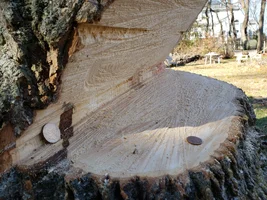
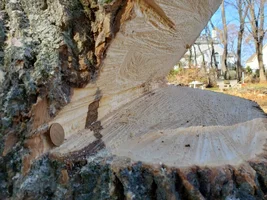
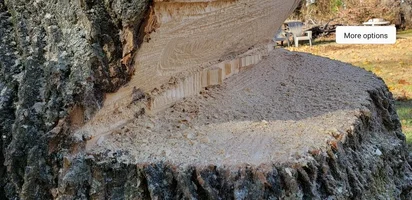
This is the same cut as seen on that locust hinge that the squirrel called a bypass...
When in fact it's as far away from a bypass as you can get...


Below two pics are a before and after cleaning out the plate cut... what he thinks is a bypass is just a failure to thoroughly clean out the plate cut... that was completely inconsequential to the outcome... may seem sloppy to some. If it needed to be done to get the tree tot he lay, it would have been done...

This is an decent sized stone dead ash I cut today... I didn't need to clean out the plate cut so well to get the tree tot he lay, but did it just to get a couple good pics to show the squirrel .... I like to use the plate cut on any fall except the most simple... For a timber faller that may seem like unnecessary overkill and a waste of time, but it provides a lot of confidence and for the few trees I cut in a day (it was three today), it's well worth the extra 20-30 seconds per tree. It actually comes in very handy when the hinge is longer than the bar as it was here... allows the faller to see exactly where the tip of the bar is as it approaches the far side apex, and take out that same corner without walking to the other side of the tree... ...plate cut w penny.webpplate cut before cleaning.webp
 

New threads New posts

Kask Stihl NORTHEASTERN Arborists Wesspur TreeStuff.com Teufelberger Westminster X-Rigging Teufelberger
Back
Top Bottom