Tapered Hinge: Diar(y)rhea of a thread gone wrong and left un-moderated

Use Tapered Hinge against Side Lean?

  • Huh?

    Votes: 0 0.0%
  • Never

    Votes: 0 0.0%
  • Hardly

    Votes: 1 3.7%
  • Sometimes

    Votes: 15 55.6%
  • Preferably

    Votes: 7 25.9%
  • Religiously

    Votes: 4 14.8%

  • Total voters
    27
  • Poll closed .
WTF?
i remember a place like this before; hoping i didn't end up there after the mass exodus!
.
i always liked the tall rooster tails on the front of Dent's book;
seems those later pix meet that standard and tradition rather well.
.
It wasn't just on here...

For some reason controversy just seems to follow me everywhere I go...

Ken Palmer took me aside at TCIA expo in 2004, right after the article was published and explained that my pictures sucked and that his scientist buddies in Germany had proved that the tapered hinge has no effect at controlling side lean...

At the same time the article was criticized elsewhere as being on a topic so simplistic and obvious that "you might as well write an article about where to put the gas and oil in a chainsaw"...
.
i think Ken Palmer is right in a narrow range where tree can compensate by simply compressing harder and pulling harder within strip hinge,.
.
But anything really leveraged etc. shows tensions/compressions just like rope fiber.
Far as i know 1 man chain saw is a 50's invention, putting Dent and Beranek as ground breaking texts.
.
i've kinda been a long time activist of Tapered Hinge; proved to self in so many ways.
.
tapered-hinge-forces-in-3-directions.png
 
WTF?
i remember a place like this before; hoping i didn't end up there after the mass exodus!
.
tapered-hinge-forces-in-3-directions.png
When someone post pictures of unacceptable cutting practices here I feel it is my duty to point it out. 6 of the 9 photos Daniel posted here were sub-standard cuts in my world, so I did just that. Heaven forbid an unsuspecting newbie goes out and recreates one of these gawd awful cuts, and either hurt themselves/others, or destroy their clients valuable property.
 
Last edited:
I’m sorry but you don’t need fancy computer generated pictures that generalize the effects of a tapered hinge. Get off the key board and go out and cut a few. Rico is right! Even your general pictures are going to get someone hurt. The one key ingredient that experience has over theory is what tree species, temperature, and local growing environment actually does to effect what you are discussing. Is hickory going to react the same as white pine? How about dead vs live hickory? What about tulip poplar? My favorite river birch? Contrast that with white birch? Now take all that and drop it to 10 degrees.... maybe 90 degrees???? There are cuts I’ll make at 90 that I would never consider at 10.

General statement targeted to all the Newbees our there:
How do you get experience like this you ask??? Get off the computer, go hang out with Rico or some of the other big names out there... if they will have you! Put the phone down and pay attention. I don’t care how much you read, write or do math... YOU CANNOT LEARN THIS INDUSTRY WITH YOUR NOSE STUCK IN A KEY BOARD! At some point you will have to get your hands dirty!
 
A few gawd awful stumps there Daniel, but the attachment of the little locust really takes the cake! You forget your saw that day? Even my wife cringed when she saw that one!

You do realize you can execute a perfect tapered hinge without cutting off your compressed/downhill hinge? You do that shit in the wood I work with and bad things are gonna happen. Guaranteed!

A little 48" DBH side leaning Red that just needed a gentle tapered hinge, a few wedges, and a little patience, and she hit the intended lay. Easy Parcheezy.

OK here we go again... You;re living in a box bro!

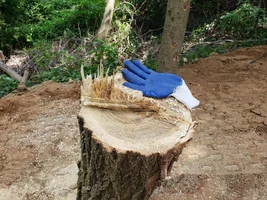
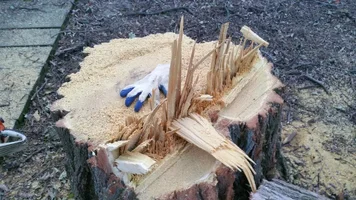
Those hinges that you called "gawd awful" worked PERFECTLY!!! The hinge on your 48" red had RELATIVELY little holding power as evidences by the lack of stringy fibers on the stump (even though it may have been plenty strong to get the tree to the lay).... The broken fibers sticking up out of the locust stump show unquestionably that the hinge held until the face closed... and it did....

Here's the important distinction to understand. If you cut the compression corner (downhill as you call it) of the hinge on a BIG tree, the weight of the tree will tend to crush and close that empty gap. When that happens the tree leans just a little farther to the side, which is no bueno. One way to handle that situation is to off-center plunge the hinge (aka gutting the hinge or as the brits call it a letterbox). When gutting the hinge most of the fibers are removed on the compression or downhill side of the hinge, leaving just enough fibers intact on the downhill corner to act as a post, propping up that corner to keep the tree from settling there and leaning even further to the side. This allows the faller to keep as many fibers in tact in the hinge as possible on the tension side of the hinge, which is optimal when using the tapered hinge.

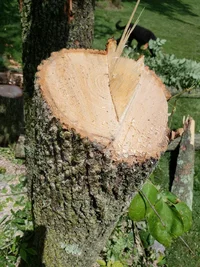
With smaller trees (this ash and locust are in the 12-14" range) the tree doesn't weigh enough to collapse on the compression or downhill side of the hinge , so there is no need to center plunge and preserve a post on the compression side corner of the hinge. In the case of this ash, I was trying to keep the tree off the neighbor's fence. That cut was made as high as I could reach (over head high) with a 201T top handled climbing saw) to shorten the fall, with the idea that even if I lost the tree to the significant side weight, shortening the fall could keep only the tips hitting the fence, which would probably do no damage. I think I was standing on the bucket of the skid loader in order to get this picture. That cut is over 6' in the air. So it would have been very awkward to plunge this hinge and more importantly there was no need...

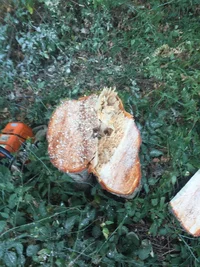
The tree stayed on the stump all the way til after the face closed, and ended up 10-15 from the fence. Look at the stringy fibers on the broken hinge, a clear sign that the hinge held well..

And that is another important distinction between logging and suburban arb... when you are working in the woods and getting paid for the timber, and that but log has the greatest value of all the wood, you try to PREVENT fiber pull.. Those long stringy fibers sticking out of the stump are money out of your pocket....

In my world, the LAST thing I think about is getting paid for the logs. I'm trying to make 3-4K/day, the mills are 2+ hours away and I'm cutting trees by the onesies and twosies.. and the trees usually have problems or I wouldn't be cutting them.. Bottom line is I've gotten paid less than 5K for logs in the past 10 years.... What I care about is getting these trees to the lay reliably. Those long fiber pulls that loggers disdain are a source of pridtapered hinge ash.webptapered hinge small locst.webpe for me. They show that my hinges held all the way until the face closed....
 
I’m sorry but you don’t need fancy computer generated pictures that generalize the effects of a tapered hinge. Get off the key board and go out and cut a few. Rico is right! Even your general pictures are going to get someone hurt. The one key ingredient that experience has over theory is what tree species, temperature, and local growing environment actually does to effect what you are discussing. Is hickory going to react the same as white pine? How about dead vs live hickory? What about tulip poplar? My favorite river birch? Contrast that with white birch? Now take all that and drop it to 10 degrees.... maybe 90 degrees???? There are cuts I’ll make at 90 that I would never consider at 10.

General statement targeted to all the Newbees our there:
How do you get experience like this you ask??? Get off the computer, go hang out with Rico or some of the other big names out there... if they will have you! Put the phone down and pay attention. I don’t care how much you read, write or do math... YOU CANNOT LEARN THIS INDUSTRY WITH YOUR NOSE STUCK IN A KEY BOARD! At some point you will have to get your hands dirty!
Great post Mr. Squirrell, and some of the best advice I have ever read here. Hope you have good day with friends and family!
 
OK here we go again... You;re living in a box bro!

Those hinges that you called "gawd awful" worked PERFECTLY!!! The hinge on your 48" red had RELATIVELY little holding power as evidences by the lack of stringy fibers on the stump (even though it may have been plenty strong to get the tree to the lay).... The broken fibers sticking up out of the locust stump show unquestionably that the hinge held until the face closed... and it did....

Here's the important distinction to understand. If you cut the compression corner (downhill as you call it) of the hinge on a BIG tree, the weight of the tree will tend to crush and close that empty gap. When that happens the tree leans just a little farther to the side, which is no bueno. One way to handle that situation is to off-center plunge the hinge (aka gutting the hinge or as the brits call it a letterbox). When gutting the hinge most of the fibers are removed on the compression or downhill side of the hinge, leaving just enough fibers intact on the downhill corner to act as a post, propping up that corner to keep the tree from settling there and leaning even further to the side. This allows the faller to keep as many fibers in tact in the hinge as possible on the tension side of the hinge, which is optimal when using the tapered hinge.

With smaller trees (this ash and locust are in the 12-14" range) the tree doesn't weigh enough to collapse on the compression or downhill side of the hinge , so there is no need to center plunge and preserve a post on the compression side corner of the hinge. In the case of this ash, I was trying to keep the tree off the neighbor's fence. That cut was made as high as I could reach (over head high) with a 201T top handled climbing saw) to shorten the fall, with the idea that even if I lost the tree to the significant side weight, shortening the fall could keep only the tips hitting the fence, which would probably do no damage. I think I was standing on the bucket of the skid loader in order to get this picture. That cut is over 6' in the air. So it would have been very awkward to plunge this hinge and more importantly there was no need...

The tree stayed on the stump all the way til after the face closed, and ended up 10-15 from the fence. Look at the stringy fibers on the broken hinge, a clear sign that the hinge held well..

And that is another important distinction between logging and suburban arb... when you are working in the woods and getting paid for the timber, and that but log has the greatest value of all the wood, you try to PREVENT fiber pull.. Those long stringy fibers sticking out of the stump are money out of your pocket....

In my world, the LAST thing I think about is getting paid for the logs. I'm trying to make 3-4K/day, the mills are 2+ hours away and I'm cutting trees by the onesies and twosies.. and the trees usually have problems or I wouldn't be cutting them.. Bottom line is I've gotten paid less than 5K for logs in the past 10 years.... What I care about is getting these trees to the lay reliably. Those long fiber pulls that loggers disdain are a source of pridView attachment 55345View attachment 55346e for me. They show that my hinges held all the way until the face closed....

As long as you continue to post pics of horrible cuts, I am gonna continue to bust your chops. The 2 examples you chose to repost just prove my point. 2 gawd awful cuts that I would never allow myself, or anyone working with me to make. You are lucky in that you seem to spend much of your time cutting very small trees, or your methods would have bitten you in the ass a long time ago. You can continue to live in "your box" and tell yourself that those cuts are somehow acceptable, but those of us who know better will continue to cringe when we see such butchery, and hopefully discourage others from following your example.

Hope you also have a great day with friends and family!
 
Last edited:
There is no Control/ Variable, nor large number of samples.

Seems like you need to find a bunch of similar trees and do both straight and tapered hinged, a bunch, then draw a conclusion.

It seems you attribute the one-off success per individual tree, which supports the idea you wanted to support.

If I dance for rain in the PNWet winter, and it rains, does that prove my dance did what I wanted to support, dancing leads to rain?

You didn't pull those with your loader, did you? You mention no such variable, so I would guess not.

This isn't the tapered hinge with a fast pull, marketed as simply tapered-hinge performance, right?.
 
Last edited:
PLEASE!

These are not one-off successes... my trees are 99.5% or better... and no I didn't have a skid loader pulling on the 12"ash or locust in question. (if I had taken the time to set a line and pull with the loader I could have put those trees anywhere I wanted with little concern for the hinge)..

but this one I did....

heavy side leaner right over and ...towards the house... losing it more than 5 degrees would have clipped the roof... tapered hinge fat locust.webp
 
Do have to say those are some ugly cuts. Do I make some sloppy cuts like that? Sure do when I don’t really give a f. I sure as hell don’t use them as teaching points on proper felling. 8B15DBC2-B466-4A17-8522-304E9777E8FD.webpF2F3DC41-0DF4-4E6D-B795-81E1EB3F6D25.webpDA14142A-9C61-499B-A01D-D559180A377D.webp
 
That's a nice fat hinge evo

Just calling a hinge ugly without any reference to your thinking doesn't do anybody much good it's really just like name calling

Perhaps there somebody here that would care to intelligently comment on the physics involved, specifically do you need the far corner of a hinge on the compression side when making a tapered hinge if the tree is not going to be big enough to compress that now missing corner


Have yet to hear any intelligent comments but I'm still hopeful
 
Last edited:
There is no Control/ Variable, nor large number of samples.

Seems like you need to find a bunch of similar trees and do both straight and tapered hinged, a bunch, then draw a conclusion....This isn't the tapered hinge with a fast pull, marketed as simply tapered-hinge performance, right?.
.
i certainly hope the contributions of Beranek and Dent are allowable in our tally.
>>for as said, there is nothing better than experience (hopefully their's count)
>>except, perhaps the better digestion of that same experience (hopefully their's count)
.
Also, Daniel is still cutting and keeping to same theory, 15yrs after article; that Beranek and Dent also always and all ways stuck to same story on.
Personally, i see these same forces played out in about everything all day, as very confirming.
Personally i don't speak, nor take time to draw out of self on things haven't cross verified in many different ways and forms as checksum and total view of all sides possible.
.
Similarly, i hope no-one is replacing experience with this forum, but rather extending experience, viewing experiences thru different faceted views of the same gem they hold.
>>i try to lend what i came to find, somethings as shortcuts to understandings to save others years.
>>alas, was not born all knowing as some; but don't think everyone should have to scrape so hard for every crumb as i
>>simply seek to be as smart as coral polyp to lend what can to whole.
.
i must admit my own ongoing advocacy for tapered hinge, somehow sneaking into 3 decades now.
Not sure if i know of any personally that has asked, searched, shown more on this.
i remember not being able to figure out Dent's drawings to central points at first; then later feeling so stupid... Confirmed some of what already doing, extended other things, gave more confidence to all.
.
Daniel, i think in a moderate sideLean the force volume in a strip hinge, especially center punched can give enough volume of RED tension fiber ballast against side force, and allow fall within target.
>>the system always trys to compensate, just generally doesn't have enough side tension fibers in strip hinge against side lean without having to extend the perimeter of hinge to deeper on 1 side if can do the job within given perimiter of fibers
>>but if enough REDS as ballast, it works out, cuz it does try to work whatever tensions /compressions allowed in most efficient form can as Nature's promise.
.
All in all, it is about experience, but even more so what you truly understand from those experiences; and how inter-relates. Once can view and really understand/see inner workings, learn even more from them like a light went on. Learn down to basic principles, can see reflections of understandings in more things to confirm lessons and aspects within a wider view. Giving more power band to original view..
.
edit: i think in tree examples of side swept horizontals(harshest angle of sideLean pull to path) on Tapered Hinges gives plenty of viability to Tapered Hinge theory, easier to replicate closer scenarios of size, weight,reach etc.
>>especially if you do it wrong!
>>Also proves scale-ability of model
Same forces, material etc. to smaller but harsher angle model
 
Last edited:
Do have to say those are some ugly cuts. Do I make some sloppy cuts like that? Sure do when I don’t really give a f. I sure as hell don’t use them as teaching points on proper felling. View attachment 55361View attachment 55362View attachment 55363
So your cut ain't the prettiest Evo. It is text-book in that it has a clean, well executed undercut, and the hinge is intact. Thats a good cut in my book buddy!

Its not about leaving a pretty, or an ugly stump. Its about doing the things that will increase the chances of your tree, top, or log hitting its intended lay. Subpar undercuts and cutting your hinge do just the opposite, and in fact decrease your odds of hitting your target, and increase the likelihood that something is gonna go sideways/backwards, and fuck people or property up. I was taught at an early age to always strive to leave a perfect cut, and I have lived by that mantra to this day. Sure I leave some ugly stumps from time to time, but what this mindset does is force me to make sure my mechanics are good. No shitty subpar undercuts, or destroyed hinge. Fuck that.

Why would a so-called expert and a published educator on the subject post pictures, advocate, and defend the dangerous act of cutting ones hinge when felling trees? The exact same result can be produced without cutting off your hinge. Plus you don't run the risks that come along with doing so.. It is simply an unacceptable practice that a few more seconds of work, and a little mindfulness can easily remedy.
 
So your cut ain't the prettiest Evo. It is text-book in that it has a clean, well executed undercut, and the hinge is intact. Thats a good cut in my book buddy!

Its not about leaving a pretty, or an ugly stump. Its about doing the things that will increase the chances of your tree, top, or log hitting its intended lay. Subpar undercuts and cutting your hinge do just the opposite, and in fact decrease your odds of hitting your target, and increase the likelihood that something is gonna go sideways/backwards, and fuck people or property up. I was taught at an early age to always strive to leave a perfect cut, and I have lived by that mantra to this day. Sure I leave some ugly stumps from time to time, but what this mindset does is force me to make sure my mechanics are good. No shitty subpar undercuts, or destroyed hinge. Fuck that.

Why would a so-called expert and a published educator on the subject post pictures, advocate, and defend the dangerous act of cutting ones hinge when felling trees? The exact same result can be produced without cutting off your hinge. Plus you don't run the risks that come along with doing so.. It is simply an unacceptable practice that a few more seconds of work, and a little mindfulness can easily remedy.
Here are some more uglies
18815078_10213059601866974_1461895224150399240_o.jpg

18739103_10213059601946976_5320065693657119062_o.jpg

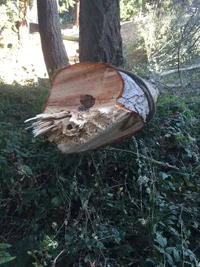
Little pucker, on a very heavy back leaning alder. Stayed at the stump and keep cutting through the barber chair. I wont teach how do that.
 
Those alders do love to barber chair, don't they? Way to stand in the pocket and keep cutting that mofo!
 
That's a nice fat hinge evo

Just calling a hinge ugly without any reference to your thinking doesn't do anybody much good it's really just like name calling

Perhaps there somebody here that would care to intelligently comment on the physics involved, specifically do you need the far corner of a hinge on the compression side when making a tapered hinge if the tree is not going to be big enough to compress that now missing corner


Have yet to hear any intelligent comments but I'm still hopeful

Those locust hinges are ugly. Ok maybe not the hinge as much as the bypasses on the face cut. If it was all that important why not fix it? You can see the flat marks the saw left behind and the hinge breaking behind it. I call it angry beaver syndrome, see it all the time with young guys. They attack the tree with the saw like it said a dirty joke about their mom. :X3:

The only physics involved here is the face cut, back cut and gravity. This discussion is so much deeper than just the tapered hinge. You are experienced, you know. Wood characteristics are not being taken into account. You show an ash tree... it was alive... do the same with a dead one. I don’t care how tapered you make it, compression, tension... its GONNA fail. Fell a tulip poplar today in this cold! Tell me how that goes for ya. Every single tree we fell is a one off success or one off failure. Only because there are no two alike. We gain experience with every one, so the next time we see something that looks similar, maybe we can make a similar cut and have a similar out come (or hopefully different if the last one failed).
 
Those alders do love to barber chair, don't they? Way to stand in the pocket and keep cutting that mofo!
I’ve actually haven’t had many. Guess it’s a spruce where I don’t push my luck. Only significant barber chair I had I blame on a untrained groundie. He started tugging hard on the tag line, dude was about 300# so that was a lot of weight pumping..
 

New threads New posts

Kask Stihl NORTHEASTERN Arborists Wesspur TreeStuff.com Teufelberger Westminster X-Rigging Teufelberger
Back
Top Bottom