swinging some white oak limbs

[ QUOTE ]

IN that case keeping the friction at the high point, reduces the force on the tree..

[/ QUOTE ]

Explain how that can be.

I've used my 100# game scale to setup mini-rigging scenarios for indoor demos. In every application of static or slam dunk rigging the upper rigging point takes most of the load, especially using natural crotches.
 
Of course the upper rigging point takes "most of the load".. with no friction in the overhead rigging point (pulley), the tree will experience 2x weight of the object. Introduce friction at the overhead point (natural crotch) and the tree will experience (2 x weight)-friction.

ps Tom, would you be in favor of changing the terminology from natural crotch to "natural branch union"? :)
 
So you're sayong the force of friction reduces load???? I would agree it reduces load on the running end manipulated by a groundsperson during lowering operations, but I am not sure it reduces load on the anchor points...in fact I would argue it places greater stress on the system.

I'm not sure I agree with you here.
 
Dylan,

Keep thinking the way that you are going, you're on the right track.

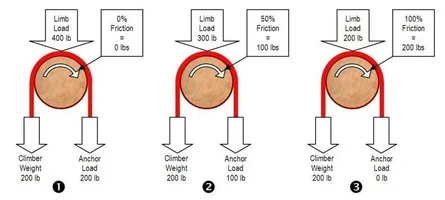
SingleJack came up with a great graphic to show the load on an SRT TIP. This is no different than a rigging point.

Take a look--->

To get a better understanding find a fish or game scale and some small pulleys. The ones that I have are made for 1/4" cord. Take some cord, I use chainsaw starter rope, and fabricate any rigging situation. Do some drops and watch where the needle pegs. Let things swing too. Try doing some dynamic lowers. Look at the trends in where the scale pegs.

This is the big one that I have:

http://www.enasco.com/farmandranch/General+Livestock+Supplies/Scales/Hanging+Scales/

Make the 'chunk' smaller if you use a smaller scale. Add friction at the hook of the scale and see what happens.
 

Attachments

  • 253145-Jack'sSRTTIPload.webp
    253145-Jack'sSRTTIPload.webp
    25.9 KB · Views: 60
Tom, you get the feelin' your doing this?
zbanghead.gif
 
[ QUOTE ]
Of course the upper rigging point takes "most of the load".. with no friction in the overhead rigging point (pulley), the tree will experience 2x weight of the object. Introduce friction at the overhead point (natural crotch) and the tree will experience (2 x weight)-friction

[/ QUOTE ]

I'm beginning to suspect that you might not have a full grasp of the physics involved here. It's a strange feeling for me, to suspect that you are full of sh#t, especially because you are so good at bragging about how much you know about everything.

Now I remember what it felt like when I learned Santa Claus is not real.


SZ
 
[ QUOTE ]
Dylan,

Keep thinking the way that you are going, you're on the right track.

SingleJack came up with a great graphic to show the load on an SRT TIP. This is no different than a rigging point.


[/ QUOTE ]

Sorry "pal".. that's not true.. There is a big difference between SRT and rigging.. You often take the slack out of the rope in rigging.
 
[ QUOTE ]
[ QUOTE ]
Dylan,

Keep thinking the way that you are going, you're on the right track.

SingleJack came up with a great graphic to show the load on an SRT TIP. This is no different than a rigging point.


[/ QUOTE ]

Sorry "pal".. that's not true.. There is a big difference between SRT and rigging.. You often take the slack out of the rope in rigging.

[/ QUOTE ]


and you don't take slack out of the SRT?
 
[ QUOTE ]
[ QUOTE ]
[ QUOTE ]
Dylan,

Keep thinking the way that you are going, you're on the right track.

SingleJack came up with a great graphic to show the load on an SRT TIP. This is no different than a rigging point.


[/ QUOTE ]

Sorry "pal".. that's not true.. There is a big difference between SRT and rigging.. You often take the slack out of the rope in rigging.

[/ QUOTE ]


and you don't take slack out of the SRT?

[/ QUOTE ]

There is NO WAY you take the slack out of the SRT.


SZ
 
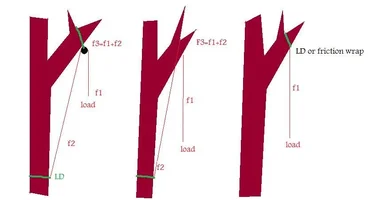
I tried to illustrate there different rigging scenarios. The Paint image is starting with a static load set-up.

Tree one is a Lowering Device LD, a low friction block, Force 1 F1 weight of the load, F2 equal and opposite force to hold load stationary. There will be a bit of friction at the block, maybe 5-10% loss of efficiency, so F3 will be about 1.9 times of the load, so for simplicity call it double the load on the rigging point. F3~200 pounds.

Tree two is a lowering device with a NC rig, which will have more friction, and will be much less predictable friction. The counteracting force F2 will be less to keep the load stationary (I don't have a good number here, can we say 30% loss of efficiency due to friction, friction eats 30% of the load, so F1= 100 pounds, F2= 70 pounds (100-30), and F3= 170 pounds.

Tree 3 has enough friction at a LD or NOT-Redirected trunk wrap to hold the load stationary, so the load generates F1 which is 100 pounds.


Natural crotch rigging with a redirect, as far as I can tell will generate less force on the anchor than a low friction block for STATIC loads.
A LD or non-redirected trunk wrap will have the lowest force on the trees.

This is not going into compressional loading of the stems versus side loading.


When the scenario changes to dynamic loading, the ability to predictably absorb the energy of the falling load MAY be greatest with a low friction block system and a lot more rope in the system, as with Tree 1. Add into the equation the nearly equal counter-force F2 to F1.

In Tree 2, F2, the counter-force, will be less than F1 because of friction at the crotch, and the ability to effectively cushion the load F1 may be minorly or drastically reduced.

In Tree 3, there is no counter-force, but little rope (and stretch) in the system as compared to Tree 1 or 2.

My take is that in different scenarios, you will get different max forces on the rigging point F3.

Rope stretch, space to let it run, and ability to predict the friction of a LD and/ or friction wrap make it variable, with no one-scenario-fits-all option.

Thoughts?

 

Attachments

  • 253274-FC,NC,Nc.webp
    253274-FC,NC,Nc.webp
    18 KB · Views: 67
Friction 'eats' the force from the load? Where does it go? dissipated heat?

Not sure I agree with your conceptualization, Sean.

Friction changes mechanical force into heat. But friction only occurs when a load is moving, does it not? If the load is static then the mechanical force acting on the anchor would be the same...right?

When the load is moving on a NC system, perhaps more mechanical force is dissipated through heat than in the FC system, due to a greater coefficient of friction. I am not sure.
 
[ QUOTE ]

Friction changes mechanical force into heat.

[/ QUOTE ]

and wear, our climbing and rigging ropes generally get worn out by friction wear rather than friction heat.

On some occasions friction heat will render the rope unsafe to use, the risk of this happening is higher when using natural crotch rigging methods as opposed to a block and portawrap/GRCS/Hobbs because it is generally easier to judge the friction which is going to be applied to a lowering device rather than a branch crotch/trunk wraps.


.
 
[ QUOTE ]

Friction changes mechanical force into heat.

[/ QUOTE ]

Sorry, also meant to say

- friction changes kinetic energy into heat not mechanical force, mechanical force is when you smash a door down with a sledgehammer,

or

when Daniel allows a giant White Oak branch to crash
through a client's roof
smirk.gif


.
 
Agreed. Perhaps written as such; kinetic energy from the load is transferred to the rope which acts on the block or union. The greater the mass of an object, the greater the energy required to set it in motion, or the greater the gravitational potential in the suspended object. The change from potential to kinetic energy (us cutting the limb free) tranfers energy from the tree to the rigging. Friction occurs where the rope and block/union meet. The friction is either dynamic or static depending on whether the object is moving. The force of friction is proportional to the applied load.

Fogive a leap here....

So, if the mass of the load the rope is carrying affects the amount of force the rope carries through the anchor, then the friction is proportional to the mass of the load the rope carries as well, correct? To me this would indicate that a system with greater friction would exert greater force on its component parts, in both lifting or lowering situations.

Does the friction encountered by the rope from the block or union affect the amount of force acting on the anchor? I would expect it does.

I am no physics major, but it seems the more I read about it, the more I need to take some of the free time a back injury has given, buy a small scale, and do some experiments.
 

New threads New posts

Back
Top Bottom