

Navigation
Install the app
How to install the app on iOS
Follow along with the video below to see how to install our site as a web app on your home screen.
Note: This feature may not be available in some browsers.
More options
You are using an out of date browser. It may not display this or other websites correctly.
You should upgrade or use an alternative browser.
You should upgrade or use an alternative browser.
swinging some white oak limbs
- Thread starter Daniel
- Start date
allmark
Participating member
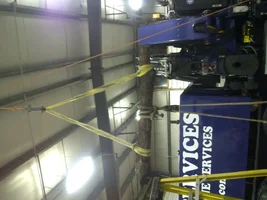
sorry pics are sideways. Dont know what happened?


southsoundtree
Been here much more than a while
- Location
- Olympia, WA
That's very interesting Mark.
I'd be interested to know about the hand force involved, and if it was roughly equal in those scenarios. Hard to test it. I'm suspecting that with 10 samples of each scenario, providing the time of ascent/descent was equal, you had similar inputs of force/ resistance.
I'm confused how you can raise 25 pounds with seemingly 15 pounds of force, where it would seem to take at least 25 pounds of force to counteract the weight, then a bit more force to raise it and overcome friction in the block.
I'd be interested to know about the hand force involved, and if it was roughly equal in those scenarios. Hard to test it. I'm suspecting that with 10 samples of each scenario, providing the time of ascent/descent was equal, you had similar inputs of force/ resistance.
I'm confused how you can raise 25 pounds with seemingly 15 pounds of force, where it would seem to take at least 25 pounds of force to counteract the weight, then a bit more force to raise it and overcome friction in the block.

- Location
- Penticton, British Columbia
Now you're gonna have to make a video, Mark! Kidding, of course. Glad you were able to get that experiment together.
southsoundtree
Been here much more than a while
- Location
- Olympia, WA
Mark, since you have a dynamometer, can you put a friction device in place of the block and measure?
With the block, will you put a friction device at the bottom, as though attached at the base, as we most frequently do with block rigging?
Thanks.
With the block, will you put a friction device at the bottom, as though attached at the base, as we most frequently do with block rigging?
Thanks.

- Location
- Chapel Hill, NC
So wait, what does all this tell us?
Does rigging natural crotches reduce the forces on a tree?
And Daniel, how is running a long rope from a redi at the bottom of a tree improve shock absorption when the friction from the natural crotch basically makes it unavailable?
What Norm said was, only one side of the system is doing the shock absorbing, the load side. You can run out 200' of rope on the back side if you want but the tree is gonna get most of the shock because the rope doesn't move without a lot of force on it. The friction at the crotch imbalances the system, not so with a block where the force on the rope is distributed evenly.
Does rigging natural crotches reduce the forces on a tree?
And Daniel, how is running a long rope from a redi at the bottom of a tree improve shock absorption when the friction from the natural crotch basically makes it unavailable?
What Norm said was, only one side of the system is doing the shock absorbing, the load side. You can run out 200' of rope on the back side if you want but the tree is gonna get most of the shock because the rope doesn't move without a lot of force on it. The friction at the crotch imbalances the system, not so with a block where the force on the rope is distributed evenly.
allmark
Participating member
[ QUOTE ]
I'm confused how you can raise 25 pounds with seemingly 15 pounds of force, where it would seem to take at least 25 pounds of force to counteract the weight, then a bit more force to raise it and overcome friction in the block.
[/ QUOTE ]
This bothered me too. I reweighed the piece a couple times.
While thinking last night the only solution I came up with is rope angle to the pulley. But Im sure it was not different and staigt down.
I'm confused how you can raise 25 pounds with seemingly 15 pounds of force, where it would seem to take at least 25 pounds of force to counteract the weight, then a bit more force to raise it and overcome friction in the block.
[/ QUOTE ]
This bothered me too. I reweighed the piece a couple times.
While thinking last night the only solution I came up with is rope angle to the pulley. But Im sure it was not different and staigt down.

- Location
- Retired in Minneapolis
This can be replicated using small chunks, shoe lace/throwline and a fish scale.
The point where friction collects is where a lot of the load is concentrated. NC rigging puts higher loads on the rigging point than the anchor point.
The point where friction collects is where a lot of the load is concentrated. NC rigging puts higher loads on the rigging point than the anchor point.

tomthetreeman
Participating member
- Location
- Rhode Island
[ QUOTE ]
The point where friction collects is where a lot of the load is concentrated. NC rigging puts higher loads on the rigging point than the anchor point.
[/ QUOTE ]
I think you just nailed it.
The point where friction collects is where a lot of the load is concentrated. NC rigging puts higher loads on the rigging point than the anchor point.
[/ QUOTE ]
I think you just nailed it.
southsoundtree
Been here much more than a while
- Location
- Olympia, WA
I'm very interested in what Mark has measured. It doesn't intuitively, or by MY (read: possibly missing out on some aspects) calculations and force analysis, make sense to me. Quantitative experimental measurements are a good way to go. Thanks for doing this.
I do wonder if the dynamometer is accurate to that low level. I don't know what you use it for. If it is for 10K loads, then it might not be measuring accurately due to internal friction. This friction would be the same (at least more or less) between NC and Block rigging. Consistent, yes. Accurate, maybe.
Perhaps a fish scale or other lightweight scale (force measuring device) would give both consistent and accurate numbers to better illustrate the point, and explain the 15 versus 25 pound reading.
I do wonder if the dynamometer is accurate to that low level. I don't know what you use it for. If it is for 10K loads, then it might not be measuring accurately due to internal friction. This friction would be the same (at least more or less) between NC and Block rigging. Consistent, yes. Accurate, maybe.
Perhaps a fish scale or other lightweight scale (force measuring device) would give both consistent and accurate numbers to better illustrate the point, and explain the 15 versus 25 pound reading.
southsoundtree
Been here much more than a while
- Location
- Olympia, WA
What do you all think of the friction device being at the rigging point as far as force on that one individual rigging point?
Static or near static (slow full-weight loading onto the rope (such as tip and butt tied controlled lower or a rip cut to ease the branch down, and slow and steady lowering) would seem to be a 1:1 scenario, aside from the small load on the rope from the roper's hand (most easily achieved if the friction is set high on the LD, and reduced until the piece starts moving).
With a dynamic load, the more rope in the system of a redirected block system, and ability of the force of the load being able to be moved to the portion of rope on the other side of the redirecting block will counteract the doubling (or portion thereof, based on rope angle) effect.
A factor that plays into the comparison will definitely be how far the NC is from the lowered wood (if its hung in the top of the tree, versus using the crotch of the branch being cut itself.
Static or near static (slow full-weight loading onto the rope (such as tip and butt tied controlled lower or a rip cut to ease the branch down, and slow and steady lowering) would seem to be a 1:1 scenario, aside from the small load on the rope from the roper's hand (most easily achieved if the friction is set high on the LD, and reduced until the piece starts moving).
With a dynamic load, the more rope in the system of a redirected block system, and ability of the force of the load being able to be moved to the portion of rope on the other side of the redirecting block will counteract the doubling (or portion thereof, based on rope angle) effect.
A factor that plays into the comparison will definitely be how far the NC is from the lowered wood (if its hung in the top of the tree, versus using the crotch of the branch being cut itself.

Daniel
Carpal tunnel level member
- Location
- Suburban Philadelphia (Wayne)
How about just going from dyno to sling to block, then set up a NC hanging from sling, and try using something more like 80-100#'s. Then try some drop tests, and some tests where the piece swings on a pendulum, or drops to a pendulum swing... Might also want to set up a redirect block or LD to a fixxed ground anchor, to eliminate line angle as a varaible and better replicate real rigging conditions..
I think the Germans already did all this and more years ago..
I think the Germans already did all this and more years ago..

Norm_Hall
New member
- Location
- Wauconda, (Chicago),IL,USA
Mark, can you rotate the pics? And repost.
- Location
- Penticton, British Columbia
For the record, mechanical advantage = output force/input force. So in the case of the simple fixed pulley we have a MA of 1 because it requires at least as much force to lift its as the load exerts, plus the force of friction. There is a greater force on the anchor, but that is simply because each leg of the rope carries the load. This is not a MA, but the redirect is advantageous because it allows us to lift a load.
In the case of the experiment, what is not doubted is that it requires at least as much force to lift the load as the load exerts on the system, plus friction. What is strange is that the force on the dynamometer reads less than the combined force of the running and working end of the rope. This seems inexplicable. One would expect the scale to read at least 50 lbs in the case of a lift with the block. Perhaps Sean is right and there is a problem with the scale. This needs refinement, but it is a step in the right direction. Thanks, Mark.
In the case of the experiment, what is not doubted is that it requires at least as much force to lift the load as the load exerts on the system, plus friction. What is strange is that the force on the dynamometer reads less than the combined force of the running and working end of the rope. This seems inexplicable. One would expect the scale to read at least 50 lbs in the case of a lift with the block. Perhaps Sean is right and there is a problem with the scale. This needs refinement, but it is a step in the right direction. Thanks, Mark.
allmark
Participating member
allmark
Participating member
allmark
Participating member
[ QUOTE ]
I think the Germans already did all this and more years ago..
[/ QUOTE ]
Does anyone have access to the results? No sense reinventing the wheel
I think the Germans already did all this and more years ago..
[/ QUOTE ]
Does anyone have access to the results? No sense reinventing the wheel
New threads New posts
-
test
-
 Alternatives to standard asphalt around roots
- Started by southsoundtree
- Replies: 5
-
-

-

-
 For Sale: 2018 Vermeer BC1000XL Chipper | 918 Run Hours | Deutz Diesel
- Started by Blue Ribbon Tree
- Replies: 2
-

