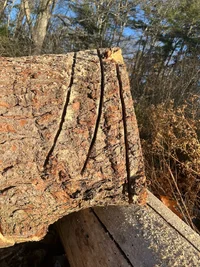
Stump Cut Troubles

Dan Thornton

Participating member
Location
Smithsburg
Maybe a kindergarten question, but I have been frustrated recently doing the final stump cut on fair-sized (greater than 28" diameter) removals. I start the horizontal cut, then about 1/3 way through the bar gets tight and I'm fighting the saw to keep it cutting through. The cut is not straight, like the bar end is cutting slightly different direction than the rest. What's happening? And how do I keep this from happening? Is the weight of the saw head torquing the bar causing the poor cut? Does the chain start the horizontal cut at a slight angle from the plane of the bar? Has anyone else struggled with this?
 
If you are cutting eastern hardwoods, make your cut a little bit higher. If you get too far down into the root buttresses, the wonky grain will push the saw all over the place and make it nearly impossible to cut a straight line.

Often times though, the real issue is a bar that needs ground or needs the groove tightened, or running a chain that is narrower than what is supposed to be on that bar will do it as well.

I have seen cases where the weight of the powerhead does tend to make the saw want to cut one direction, usually that happens when the chain is not sharp enough or the rakers are set too high and you are pulling on the saw harder than you should be.
 
I frequently have that type of issue. Seems like slightly dull chain and not perfectly symmetrical hand sharpening in my case. (Almost always some rain splashed up dirt on my stumps near the bottom.)

Backchaining seems to be a tolerable work around to get through one tree or job. Then I try sharpening one more time and after that put on a new chain.

I have a small box of chains about to send off to have machine sharpened and get back to even cutting hopefully.
 
If you are cutting eastern hardwoods, make your cut a little bit higher. If you get too far down into the root buttresses, the wonky grain will push the saw all over the place and make it nearly impossible to cut a straight line.

Often times though, the real issue is a bar that needs ground or needs the groove tightened, or running a chain that is narrower than what is supposed to be on that bar will do it as well.

I have seen cases where the weight of the powerhead does tend to make the saw want to cut one direction, usually that happens when the chain is not sharp enough or the rakers are set too high and you are pulling on the saw harder than you should be.
The point about the wonky grain down low is really awesome. I feel like I have encountered that a time or two, but maybe I'm just making excuses for myself.
 
The point about the wonky grain down low is really awesome. I feel like I have encountered that a time or two, but maybe I'm just making excuses for myself.
Around here, it is a very real thing. We usually cut our stumps at the top of the buttress, and then grind from there down. Oaks are one of the worst it seems, but most of our harder hardwoods do it. It took me a few years of fighting stump cuts to figure that out.
 
Odd grained flares often make odd non-centered loading on the dogs and handle, which gets exacerbated by larger yanking required by a dulled chain, which usually gets dulled because of crap right near ground level where you're cutting, often embedded right in the flare bark. IMO Hard to win. On some occasions odd stress is released as you cut binding the saw. Gravity can sag the cookie, cheap trick is wedge in twigs where you've already cut doesn't matter if you hit them with the saw. I think twigs can help mitigate released stresses too.

To the og question, struggle more often than not.
 
Last edited:
Odd grained flares often make odd non-centered loading on the dogs and handle, which gets exacerbated by larger yanking required by a dulled chain, which usually gets dulled because of crap right near ground level where you're cutting, often embedded right in the flare bark. IMO Hard to win. On some occasions odd stress is released as you cut binding the saw. Gravity can sag the cookie, cheap trick is wedge in twigs where you've already cut doesn't matter if you hit them with the saw. I think twigs can help mitigate released stresses too.
Easy to make wood wedges, too...poundable.
 
@Dan Thornton just for a data point: How does the saw cut everywhere else leading up to the stump cut? I think @Bart_ and @Reach nailed it though.
I think you may be right. The saw usually has been working fine up to the stump cut - suggesting I'm being overly generous trying to get the stump too close to the ground.

This discussion has been very helpful thinking about all the potential complications when cutting across the buttress: dirt, uneven dogs, releasing internal grain stress, more wear since sharpening chain, sagging wood.
 
I usually bore cut to the middle. I keep the bar in the cut and work around the stump. Not to brag, but I usually have too short of a bar and half-dull chain making a straight cut not happening
Keeps from dulling better pulling out.

If the bar is long enough and the saw has the power (all mine do :-D), I plunge through the center and rotate so the top and bottom of the bar are both cutting but pulling out of the dirty bark.


I really like the husky roller guide in the field.
 
Check the bar, close rails and dress.
Some chains you can ‘steer’ semi chisel/full chisel

A wedge or a twig in the kerf and then once past center pull it out and place one near the tip and one near the power head. As the kerf closes where the cut started this will cantilever the rest upwards keeping weight off the bar.

Everyone else had great advise so not going to repeat.
 

New threads New posts

Back
Top Bottom