SRT DRT DmRT vs. MRS SRS What do we call it?

Clearly DRT & DdRT is the source of much confusion. Wesspur took it upon themselves to clarify this when they proposed SRS and MRS, but as Yoyo and others realized, it leaves out the DRT, aka: twin line SRT.

As more attention is given to this issue, a clear path becomes more evident, but there needs to be a consortium and agreement in order to achieve consensus, at least amongst the primary players, including major equipment dealers, the ISA and similar orgs.

SRT, MRT & TRT gets my vote.
 
Last edited:
Maybe just stop the abbreviations
Yes, the various climbing options are now so complex that it might be easier to simply spell out completely each time, whatever we are talking about. If we use an acronym that someone else does not understand, we will have to explain it anyway. And the sodding acronyms invariably have to be explained for newcomers every time too.
 
To avoid further confusion and with all due respect, DRT might be better served if its renamed as "Twin Line SRT", or how about TRT for short?

So you now need to change the entire climbing communities deffinitions. Windowwashers, steeple jacks, high scalers, rescue, windmill techs, tower climbers, and more! Let’s let them keep DRT, we could use it for the same, but twin line srt is a different animal.

DRT as the rest of the world looks at it is hardly ever used in Arboriculture. I’d say never used, but some have experimented.

I don’t see the need to define twin srt any more than double crotching a DdRT system. One is just simply using two systems as part of a greater technique.

See back to system vrs technique vrs method, etc..
 
Just a suggestion, aligned with the topic of this thread.

So you now need to change the entire climbing communities deffinitions. Windowwashers, steeple jacks, high scalers, rescue, windmill techs, tower climbers, and more! Let’s let them keep DRT, we could use it for the same, but twin line srt is a different animal.

DRT as the rest of the world looks at it is hardly ever used in Arboriculture. I’d say never used, but some have experimented.

I don’t see the need to define twin srt any more than double crotching a DdRT system. One is just simply using two systems as part of a greater technique.

See back to system vrs technique vrs method, etc..

 
It's doubtful, but maybe we can start by agreeing on these descriptions in Treestuff's glossary of terms...

"DRT Acronym for double rope technique. Climbing system n which two separate ropes and two separate anchor points are utilized. Contrast with DdRT and SRT.

DdRT Acronym for doubled rope technique. Dynamic or static climbing system in which a rope is doubled over a branch and the climber utilizes both parts of the line. Contrast with DRT and SRT

single rope technique (SRT) A set of methods used to ascend (or descend) on a single leg of a single rope."
 
Yes, however taking it one set further DRT is not double SRT.

Well you could do so, but in a DRT set up on a tower, or any other use it runs in parallel and the second line is a backup to the primary.

In double SRT you can have two remote anchors and switch back and forth. One quickly realizes that if one line fails you’d take epic whipper, or swing.
 
We are talking about how we use ropes or the techniques employed so let me start with what I believe is the most confusing definition. It is a verb, an action word expressing how we use something.
DOUBLED

doubledl.webp
1. If we double a recipe for bread because twice as many people showed up, we have not changed the fact we are having bread. If we double the ropes in the tree because twice as many climbers showed up, we have not changed anything, except that it will probably be more fun. If a climber adds another rope because he/she does not trust one, nothing really changed, it is still being used the same way, it is still bread. It would be like changing the color or the size, it is not sufficiently different from what has been used or described before.
We have to stop thinking of "doubled" or "double" as adding another, multiplying something because it does not change anything, just makes it bigger. So, #1 is out.
2. Doubled is an action that we do to the rope that changes how it is used. A different technique with the same components, (ingredients). We doubled the rope over a limb so that we could use it to create a mechanical advantage...
So now the comment will come, why not SRS and MRS? Because we have left out the entire 3 pillar to our foundation. That 3 pillar may not seem like much now but as innovation evolves and new techniques and methods are discovered it may become a major support.
 
... So now the comment will come, why not SRS and MRS? Because we have left out the entire 3 pillar to our foundation. That 3 pillar may not seem like much now but as innovation evolves and new techniques and methods are discovered it may become a major support.

Remind me again what the 3rd pillar is and how it is not covered by stationary or moving.
 
Richard has made an excellent a point with the 3rd pillar. From a marketing standpoint, this opens up a new array of potential progress capture products designed to accommodate dual lines. A Doublecender or a Doubledcender may be a safer option, appealing to certain climbers.
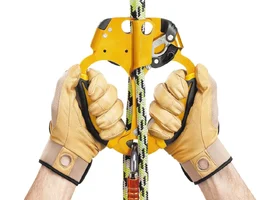
 
Remind me again what the 3rd pillar is and how it is not covered by stationary or moving.
The 3rd pillar is a rope that has two accessible attachments at the climber, those could be like the double hand ascender, a Petzl Shunt, Rock Exotica Duelcender or friction hitches. The support point above is not anchored, cinched or tied, simply doubled over the branch or support.

The mindset to the 3 pillars or foundations from which we build our systems is that it is about the anchors and support points and when you think about it, what could be more important than what and how the rope is anchored and supported.
 
The 3rd pillar is a rope that has two accessible attachments at the climber, those could be like the double hand ascender, a Petzl Shunt, Rock Exotica Duelcender or friction hitches. The support point above is not anchored, cinched or tied, simply doubled over the branch or support.

The mindset to the 3 pillars or foundations from which we build our systems is that it is about the anchors and support points and when you think about it, what could be more important than what and how the rope is anchored and supported.

I'm intrigued with the third pillar system. DmRT, is not to be confused with DRT or DdRT. I'm not sure how practical and versatile DmRT is in the real world, but the inch-worm like ascending result with the use of two foot ascenders, with a 2:1 advantage certainly warrants a new acronym and perhaps a new dAkimbo to support the technology.
 
So trad foot lock isn’t 3 pillars or what ever we are talking about? It has only one point of attachment, the foot lock prussic. I think we need a new acronym! But if used with a shunt or two rope handled ascender it is? :vomito:
Now what in the hell is DmRT? Double moving rope? Or doubleD moving rope?
How about get your ass up into the damn tree already
YAUDT

Don’t fix what’s not broken idkam BuOMT
 
FYI: I've revised my list of acronyms.... Very literal and straight forward. Thanks in advance for all the accolades and I'll be sure to thank everyone when I receive my Pulitzer prize for this.

SSR = Single Stationary Rope Technique, versus: SRS & SRT
SMR = Single Moving Rope Technique, versus: MRS & DdRT
DSR = Double Stationary Rope Technique, versus: DRT
DMR = Double Moving Rope Technique, versus: DmRT
 
Last edited:

New threads New posts

Back
Top Bottom