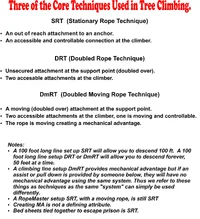
SRT DRT DmRT vs. MRS SRS What do we call it?

This lack of agreement on just what these acronyms stand for has been in flux far too long. They by themselves should not be that complicated! Like angiosperms and gymnosperms in tree taxonomy only give you a starting point for a very diverse and complicated group, so it is with these acronyms.

I was perfectly happy with SRT, DRT, and DdRT. I would be equally as happy with SRT, DRT, and DmRT. As I said earlier you could even talk me into SRS and MRS. These are very base descriptors of how we, as tree workers, do things. They will need to be explained regardless of what the letters stand for and they will not and were never meant to cover all potential possible configurations.
 
I continue to debate a move to simplify climbing techniques and the associated acronyms (SRS and MRS). I think a crucial aspect is being missed and this leads to the discussion. The techniques we employ has more to do with how we connect to a rope and how it is connected to an anchor than what the material is made of, how many of them there are and whether it stretches or even if it moves.

SRT DRT DmRT.webp
 
I continue to debate a move to simplify climbing techniques and the associated acronyms (SRS and MRS). I think a crucial aspect is being missed and this leads to the discussion. The techniques we employ has more to do with how we connect to a rope and how it is connected to an anchor than what the material is made of, how many of them there are and whether it stretches or even if it moves.

View attachment 55035

I like where you are going with this. My only comment is that I like to refer to double rope technique as DsRT and I refer to what you are calling DmRT as DdRT.

I definitely think we need to keep a distinction between systems and technique.
 
It has taken me a while to understand why this is confusing. There has to be a distinction between to support point that has a moving rope and a stationary one. I understand the movement to narrow to just those but it does not cover the THREE.
What I keep yelling is doubled and cinched is meaningless! It may as well be tripled and cinched or bed sheets or 5 ropes, THAT IS MEANINGLESS.
No offence at me yelling but I see this huge distinction that is just getting thrown away. I can go to a comp or watch people in a group climb and identify each of these three core techniques and if I need to help someone these are significant.
French climbers often use the DRT method with a friction hitch on each leg for ascent, then simply control the other leg and make it DmRT. That can't be explained with SRS/MRS.
 
I agree, srs and mrs was a lame switch. It does not even make sense...

e7e04538e43fa440ffe92f949141ea89--bruce-lee-quotes-enter-the-dragon.jpg
 
The new abbreviations snuck up on me and I don't know what motivated the change. Is the move to call it a system related to certification requirements? As in how the Rope Wrench got certified in Europe?
 
The new abbreviations snuck up on me and I don't know what motivated the change. Is the move to call it a system related to certification requirements? As in how the Rope Wrench got certified in Europe?
To me it is a simple concept that there are three foundational pillars in which we build our climbing systems and Implement our techniques. It's really more about understanding how are ropes work than anything else, and sure having some way of naming those foundational concept is beneficial.
 
To me it is a simple concept that there are three foundational pillars in which we build our climbing systems and Implement our techniques. It's really more about understanding how are ropes work than anything else, and sure having some way of naming those foundational concept is beneficial.
Wesspur's Dave was the one who initially defined the SRS and MRS designations for clarification purposes. Now if TreeStuff and others all started using the same acronyms, people might become more receptive to the change, rather than staying with SRT and DRT, which I think is fine too.
 
Wesspur's Dave was the one who initially defined the SRS and MRS designations for clarification purposes. Now if TreeStuff and others all started using the same acronyms, people might become more receptive to the change, rather than staying with SRT and DRT, which I think is fine too.
I have the upmost respect for Dave, not because he is just a nice guy but because he stands for so much in the industry. Dave will forget more than I will ever know about products and the industry.
Still I feel strongly about these three pillars of foundation used in climbing methods.

Where (accessible?) the rope is connected at each anchor, how and if it is supported between those anchors and if it moves or not.
 
Last edited:
Maybe if someone illustrated the 3 methods in a cartoon or a basic video, it would be more easily clarified. Is the 3rd method two DRT or SRT systems combined into a single climbing system when used in tandem?
 
Maybe if someone illustrated the 3 methods in a cartoon or a basic video, it would be more easily clarified. Is the 3rd method two DRT or SRT systems combined into a single climbing system when used in tandem?
Hi John,
I've tried to let this go and it continues to percolate in my head. I don't know if anyone wants to see another video on this from me but I'll probably do it just because I need to get closure on this damn thing.
 
. . . I don't know anyone who prefers to climb a double rope that isn't moving.
I have seen it a number of times with guys footlocking up a rope they tossed over a limb, with both legs of the rope held together in their hands. Did not seem all that useful other than as a demonstration of extreme minimalist climbing. Also, I once saw a pair of hand ascenders rivetted together, for going up two legs of a rope at once, same as one would on a single rope.
 
I have seen it a number of times with guys footlocking up a rope they tossed over a limb, with both legs of the rope held together in their hands. Did not seem all that useful other than as a demonstration of extreme minimalist climbing. Also, I once saw a pair of hand ascenders rivetted together, for going up two legs of a rope at once, same as one would on a single rope.
I've climbed with French climbers that ascend with a friction hitch on each leg of the doubled over the branch single line. It is minimalist, may be used for descent if needed, (shared load on two friction hitches) but is a young mans game for sure. I've seen top climbers at comps footlock up that double over the branch single line using a single footlock prusik and then quickly convert it over to a doubled over the branch moving rope with a 2:1 MA for working and descent.
I do agree that things change and what becomes most useful at a given time depends on the innovation at that time. I still think that these are the 3 foundations to understanding how systems work which then leads to variations and innovations in climbing techniques.
 
Hi John,
I've tried to let this go and it continues to percolate in my head. I don't know if anyone wants to see another video on this from me but I'll probably do it just because I need to get closure on this damn thing.
I can see the benefit of identifying and accurately defining the climbing methods, while charting the types of functions one may offer over another, such as when using ground or canopy anchors together with moving or stationary climbing lines and when ascending, descending or maneuvering. But it all basically revolves around two primary principles, using either a stationary or moving rope system, despite the use of labels like single and double.

Lets combine these two concepts together and alleviate the confusion:

SSR = Single Stationary Rope Technique, fka: SRS & SRT
SMR = Single Moving Rope Technique, fka: MRS, DRT, DmRT or DdRT
DSR = Double Stationary Rope Technique, fka: Dual DRT/DdRT/SRT
DMR = Double Moving Rope Technique, fka: Dual DRT/ DdRT/DmRT

When climbing on a dual climbing system, the possibility then arises when one could climb (wait for it) ... DS&MR. As for using three climbing systems in tandem, the shit gets even more real.
 
Last edited:
How about starting at the beginning

Style?
Technique?
System?
Method?

Screw what the rope is doing, let’s write a dictionary
 

New threads New posts

Back
Top Bottom