Technique for climbing dead tree while TIP in another.

ClimbingTN

Branched out member
Location
Columbia
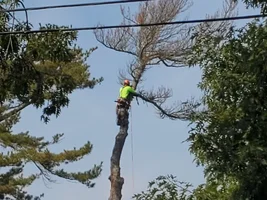
No bucket or crane access or felling allowed, climbing only. If the dead tree is questionable…..Do you spike it and do the old three point with your hands while advancing your rope. Or do you go up the TIP and swing 6ft to the dead tree. I’ve also seen the accessory carabiner on the lanyard trick. Just wondering what the safest way to do this for the just in case the tree fails. How is this done?
 
No bucket or crane access or felling allowed, climbing only. If the dead tree is questionable…..Do you spike it and do the old three point with your hands while advancing your rope. Or do you go up the TIP and swing 6ft to the dead tree. I’ve also seen the accessory carabiner on the lanyard trick. Just wondering what the safest way to do this for the just in case the tree fails. How is this done?
Spiking up a dead wobbly canopy, even if tending your weight into a cozy TIP in a tree adjacent, is likely to set some dead canopy limbs crashing down into you. It kind of gets gyrating and the motion increases as you continue to move up. So if it’s that kind of tree, I’ll ascend up the main TIP and swing / drift over to dead tree. If it’s really disgusting and dead, I’ll clip my lanyard into zip ties on my saddle that would break if the tree failed (in theory), swinging me back to adjacent tree. Aaaaaah!

If it’s more like a dead spar, I might spike up it instead.

If it’s sturdy and dead, I might redirect my main TIP into a stout branch partially up the tree so I don’t have to swing to get started.

Or I might be tied into the dead tree, if no other option is available and I’m confident it can support my weight and the work.
 
What Stumpsprouts said. It's a conundrum - breakaway lanyard. Great to not have the tree take you down with it but what if it breakaways right in the middle of a cut? If you can get a reliable weak link I think it's good. Tip in a good tree is a pretty nice luxury. Belly tweak is when you have to climb above that tip (better than nothing) or commit completely to the crispy tree. Did that once and had definite butterflies barrier to overcome. I became Gentle Ninja:)
 
Remote TIP for dead trees can be a luxury or an annoyance depending on how suitable it is. Facing your TIP and tending slack gently is good, on spurs. If your TIP tree is only 6 feet away I would call that close. Sometimes it’s worthwhile to ascend the live TIP and re-crotch into the highest union and or direct your line into the right channel from aloft rather than hitting a perfect throwball shot from the ground
If I’m going to swing into a neighboring tree it can be comforting to have ground support on your tail to help pull or slow you down if you miss
 
Last edited:
Thanks folks! All good suggestions. I know judgement comes from experience with dead trees. I’m gaining more confidence in my evaluation with every tree. When I cut my dead pine, my gut said high enough when the wobble started. I must be a dead tree magnet since I get the ones that can’t be dropped. Fortunately I’ll just say no. I know a good TIP applies to any tree dead or not. If you use a break away on the lanyard, doesn’t that negate your 2nd TIP? I need another rope or lanyard before cutting? I’m trying to mitigate risk.
 
I climb a lot of dead trees with no good TIP as most of the trees in town have already been burned and removed. I have the luxury of a very experienced mentor, and he has never been wrong. The few trees he was cautious with did end up being super rotten inside, so when he says it's good, I trust him. You get used to certain wobbles, and when you feel it get a bit too punky under your spurs, check it with your hand saw. If you climb slowly and be very gentle with your flipline, you can keep going. Climb high and cut small. A few months ago, I finally got one that had been dead long enough to have almost no branches left. The sapwood had started to rot a bit, but the heart was all there. Ponderosa pine. At the end of the day though, I don't think I would have climbed almost any of them without 65 years of cumulative experience stand next to the trees in question, telling me that that particular tree will be fine, and the two times I backed out, they got up there and did it exactly how they asked me to do it.
 
Another thing to consider is to wreck it from the ground without felling. I don't know if you have that kind of situation, but sometimes one can remotely set XRR and remotely tie off the top, or a piece and use force to pull or pull apart. If the tree is so dead that it's a hazard to climb, what would it look like if the tree failed the night before you were scheduled to remove it? As in, could you help it along while keeping yourself out of the major danger?
 
2 ropes, one breakaway lanyard


This applies to long limb-walks, too, where severing your rope would drop you onto something that won't support you. Often overlooked or considered unneeded when you're rope is behind you and you're cutting on the opposite side, toward the branch tip.
 
Last edited:
Floating at the bottom of a V from TIPs in two trees can be useful
I keep DMNs small rigging hub in my kit. Makes for a great floating TIP above the dead specimen, when actable.
If the floating TIP can be positioned just right, it can negate the need for a flip line. Although I've been carrying the hub for 8yrs, I've only used it 2x. Thankful to have had it available though.
 
If a tree doesn't feel safe to climb, I'll often set rigging lines and break out the crispy stuff first. Sometimes you can get the top out of it, but others you can clear the limbs that you would have to manage while your up there. Less shock and wobble on a stem to clear 2 foot stubs while climbing than 15'-20' limbs (and stubs won't break overhead while climbing).

At a certain point a decision is made, it's either now short enough to fell, light enough to tip tie and rig whole into the nearby tree or the remaining portion that wouldn't break is strong enough to safely climb.


This doesn't work for every tree, but definitely a tool in the box.

An extremely crispy tree with "no felling allowed" is a homeowner problem and not yours. At a certain point you've got to tell them that their flower bed just might have to be smashed.
 
Last edited:
I work solo and I’m very safety conscious. I don’t have a bucket, chipper, crew or crane. I’ll pass or refer something I can’t or don’t want to risk doing. I’m retired and just do this every other week. I’ll notch and pull trees or work the holding wood and in my favor. This tree was between two houses and a fence on the third side. It needed the top out to reduce hitting or causing collateral tree damage. I was overly concerned. It was a recent dead ash. I was surprised by how solid it was and I kept the wood. I tied in the tree behind and the lean let me tend my rope to the side. In hindsight I could have just gaffed it. I really had to sink my gaffs in. The bark was intact and almost zero wobble. I went up to first union, let the top go, came down and dropped it. I did wedge it for extra insurance. Unnecessary but, a backwards fall would have resulted in a hang up and more work. Thanks for sharing your experience. I learn something new often here on Treebuzz! Now..where’s that dead tree? Craig IMG_4127.jpeg
 
Hi - nice thread,

Does anyone have experience specifically with climbing dead Sassafras?

I love the comments about using multiple techniques to break down dead tops before the climb even begins.

The breakaway lanyard conundrum is real!
 
Hi - nice thread,

Does anyone have experience specifically with climbing dead Sassafras?

I love the comments about using multiple techniques to break down dead tops before the climb even begins.

The breakaway lanyard conundrum is real!
I have enough experience with dead Sassafras to know I'm not climbing one! Maybe on real big wood, but that's it, and we don't have big Sassafras around here.
 

New threads New posts

Back
Top Bottom