
If the tree is busy Tim ....it is a base tie, get up and the pick my ideal canopy anchor....if it is a nice open tree then the highest canopy TIP will be choosen, most often a lovely crotch in centre of canopy isolate and cinch with Pinto/alpine/biner....then I get up and advance my TIP higher wrapped around main stem choked....but this all depends on where said work is and type of tree..I climb mostly vrry hard strong trees so TIP can be on some small stuff high up...as long as wood has not been compromised ..many variables but that is the norm....If this thread gets slow, I would love to hear you "go on" about canopy anchors, swingdude. Am I correct in thinking that you do indeed isolate a single branch for your canopy tie? Or do you shoot for getting your rope around the main trunk of the tree all of the time?
Thanks in advance for any responses.
Tim

Navigation
Install the app
How to install the app on iOS
Follow along with the video below to see how to install our site as a web app on your home screen.
Note: This feature may not be available in some browsers.
More options
You are using an out of date browser. It may not display this or other websites correctly.
You should upgrade or use an alternative browser.
You should upgrade or use an alternative browser.
srt cut rope
- Thread starter skew
- Start date

JontreeHI
Branched out member
- Location
- West Michigan lakeshore
Exactly. To me this is an advantage of base tie over canopy anchor everytime. Almost never are you reliant on a single branch for life support, if you set a line w care you are using the whole tree for life support, if psp fails, you may have a gnarly pelvis crushing drop but you might not die. (Rope over multiple branches )I do not think I would wish to hang my life off of a single branch anymore, now that I've experienced the load sharing qualities of climbing SRT.
Also, I'll put a base tie against a canopy anchor in a pull test every time, compression force wins.
Canopy anchor sketches me out. Out of touch with ground support for rescue, etc
Choose tie in points carefully. Throw conservative and then advance, easy to advance a base tie using your tail as a dbld rope climbing system. Cut careful always, no blind cuts, lanyard in.
And enjoy never having to fight a friction saver, a stuck delta, chasing all your redirects just to exit the tree.
Climb free.
Last edited:
I disagree....I cannot remember in over 4 years of SRT getting a stuck anything I have used as a canopy TIP....I also climb like I dive....as if no one is coming...self preservation is a strong force....I am the only climber on my crew so rescue is null and void...I choose solid wood to tie into...not every and anything...this is no joke..serious biz...if you cannot choose a good TIP you have no right in this biz
TimBr
Official Well Known Greeter
- Location
- Northern Virginia
I disagree....I cannot remember in over 4 years of SRT getting a stuck anything I have used as a canopy TIP....I also climb like I dive....as if no one is coming...self preservation is a strong force....I am the only climber on my crew so rescue is null and void...I choose solid wood to tie into...not every and anything...this is no joke..serious biz...if you cannot choose a good TIP you have no right in this biz
Thanks for your post, swingdude. It is good to get the perspective of someone who does things from a completely different approach to oneself, and has managed to make it work so well for so long. It definitely adds weight to your argument, and will cause me to think more about the options available to me.
If you don't mind my asking, why are you the only climber on the crew? I would think that guys would be jumping at the chance to learn from someone like you. It takes a long time to learn how to climb well. What happens if you get injured? Now the whole crew is unemployed, for lack of anybody who can jump in and keep the ball rolling? The lack of anyone to back you up would seem to me to make the whole crew vulnerable, even if only in a financial sense.
Thanks again for your time and comments.
Tim
TimBr
Official Well Known Greeter
- Location
- Northern Virginia
I see the point about the base tie but I wish people would move away from the myths about doubled force, especially without a mention of wood compression as Jon and others have pointed out countless times.
Hey, Levi! Forgive me for having missed this if it went by in earlier threads, but would you mind explaining in further detail what you mean by the post of yours I've quoted above? Are you saying that the forces generated using a base-tie are not really doubled? Thanks in advance for any answers you choose to give.
Tim

Richard Mumford-yoyoman
Been here a while
- Location
- Atlanta GA
It's doubled minus friction, so yes, if you know the friction subtract it.

fall_risk
Participating member
- Location
- Philadelphia
The forces on a basal anchor are described by a 2:1 block and tackle. As with any mechanical advantage system, the theoretical change in force is accurate only in a physics teacher's frictionless vacuum. In the real world, there are losses. The 2:1 of a canopy anchor is extremely inefficient because of friction at the PSP. @yoyoman recently did some empirical testing of this subject:Hey, Levi! Forgive me for having missed this if it went by in earlier threads, but would you mind explaining in further detail what you mean by the post of yours I've quoted above? Are you saying that the forces generated using a base-tie are not really doubled? Thanks in advance for any answers you choose to give.
Tim
Wood is stronger in compression than tension, think of the difference in cross sectional area between a stud and a joist. Loading wood fiber this way comes up in speedlining too, there's a lot of threads on that.
Sent from my XT1080 using Tapatalk

treehumper
Carpal tunnel level member
- Location
- Ridgefield, NJ
Exactly. To me this is an advantage of base tie over canopy anchor everytime. Almost never are you reliant on a single branch for life support, if you set a line w care you are using the whole tree for life support, if psp fails, you may have a gnarly pelvis crushing drop but you might not die. (Rope over multiple branches )
Also, I'll put a base tie against a canopy anchor in a pull test every time, compression force wins.
Canopy anchor sketches me out. Out of touch with ground support for rescue, etc
Choose tie in points carefully. Throw conservative and then advance, easy to advance a base tie using your tail as a dbld rope climbing system. Cut careful always, no blind cuts, lanyard in.
And enjoy never having to fight a friction saver, a stuck delta, chasing all your redirects just to exit the tree.
Climb free.
When you apply the highlighted points to any system then they are safe. You were careful to qualify your words with these points and well you should. This accident happened not due to using SRT but for failing to follow these actions.
You're almost never reliant on a single branch, if you set your line w/ care. How often is a line set that functionally relies on a single point due to the angles, i.e., the vectors?
Choosing tie in points carefully is a process that includes consideration of the species, health, apparent storm damage, angles, size, etc... So, you take that all into account then conservatively choose something bigger than the minimum.
We may be able to assume all this was done in this incident. What wasn't done was your final point, which is the whole point of being up there: cut carefully, not blindly AND with a lanyard or second point of attachment.
Safe work practice is a system not a single item.
JontreeHI
Branched out member
- Location
- West Michigan lakeshore
All good swing, even if it was, my order of thick skin came in yesterday!Jon that last comment was in no way directed at you by any means....
JontreeHI
Branched out member
- Location
- West Michigan lakeshore
Don't forget only w parallel rope angle as well!It's doubled minus friction, so yes, if you know the friction subtract it.
Richard, you are doing some awesome things w hybrid/multiple systems and it's inspiring
JontreeHI
Branched out member
- Location
- West Michigan lakeshore
@treehumper
"You're almost never reliant on a single branch, if you set your line w/ care. How often is a line set thatfunctionally relies on a single pointdue to the angles, i.e., the vectors? "
I'm thinking of doubled rope climbing and canopy anchor, pre redirects. If your tie in point breaks, you drop hard with no parachute.
"You're almost never reliant on a single branch, if you set your line w/ care. How often is a line set thatfunctionally relies on a single pointdue to the angles, i.e., the vectors? "
I'm thinking of doubled rope climbing and canopy anchor, pre redirects. If your tie in point breaks, you drop hard with no parachute.
JontreeHI
Branched out member
- Location
- West Michigan lakeshore
Swing you probably climb monkey pods so that's not fair in the first place
treehumper
Carpal tunnel level member
- Location
- Ridgefield, NJ
Oops, my bad... what I meant was even in a basal anchored SRT that runs over mulitple branches, if it's not set w/ care then it could be that the bulk of the load is on one limb. The care in this scenario is to be sure of the angles of attack between each contact point and how the load is being distributed.@treehumper
"You're almost never reliant on a single branch, if you set your line w/ care. How often is a line set thatfunctionally relies on a single pointdue to the angles, i.e., the vectors? "
I'm thinking of doubled rope climbing and canopy anchor, pre redirects. If your tie in point breaks, you drop hard with no parachute.
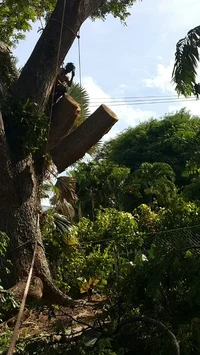
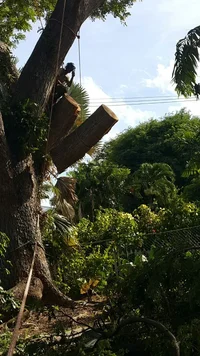
Well here goes Tim....I have trained a few climbers but only one made my cut and has since moved on...because I do most of my climbing, guys here just can't do what I do...they tend to NOT listen and be lazy climbers...I always go the extra mile ....am real particular how I view safety and am efficient with the way I work a tree...these guys burn out of energy real quick....if you cannot get out or up to tips you need not apply....SRT is key working in wide tropical trees with not so great TIP's so you have to be creative...SRT makes things happen fast...my trainees cannot get SRT...anyways at this point it is what it is...guys claim to want to climb ...I cannot allow crap work or dangerous practices on my jobs....Thanks for your post, swingdude. It is good to get the perspective of someone who does things from a completely different approach to oneself, and has managed to make it work so well for so long. It definitely adds weight to your argument, and will cause me to think more about the options available to me.
If you don't mind my asking, why are you the only climber on the crew? I would think that guys would be jumping at the chance to learn from someone like you. It takes a long time to learn how to climb well. What happens if you get injured? Now the whole crew is unemployed, for lack of anybody who can jump in and keep the ball rolling? The lack of anyone to back you up would seem to me to make the whole crew vulnerable, even if only in a financial sense.
Thanks again for your time and comments.
Tim
I do...Swing you probably climb monkey pods so that's not fair in the first place
Attachments

Frax
Participating member
Basal anchors and canopy anchors have different characteristics. What's best in one situation might not be in another.
Canopy anchors are super secure because they cinch the stem. I might install it so it looks like it's in a crotch, but really it's mostly grabbing the main stem. It can't roll either, so if it's not directly in the crotch it's not as big a deal as doubled rope or basal tie.
If you have to move out far laterally to get limbs over a roof, a basal anchor that redirects over the target zone is probably your most secure. In these cases you probably aren't cutting near your base tie either.
The main danger with basal anchors is cutting your own line in my opinion. Don't think it can't happen. (For comparison >>guys cut out their tie ins on removals occasionally either old school or new school.) It can happen. I strongly believe one should eliminate this hazard if you're cutting near the base leg if possible.
Canopy anchors are super secure because they cinch the stem. I might install it so it looks like it's in a crotch, but really it's mostly grabbing the main stem. It can't roll either, so if it's not directly in the crotch it's not as big a deal as doubled rope or basal tie.
If you have to move out far laterally to get limbs over a roof, a basal anchor that redirects over the target zone is probably your most secure. In these cases you probably aren't cutting near your base tie either.
The main danger with basal anchors is cutting your own line in my opinion. Don't think it can't happen. (For comparison >>guys cut out their tie ins on removals occasionally either old school or new school.) It can happen. I strongly believe one should eliminate this hazard if you're cutting near the base leg if possible.

- Location
- Retired in Minneapolis
When I was sorting out SRT years ago and it was starting to catch on I knew the day would come when "SRT"---the climbing technique---was going to be blamed for an injury/death. Since SRT was/is new and not well understood it will be blamed. Like any bias this based on not knowing what is going on.
I've known Skew, the OP, for many years. I trust his assessment of the climber and situation. From what he shared it seems like the climber was bound and determined to hurt himself.
"SRT" isn't to blame anymore than Ford/Chev/Toyota are to blame for innattentive driving accidents. The climber made the mistake not the rope/climbing system
I've known Skew, the OP, for many years. I trust his assessment of the climber and situation. From what he shared it seems like the climber was bound and determined to hurt himself.
"SRT" isn't to blame anymore than Ford/Chev/Toyota are to blame for innattentive driving accidents. The climber made the mistake not the rope/climbing system

Evo
Been here much more than a while
- Location
- My Island, WA
True, also dont forget that goes for every point your rope is touching the tree which can be every limb on the rope path to the base tie. That base tie can be a different tree, truck, house, or any other suitable object (just make sure it's bomber). I have tied into steel railings, concrete piers, chippers, and even a '81 Subaru GL wagon. The Subaru base tie went through the passenger window, out the drivers window, then driver side rear door window and passenger rear window. (don't forget to take the damn keys out and keep them with you)It's doubled minus friction, so yes, if you know the friction subtract it.
Last edited:
New threads New posts
-
test
-

-
 Throwline training and climbing 9/28/26
- Started by ClimbingTN
- Replies: 10
-

-

-

-

