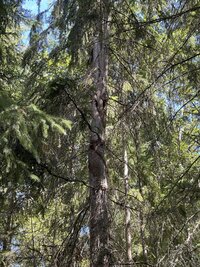
Split Stem Through Bolting

not to think of trees linearly, that they move on more axis than just two, and that they have developed an incredible ability to handle the environment.
EXACTLY! One of the key points of bolting is mitigating torsional forces. All tree failures have a strong torsional element.
That and bolts also mitigate the (us) tweaking of mass dampening design the tree grew into as we are now removing one of the main axis’s out of the equation. The effects are not linear, that force has to go somewhere
 
EXACTLY! One of the key points of bolting is mitigating torsional forces. All tree failures have a strong torsional element.
Ding ding ding.... That's the answer I was looking for....
Do we really need science to understand that bolts can make up for less than ideal cabling scenarios?

The question I was asking is why use bolts in trees that are well cabled... It's all about torsional forces ripping an existing split to the ground, even when the co-dom stems cannot be pulled apart any farther than the cable(s) allow.

Googling torsional forces: The torsion force (sometimes referred to as twist force) is the force applied to the structural member or an object causing one end to twist with respect to the other end. This twist further causes shear stress to be exerted along the cross-section of the object or structural member.

So given that the main purpose of the bolts in well-cabled trees is to prevent further ripping of an existing split from torsional forces, does it really matter if the bolts are installed above or below the crotch?

In all but the most extreme cases, the answer is going to be NO! Any single bolt above the bottom of the split (not the crotch) is likely to be plenty strong. Then double that with two bolts, and there is no way any torsional force is going to increase the size of that split. NFW...

 
Ding ding ding.... That's the answer I was looking for....
Do we really need science to understand that bolts can make up for less than ideal cabling scenarios?

The question I was asking is why use bolts in trees that are well cabled... It's all about torsional forces ripping an existing split to the ground, even when the co-dom stems cannot be pulled apart any farther than the cable(s) allow.

Googling torsional forces: The torsion force (sometimes referred to as twist force) is the force applied to the structural member or an object causing one end to twist with respect to the other end. This twist further causes shear stress to be exerted along the cross-section of the object or structural member.

So given that the main purpose of the bolts in well-cabled trees is to prevent further ripping of an existing split from torsional forces, does it really matter if the bolts are installed above or below the crotch?

In all but the most extreme cases, the answer is going to be NO! Any single bolt above the bottom of the split (not the crotch) is likely to be plenty strong. Then double that with two bolts, and there is no way any torsional force is going to increase the size of that split. NFW...
Ding ding ding, newsflash but there are other factors going on too. The physics behind it all is fascinating.
How about you prove it with research and studies. Or are you speaking only from your anecdotal toilet paper roll?
 
Sounds like there are candidates to be active on the ANSI A300-Cabling and Bracing standard committee.

Get your voice and name out in public and around the world. Share your knowledge and enthusiasm. Its easy to toss a few lines out here to discuss.

Well???
 
Ding ding ding, newsflash but there are other factors going on too. The physics behind it all is fascinating.
How about you prove it with research and studies. Or are you speaking only from your anecdotal toilet paper roll?
Let's discuss that.. what other factors?

Common sense goes a long way when science comes up short in this business...

Does anybody need to see science or read a paper saying that if bolts alone are being used to brace a weak branch union, the higher they are, the stronger they will be?

If you think there is any scientist that can cut, rig, or prune trees better than me, please name him or her. And that's not bragging, that goes for any skilled arborist or tree faller. You can't learn this stuff, sitting in a classroom.
 
Voltaire, and others, have said:

Define your terms and we'll have a short discussion.

Please, in your own words, define 'common sense'.

Your understanding of a support system is a bit off.

The placement of any component has nothing to do with their strength. They have the same strength no matter where they are installed. What support systems do is reduce the load on a weak point in the tree. Sizing component parts is based on work done decades ago with engineers who designed guying systems for towers and antenna. Add to that many years of anecdotal observations has given us the sized dimension charts in the A300 Standard. When the Rope CHallenge Industry was getting ready to write an ANSI Standard for installation and maintenance they had several degreed and certified engineers on their committee. I spent a couple years with them bringing in some tree insights. I learned sooooo much from them about cabling/support systems. In the group ALL of the engineers were installers/climbers. They climbed the climb and talked the talk.

So, what is common sense?

if bolts alone are being used to brace a weak branch union, the higher they are, the stronger they will be?
 
It's neither, it's evasion. Saying what is not something is an example of talking without a leg to stand on.


Oh, wait, defect and attack a dead person... what a class act!!

You may as well lock the thread, now, along with any others with self-aggrandizing, mentally ill, ass-clowns who let there crew chip a rope as they stand on it.
 
  • Love
Reactions: evo
Transcribing a definition isn't your definition.

From a first aid class I took years ago:

The practical application of everything you know.

The common sense of an adolescent is different than a retiree. Since CS is based on knowledge then application the outcome will be different for people given the variables.
 
Ding ding ding, newsflash but there are other factors going on too.


A few days ago I thought of one very important consideration for every installation. Could be cables or bolts.

There is going to be wounding.

Aligning the anchor points one above the other is not a good idea. there is the chance that the two decay pockets can run together and make a large, weak spot. Look at the decay already in the tree and what will be there from our intrusions.

Another thing to plan if you decide to bolt a fractured trunk
 
A few days ago I thought of one very important consideration for every installation. Could be cables or bolts.

There is going to be wounding.

Aligning the anchor points one above the other is not a good idea. there is the chance that the two decay pockets can run together and make a large, weak spot. Look at the decay already in the tree and what will be there from our intrusions.

Another thing to plan if you decide to bolt a fractured trunk
This is a good point. The western red cedar in my photos was braced, cabled then braced and selectively reduced. I posted about it a good number of years ago before I did the job.
I ‘zippered’ the main trunk with a staggered pattern of 3/4” 5’ long rods. Installing 6 (I believe). From there each stem had another bifurcation in nearly exact opposite orientation from each other. I installed two cables to simulate an open triangle >, but since the most ideal location was above the second bifurcation I was concerned about adding f-ed up loads on these much smaller unions. To mitigate those loads in brittle wood (western red cedar can be very brittle and is known to blow tops) i ‘cabled’ with bolts. Then reduced one of each pair of bifurcations.

Each element was thought out extensively. I aimed to go through the rams horns of the split stem to try to gain the most strength and limit decay, as these zones seem to be the most impregnated with defensive chemicals. The second bifurcation bolts were to add anchor to the cables, and the spacing between their stems were so slight a cable wouldn’t have been practical. A rig guy or wedge grip could have worked but it would only leave about 12” of cable exposed and the concern was flex fatigue. The reduction is to lesson the mass flopping around, maintaining tree form, and lessening the loads on the second bolts.

I’ve climbed it every year since, pruned the regen and deadwood just to monitor the rate of potential decline (it has bark beetles going after limbs and shows signs of our classic cedar decline). Last time I installed lag bolts in each crossing limb in hopes of limiting rubbing and perhaps inoculations. It’s rare but I do come across it naturally from time to time.

Eventually I want to learn how to do this!IMG_1374.jpeg
 
Anyone ever find a difference for X-ed bolts vs paralleled bolts (2, vs singe bolt), in overall strength, resisting torsion, decay weakening promoting later failures etc? Maybe its bubbling around in someone's library.
 
Anyone ever find a difference for X-ed bolts vs paralleled bolts (2, vs singe bolt), in overall strength, resisting torsion, decay weakening promoting later failures etc? Maybe its bubbling around in someone's library.
I have only done singles vertically, pairs or zig zag... I have done a x but spaced 1 trunk diameter apart, mostly due to the stems twisting and that was the natural placement
 
But has anyone ever seen a thru bolt fail?

My guess is that it is such a rare occurrence as to defy the development of any practical knowledge about the differences between bolting configurations
 

New threads New posts

Back
Top Bottom