Splicing help for bailout and ultra tech

Me too, I can't wait. I hope after Sampson tests Brion's splice and finds that it meets our industry standard, we will finally get some people to hand splice Bailout for us.

All you splicers out there may have some custom work coming your way for Bailout.
 
Hi again,
First, Ultra Tech is good rope, and Pancake did a nice job splicing it. But its polyester cover is not well-suited to high-heat, high-friction applications like friction hitches. Different tools for different jobs. That's why some of us have been struggling to come up with a splice for Bailout, which has an extremely tough Vectran cover.
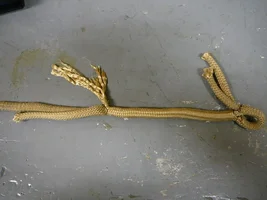
The "Dutch Hat" is a form of core-to-core splice, but is easier to run home, and allows for some "tuning" options, like trimming the cover back if there's too much slack in it,or using the ears to cover core that the cover can't reach.
Anyway, I will now commence attempting to load photo's. Thanks to Kathy for making them postable.
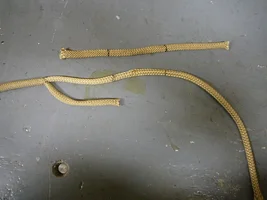
The first photo shows the core marked, the cover skinned back, and the "hat" marked and ready.
Fair leads,
Brion Toss
 

Attachments

  • 147342-Dutch_Hat_in_Bailout.webp
    147342-Dutch_Hat_in_Bailout.webp
    44.3 KB · Views: 232
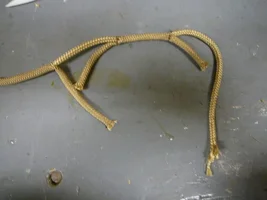
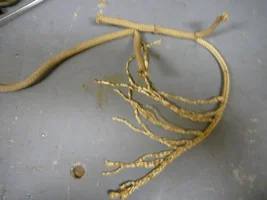
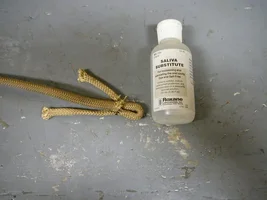
After the core is tapered, run the cover up, adjusting as needed. Ideally it will run right up to the throat of the splice. Saliva, either your own or store-bought, can be a useful lubricant. The store-bought has a fresh, minty taste.
 

Attachments

  • 147348-012.webp
    147348-012.webp
    44.9 KB · Views: 196
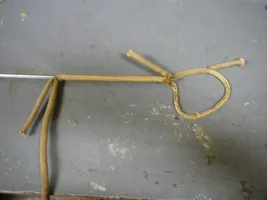
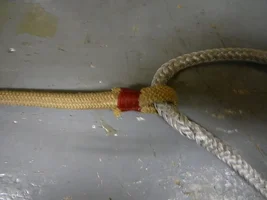
When all is home, whip, serve, tape,or heat-shrink the ears down.
The fine points: the cover will shrink about an inch from the tucking of the core, so I extract the core at a point one inch short of nominal. Then when I pull out an extra inch, it puts just enough slack into the cover to enable it to swallow the splice.
Leave the cover tail on until the splice is almost home. That way it won't ravel or invert as readily. Cut it away to finish.
Secure the ears before covering them. Use a bit of tape or a light stitching, so they'll lie fair and stay that way. A short taper under service, tape, or heat-shrink is a nice touch.
Fair leads,
Brion Toss
 

Attachments

  • 147349-014.webp
    147349-014.webp
    35.4 KB · Views: 197
Brion- great pics! Just a few questions:

From a strength stand point, do you see a reason why the Dutch Hat is needed? Climbers are used to using Beeline and HRC with exposed eyes. I think it might be cleaner to do the same here.

How do you finish the splice? Just whip the hat down over the cover?

How much core did you bury? It looks like a solid 6" or more that might make this already-firm rope quite stiff. Does that sling still hold a prusik when spliced about 26" long? The bailout I spliced had locking brummels and much shorter tails. I've climbed on them, but they haven't been broke-tested yet (in the coming weeks, though!).

I'm glad you're getting involved in the Bailout splice. I called samson a couple times on it and they only answer I could get is, "Bailout is not spliceable." They were sticking to the company line on that one!

love
nick
 
[ QUOTE ]
Brion- great pics! Just a few questions:

From a strength stand point, do you see a reason why the Dutch Hat is needed? Climbers are used to using Beeline and HRC with exposed eyes. I think it might be cleaner to do the same here.

[/ QUOTE ]

Hi Nick,
The hat is for protection from chafe, cuts, and UV; it adds nothing to strength. A hatless version would be just as strong, and you could run the cover up and secure it at the throat instead.

[ QUOTE ]
How do you finish the splice? Just whip the hat down over the cover?

[/ QUOTE ]

Yup

[ QUOTE ]
How much core did you bury? It looks like a solid 6" or more that might make this already-firm rope quite stiff. Does that sling still hold a prusik when spliced about 26" long? The bailout I spliced had locking brummels and much shorter tails. I've climbed on them, but they haven't been broke-tested yet (in the coming weeks, though!).

[/ QUOTE ]

9" tails, which is still really short, so I'm not expecting ultimate strength, but longer tails would disable the Prussikability, as well as being impossible to splice. So what I'm going for is a high enough break strength for a reassuring safety factor. Hoping for at least 2,000lbs. As for the Prussik, I thinks so, but let's do the test first.
Locked brummels seem unlikely to approach that, but I'd love to see test numbers. Samson describes this stuff as liking knots, but my experience has been that knots weaken HM too much. Plus they're clunky, for this app.

[ QUOTE ]
I'm glad you're getting involved in the Bailout splice. I called samson a couple times on it and they only answer I could get is, "Bailout is not spliceable." They were sticking to the company line on that one!

[/ QUOTE ]

So it's a wonderful thing that they have graciously offered to test this sample. Not a statistically significant number of tests, but if the first one is encouraging, we could always do more.
Fair leads,
Brion
 
Hi everyone,
I just realized that I never posted the results of the destruction test that Samson did for a Bailout splice. My apologies.
Attached you'll find the report from the test, along with some photo's. As I had hoped, the Bailout broke at a high enough load (about 5,000lbs) to qualify the splice for work at a fall-arrest level. That's a good start.
Some further background: note that the rated strength of Bailout is about 700lbs less than our break strength. This might seem odd, especially when you consider that the splice I used was completely core-dependent -- we only used half the potential total strength of the rope (or less, as it is possible that the core is actually weaker than the cover). But it makes sense when you consider that this rope is officially "unspliceable", so it would have been tested with knots, likely a capstan or other hitch, and knots will reliably weaken HM rope by 60 to 70 per cent.
A bit more background: I am fairly confident that we could get an even higher break strength had we attached to a thimble and shackle, or even a carabiner, instead of to a Spectra loop, but I wanted a worst-case tight radius; with a fatter radius, I would expect the eye to hang on, and the line to break in the standing part.
So if you do the math, it appears that the splice we used approached 100% of core strength, and that was easily more than the best results you could get using cover and core. One practical advantage to the splice, then, is that a chafed cover does nothing to reduce break load, whereas a chafed cover with knots could take out 50% or more. The same would be true for the cover-dependent splice variation that I have seen for Bailout.
One more detail: you'll notice that the eyes are covered with "Dutch Hats", so there's no uncovered core. Again, this does nothing to increase break strength, but it does protect all parts from chafe and UV. If neither of these are problems in this application, it were simpler to leave the eyes uncovered. A conventional core-to-core splice would also cover the eyes, but it just won't work, at least not readily, in this very stubborn rope.
Fair leads,
Brion Toss

ps,
Many thanks to the folks at Samson for running this test!

 

Attachments

Awesome brion! Couple questions:

1- Locked brummel splices?
2- How far did you bury the tail?
3- How much of the tail was tapered?

I ask because I made one with less than 3" of buried tail. This is effective when being used as a friction hitch. Longer tails create stiffness in the cord which is less than ideal for tying knots. The core of bailout is a bit peculiar. It's a little tight. I wanted to bury even less!

I think it is good that you didn't use thimbles. I'm sure no climber would actually use thimbles on this rope when tying their climbing hitches. Your test is a accurate representation of how it would be used. Actually, most 'biners are about 1/2" thick, which is a much better bend radius than the cord you used!

Cool stuff. Thanks for sharing it with us.

Will samson be printing up splicing directions for us all to use?

love
nick
 
Hi Nick,
10" tails, no Brummels, locked or otherwise (but thorough stitching), taper started after about 8 diameters, then smoothly down to a rat-tail.
Brummels + vestigial tail bury is another way to go, of course, and I would love to see break tests for this. In tests we have done, multiple Brummels broke in the mid-70's, but singles were usually down around 60, or less. My aim was to produce a splice with high strength that was still flexible enough to perform for the application. I think I succeeded, but, uh, I still haven't made up another sample for Kathy to try out. I better get on that.
As for the radius, my thought is that the Spectra will neck down to some extent, just because it is soft, presenting a tighter radius than a carabiner would. Might be a moot point.
As for Samson printing up instructions, to my knowledge they still officially consider this rope "unspliceable". You'd have to talk to them about why.
Fair leads,
Brion Toss
 

New threads New posts

Back
Top Bottom