Spider Lift - Usage Tips & Tricks

If you have room in your basket mount 2 scabbards..1 for a top handle and 1 for an 18". Then when you get down to larger wood switch the top handle for a large saw.

Having the right saw for the job right at your elbow will save a lot of time.

Best of luck to you!
We do that one as well. We have a fiberglass bucket mounted on our lift, so we have an inside mount scabbard for the little saw, and an outside mount scabbard for a bigger one. The outside mount allows us to hang any length saw, so you can put something big up there when need be without the bar tip stuck into the floor of the bucket.

Also, I have found that it is often faster to make more cuts, dropping smaller pieces with the lift rather than climbing where you drop as big of pieces as you can. The lift moves fast enough that sometimes it’s quicker to just drop a lot of little pieces than it is to rig something bigger.
 
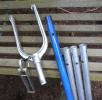
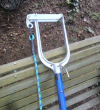
Here are a couple of photos of my 'Conifer Climber' that I made for a few of us several years ago. I might gear up to make a few more of these soon, if there is interest. I would need a couple hundred for one (shipped free in the Lower 48) and customer would supply there own pole(s). My own extends out to 16 feet, uses the same pole as one of my hand saws, and I love the thing. It is great for moving TIP up through one of these big conifers with lots of smaller limbs in the way. Note: I did not invent this gadget. There was a similar device years ago for boaters called a 'Happy Hooker' for putting a mooring line around a piling or something. All I did was make a foundry pattern to cast a smaller version in aluminium that can handle a limb about 4 or 5 inches in diameter. Anyway, let me know if there is any interest. I am going to have some free time in the next month or so, to make some again.
hooker1.png hooker2.png


Not sure if lift owners have seen this device. I'm thinking mine will get more use setting rigging lines when just the right place is out of reach even with a lift.
 
One other trick or important point I just remember being shared with me...as I understand it, when going up or downhill it is best to have the tracks drive motors positioned on the downhill side. This enables the tracks to be kept under tension.
 
Hmm, now, with a clearer head in the morning I'm wondering. The whole point was to have the tracks with tension on them in such a way that it's not producing slack at one spot. That drive sprocket pulling from uphill would seem to do that less than if turned around and pushing the track. I'm not sure.

I'll have to wait for an experienced person who knows the Easy Lift to weigh in. I doubt it's any different than CMC or others - physics at play there. My apologies.
 
Hmm, now, with a clearer head in the morning I'm wondering. The whole point was to have the tracks with tension on them in such a way that it's not producing slack at one spot. That drive sprocket pulling from uphill would seem to do that less than if turned around and pushing the track. I'm not sure.

I'll have to wait for an experienced person who knows the Easy Lift to weigh in. I doubt it's any different than CMC or others - physics at play there. My apologies.
Check your manual and do what it says. CMC requires the basket uphill due to the weight balance of the machine, the basket end is heavier. Run uphill the other way and you’re more likely to stand the machine up on its tail, and it’s a royal pain to get it back down on the ground and up the hill that direction. I learned that one from experience.
 
At TCIA this year I was very appreciative of lift owners taking the time to talk with me as I was making my final decision to purchase.

Just an idea like when matting in, I can leave a foot between mats sounds like it will save a bunch of time and effort. I've never used mats for any of my work. Am thinking of going with 2' x 6' with hand holds - Alturnamat.
Welcome to the simple inside community, Merle. Congratulations! We place 3 by 4 mats chopped mats under sliding outrigger pads most always and definitely when on soft soil , it helps get maximum side reach when needed. The 3 by 6 size are are nice, as well we have 20 of them because they aren't too heavy yet give room to maneuver or set up on outriggers. When driving on the dunes or thick pea stone yards mats are usually necessary ,mostly for under carriage preservation and less chance getting stuck. I've snapped a track in beach sand when I came off the mats on side slope tried to recover and had sand wedge in so tight it ripped , luckily I had room to jack machine onto outriggers and replace onsite hindsight I should have lifted nachine and place mat under. The machine had over 1000 hours when this occurred and the tracks were fairly worn because we do alot of tracking and although we mat for turns on the non tread side , another thought I just had on mats get one tread side on one no tread... We find for lift the tread down to ground, slick side up is best for turns as the machine glides on slick side right into position.
Your 100 is vastly different operationally than my 70 , so I can't comment much more than that I don't think. We've had our easy lift since 2019 and it's shy of 1800 hours now. We bought a crane last year , so time in it has lessned, mostly for pruning and assist removals tight spots crane can't access.
Obviously what was said about don't hit your machine, no Brainer there.. We work on many tall trees sometime well over our lift height, I needed a 70 more so for the very compact footprint for the tight yards I frequent , I can deal with tree well over head. In regards we have made ways to rig and set up cuts rigged to intiate piece movement with tag lines mostly , once lift has boomed out of harms way if it's tricky or there's any chance to touch the lift. My machine doesn't have the massive side reach of yours and your height is great , so maybe this won't apply for you as much. If I think of more I'll get back in the thread.
 
I pull mine on a 22' PJ tilt trailer, not enclosed. Enclosed is probably a good idea if you don't have a garage you can pull it into at night. But I have a big garage so I like non enclosed better. You could make it work with a 20' trailer but I like the extra length to put a couple of big tool boxes on the front of the trailer to keep all my slings for crane work and saws everything else so I can pull the lift with any of my trucks and all the gear I need will go with it.

We almost never rig any more. Too slow. If we can't safely bomb it down we use a crane. Its a lot easier to safely drop without rigging on the easy lift because the way the lower boom is you're almost always working 20-50' away from the lift. When I had a CMC I was working right above the lift a lot because of its shorter outreach which makes it harder to get pieces to the ground without a risk of them bouncing into the lift.
 
Bck. :) Smart ass answers asside. I've been looking at lifts for six years or more, tried at least 3 or 4 others observed the staff and listened over time.

Not only do I like the machine and how it's built but given that I expect to need help with technical issues through its working life I have a high degree of confidence I can get that heip from the team at Upequip. (Personal dealings and reports from others.)
 
Maybe been said already , just spitballing some gimmes.. Always load and unload with outriggers low to ground, as possible on /off trailer / or on slopes. I prefer to jack outriggers drive out from under and even back under quite a bit.
 
Telescoping through the crown
Then jib up or down your in a new work area.
So many new angles of approach become visible.
Don't get stuck in one spot. It takes five minutes to come down reposition machine for new out look or that one pesky limb otherwise non reachable from first setup
 

New threads New posts

Back
Top Bottom