Smashed Trunk & Bark: Opinions

mdvaden

Participating member
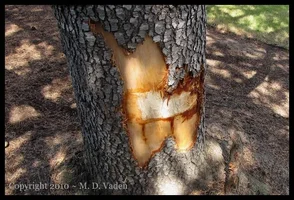
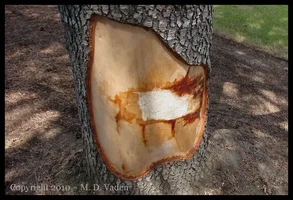
This is an Atlas Cedar trunk that was bashed with the bumper of a construction truck or its trailer about a year ago.

When I went out to this tree, I noticed that some of the fairly thick bark had been separated, but was still moist.

Most bark was intact. But the loose spot - I think the upper right - could be pulled away like 6 inches worth.

So I used a few small nails to pull the bark tight against the moist wood. So I guess what separated was bark with cambium and phloem. It was fastened to keep it moist and seal out air. A tight fit resulted.

My question is ... do any of you know from experience or from university research, if bark and tissue fastened back like that, will continue to grow and develop in the future?

Here are the before and after pics.

269140-Cedar_Trunk600.jpg
 

Attachments

  • 269140-Cedar_Trunk600.webp
    269140-Cedar_Trunk600.webp
    77.8 KB · Views: 70
In Chicago last year at the ISA conference one of the speakers covers the wound with black plastic. He stated that with keeping the wound moist and wrapped he gets wound wood to grow over the entire wound.
 
[ QUOTE ]
In Chicago last year at the ISA conference one of the speakers covers the wound with black plastic. He stated that with keeping the wound moist and wrapped he gets wound wood to grow over the entire wound.

[/ QUOTE ]

Did he happen to have any photos of that?

Sounds like the cambium did did not pull away with the trees he did that too.
 
[ QUOTE ]
http://www.treebandage.com/ You could try this stuff.

[/ QUOTE ]

That site offers no proof or evidence that it works. The page begins with a photo of two trees shown from such a far distance, no detail can be seen.

Going back to the OP ...

Have you seen any examples of re-fastened bark-to-cambium surviving and continuing to grow?
 
[ QUOTE ]
You could always apply some Lac Balsam, at the least it will make the wounds less noticeable.

[/ QUOTE ]

Right now, this is a year in the past, and I'm not treating it.

What do you know about whether bark fastened-down being able to sort of bond again?

That was the question in the OP.

Wish I knew the address for this place. I may dig through some papers so I can go back to the tree later this year or next.
 
I don't have any helpful evidence Mario, but I think an important question is: What specifically is being separated when bark is damaged in this way? I would think that the vascular cambium and the phloem are separated but I'm only supposing.

This interface that easily pops apart seems to be common to most species. My guess would be once this separation occurs, the bonds that join the living tissues are severed and cannot 'heal.'
 
I would agree that the living tissue in that area is done for, but trees don't "heal" anyway. I believe it could compartmentalize the wound over time. Whether it has been compromised beyond help, only time will tell. I don't know much about Atlas cedars, or true cedars in general because we don't have very many in S. Carolina. I have seen about 30 or so Sweetgum surrounding a pond that I fish at that have had all of there bark stripped down to bare wood, much like the wound on this cedar, except all the way around. This has been done by beavers in the area. Contrary to what I would have thought, and contrary to a fellow arborist friend of mine, these trees are still alive. We both await every spring (for 4 years or so) to see how much die back will be evident and so far they bud out every year. I know it can take some time for this kind of wound to become fatal, but it is still quite mind boggling. From what I have been taught and read, I don't know how they are transporting nutrients and water up the trunk.
 
There was a good thread on this here last year I think. Had good success with nailing down the loose bark the plastic was discussed as a good thing for the short term. Conifers, pinaceae, had the poorest success though. Best on some deciduous. So I'd describe the injury as the beginning of the end. Could be thirty years in the making but decay, ants, woodpeckers and chainsaws are in that trees future I'm afraid.
 
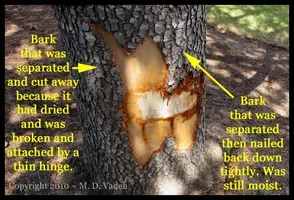
This might illustrate what I wrote further. The bark on the left was pulled loose and attached like a hinge of the outer bark. So I never nailed the left side. Just the upper right hand area.

269290-Cedar_Trunk600B.jpg
 

Attachments

  • 269290-Cedar_Trunk600B.webp
    269290-Cedar_Trunk600B.webp
    86.1 KB · Views: 24
you also could have used some twine wrapped around tightly and then cover the whole spot with a black trash bag and seal it with duck tape until the bark has fully grown over. i have done this with a eucalyptus and it works fine.
 
Over the years there have been anecdotal comments about tacking down bark. In most cases the reports were that at least some of the area reattached. In most cases the loose bark was tacked/secured within a few hours.

From what I understand is that if the bark isn't put in place and wrapped to keep it moist the cells die and there is little hope of reattachment.

On the other hand...there's not much to loose. I'd tack/secure/wrap any bark that was still moist and give the tree a chance.
 
Well, I guess I should let out what I have learned.

But then Bartlett or Davey or some other big outfit will do a test on it and act like it was their own idea like always.

I'm reluctant, but should share I guess.

Over the past 4 years I've tried some things on damage like this.

attaching loose bark with nails is good, I usually use aluminum flashing nails so it won't really hurt anyones chainsaw or chipper in the future.

I bark trace a little, if it is shredded bark.

Quick response is very important, especially in summer heat.

The big news: Apply a lumber wax. I buy from Baileys. Do not buy the winter mix, as it has some kind of antifreeze in it.

Apply thick.

Then wrap area with burlap to stop the UV damage.

I tried just the wax before. It was amazing, I've seen bark produce right from the bare wood, in little circles.

but then, the area would die.

I figured it was because the wax was clear and the UV light eventually killed the cells.

I then started waxing and burlapping and more tissue seems to stay alive.

try it
 
There was research done in Wisconsin some years ago that showed how beneficial using saran wrap over wounds was to stimulating new growth. The research used clear and black with better results from black. the research was presented in The Journal of Arboriculture, the ISA should be able to search it out for you.
 
[ QUOTE ]
Apply a lumber wax. I buy from Baileys. Do not buy the winter mix, as it has some kind of antifreeze in it.

Apply thick.


[/ QUOTE ]

Is that what woodworkers use to seal the end of logs to store it while is slow-dries?
 
[ QUOTE ]
In Chicago last year at the ISA conference one of the speakers covers the wound with black plastic. He stated that with keeping the wound moist and wrapped he gets wound wood to grow over the entire wound.

[/ QUOTE ]

Yup this is the way to go. No one asked him about which species worked better. The thing is you have to cover it pretty much right after the wound happened. If it gets dry you are out of luck
 

New threads New posts

Back
Top Bottom