Smashed Trunk & Bark: Opinions

Not wanting to be too much of a dick but if you have to use this treatment quickly that would mean you caused the injury. So the ultimate solution would be to slow down, take smaller pieces and quit smashing trees. Or look where your driving your bobcat.
 
[ QUOTE ]
[ QUOTE ]
Apply a lumber wax. I buy from Baileys. Do not buy the winter mix, as it has some kind of antifreeze in it.

Apply thick.


[/ QUOTE ]

Is that what woodworkers use to seal the end of logs to store it while is slow-dries?

[/ QUOTE ]

yes
 
I apologize.

I had wanted to make sure that I could upload the Gilman illustration, so I opened the thread to check that the picture would appear, and then went back to writing. I didn't know that this would stay available to the readers while I was off chattering at my machine. I'm deleting those edits and getting back to another writing program because I discovered previously that if I have stepped away from the buzz post box here, everything would disappear in my trying to go back.

Having watched my work disappear with such grace and finality so many times really ticked me off, so I've now learned another lesson--don't think aloud in incomplete thoughts where others can watch. Oops, looks like I mixed a metaphor.

Mea culpa.

Tubbs
 

Attachments

  • 269535-gilmancambiumcopy.webp
    269535-gilmancambiumcopy.webp
    34.3 KB · Views: 60
[ QUOTE ]
Not wanting to be too much of a dick but if you have to use this treatment quickly that would mean you caused the injury. So the ultimate solution would be to slow down, take smaller pieces and quit smashing trees. Or look where your driving your bobcat.

[/ QUOTE ]

You might not "want to" but you just can't help it.

It's okay.

No, it's not from me or co-workers causing the injury, but I'm sure it's happened once or twice. OH, I remember one where it was me, I felled a log that beat up a small sassafras tree, I then learned the people actually liked it; so yes, that time i did go and get the wax, tree bark wrap paper and mend it up. (Oh, and I often use the tree wrap paper too, instead of burlap).

but otherwise no; we are not causing the injury smartass.

the ones that come to mind have been when I've been called to evaluate a tree after an auto accident, multiple times. Also when a big limb split off of a tree from (natural means) and the butt of the limb slammed back to the main trunk knocking off bark. This has happened serveral times.

Also we have waxed up two lighting struck trees that i can think of. A Norway Spruce and a Kentucky Coffee tree.

Also, I've had customers want something under 15 feet tall taken out. I have ripped them out of the ground with skid steer and if they had decent root, i planted them at my house. well, quite a few times, I've skinned them really bad, sometimes taking off all the bark, so I wax and wrap them. I should post some amazing pictures of a deodar cedar I have. A seperated thin strip is the only cambium that stayed alive and it feeds the whole tree.

I was called to look at a tree damaged by another tree service once, but they called me too late, it was a week later in the hot summer. We tried it, but i explained we weren't likely going to keep that tissue alive; maybe just help the outside edges not die back as far. Tree died 2 or 3 years later.

on lighting strikes, the wax also does a great job hiding the area to keep out bark beetles or ambrossia type beetles. It happens in the summer usually, and lots of those buggers flying around sniffin' the air. That norway spruce we did, didn't have any shot holes in that naked wood months later. Normally, it would have been rittled with them. We didn't wrap that one. just waxed to help retain some moisture and keep away the beetles.
 
[ QUOTE ]
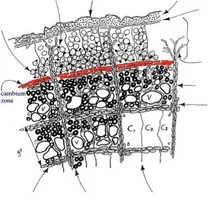
The photo below is from Gilman and I like to use it in explaining the many perceptions and impressions about what goes on under the bark of most trees.

[/ QUOTE ]

269535-gilmancambiumcopy.jpg


In other words, the Cambium is like maybe 2 or 3 cells deep?
 
[ QUOTE ]

The insight that everyone is asking about requires us to understand what the cambium is and what it does. I'll state again that I'm making no personal comments on anyone, but we have to again suspend our disbelief and look critically at the dogma and the clichés that keep us misinformed.

The photo below is from Gilman and I like to use it in explaining the many perceptions and impressions about what goes on under the bark of most trees.

[/ QUOTE ]

yes, I want to understand better, because things I've experienced these past few years don't seem to make sense from the biology I learned in college.

1. Trees alive for many years, with no bark due to horses chewed it all off the lower trunk. Wood exposed is dead.
(I finally got to cut down 2 of these mysterious trees) One ony had about a 3 or 4 inch section just under the surface that was alive, supplying the tree, on a 20" diameter tree. the rest of the circumference was extremly rotten.

on another horse tree (no bark and dead grey outside wood, but live top), when I cut the tree down, just inside the outer dead 1/16 to 1/8 inch surface, cells were alive and supplying the tree.

2. That deodar cedar in my yard. I had dug and picked the tree up with a strap that skinned the trunk all the way around. I waxed and wrapped with burlap and tied with string for over a year. Tree very much alive, but only a one inch strip survived on that 6 inch diameter tree. But here is the interesting part; the strip is not attached to the tree, it floated off away from the wood. It looked like just bark thickness, but must have entire cambium as it keeps growing and expending in all directions now. Will it produce heartwood after a while? It must have xylem and phloem for tree to be alive, what, I think 4 years now. I figured thin bark area like that would not contain both in such a thin ribbon of material.

Then trees or limbs surviving a chain or cable girdling them. growing past the strangling material and then mending back together with no bark seam.

really cool stuff that i want to understand better.
 
[ QUOTE ]
I would agree that the living tissue in that area is done for, but trees don't "heal" anyway. I believe it could compartmentalize the wound over time.

[/ QUOTE ]


CODIT's 1,2, and 3 can apply in a minor way to this kind of wounding in trying to protect the tree, but CODIT 4 which is the strongest and most effective compartmentalization can only occur with the cambium present and alive. If the cambium ain't there, there is no Wall 4.


[ QUOTE ]
Contrary to what I would have thought, and contrary to a fellow arborist friend of mine, these trees are still alive. We both await every spring (for 4 years or so) to see how much die back will be evident and so far they bud out every year. I know it can take some time for this kind of wound to become fatal, but it is still quite mind boggling. From what I have been taught and read, I don't know how they are transporting nutrients and water up the trunk.

[/ QUOTE ]

I'd like to take up your questions in another thread because textbooks and PowerPoint presentations really don't do a good job in explaining the actual tree processes so we can internalize that knowledge and feel comfortable in looking back and thinking about them.

With most things we've been taught and we've read, they've only had to repeat previous things to get printed on a page or slapped up on a screen. Real teaching should provide an awful lot of AAHA moments. When that happens, mind-boggling can't continue.

Maybe we could call the thread, the de-mind-boggleization of general treedom.


Tubbs
jiggy.gif
 
[ QUOTE ]
I don't have any helpful evidence Mario, but I think an important question is: What specifically is being separated when bark is damaged in this way? I would think that the vascular cambium and the phloem are separated but I'm only supposing.

This interface that easily pops apart seems to be common to most species. My guess would be once this separation occurs, the bonds that join the living tissues are severed and cannot 'heal.'

[/ QUOTE ]


--------------------


The insight that everyone is asking about requires us to understand what the cambium is and what it does. I'll state again that I'm making no personal comments on anyone, but we have to again suspend our disbelief and look critically at the dogma and the clichés that keep us misinformed.


The illustration below is from Gilman and I'd like to use it in helping to explain the many perceptions and impressions about what goes on under the bark of most trees.

269535-gilmancambiumcopy.jpg


The red cells are the cambium that I call the gossamer engine and I have tried to explain for many years that a perspective that understands the importance of cambium and its functions, will make a great deal of difference in how we think about, and what we do to trees.


When I talked about “microsurgery” on problems like included bark, I was explaining a technique for 1. Minimum intrusion and wounding, 2. Minimum exposure to pathogens and elements, and 3. A basic concept that once the two separate woody cylinders of included bark are reconnected as a single cambium, the tree will never go back again to that condition of included bark.

That included bark will be left behind as a defect and we can pridefully expand our roles as stewards using new techniques that fit into Alex Shigo's discussions of Modern Arboriculture. (With Mario's permission, later on I'd like to use some of his photographs to illustrate the correction processes that trees do naturally and we might have overlooked.)


---------------------------

As I said, the red cells are the cambium and Gilman and I are in agreement that the cambial layer is extraordinarily thin--I describe it as one cell thick which is the opinion of many scholars and I will concede that nature is wet and sloppy, so she can have a few cells out of sequence in development that can constitute a cambial zone.

The cambium is a magical place where those red cells can be considered to float around in a liquid and push quietly sideways and forward between the hardening walls and structures of the dedicated xylem and phloem produced as daughter cells. Think of it as a smear of Jell-O in between two sets of types of cells that are being strengthened with lignin and cellulose that will never divide or rmove again.

As the phloem and xylem mature, they strengthen and are cemented together by all of the chemicals and products described in textbooks that make up the A, B, C, or D questions given in tests that we all hate, or at least I did.


I suspect that if we had a perfectly circular tree trunk out of dormancy, and cut it all the way around at the top through the bark and then cut that section again 12 inches below, we would be able to grab it with two hands and rotate the section as a band of bark. Everyone already knows, with the appropriate blade that we could cut a square out of a bark, take a look at its underside, and stick it back in the hole. Minimum cut, minimum exposure, and a couple of nails will keep it in place. (Mario would be pleased that I'm endorsing simple nailing back in place as a perfectly valid and practical technique.)


There have been many experiments where a square of bark was cut out of the trunk and then rotated 180° before being placed back, which implies that the xylem and phloem would be transporting in the wrong directions. But not to worry, when experimenters would go back to examine the misplacements, the tree would've already figured it out and the flow directions would be corrected.


Let's also go back a number of decades where the method for determining if a tree had come out of dormancy was to cut a circle of bark with a hole saw and attach a little lever that could be tugged at by inquisitive scientists. If the circle didn't move, the tree was still dormant. When it moved by twisting at the lever, that was the proof that the cambium had regained its semi-liquid state and was prepared to get back to seasonal work.


My point here is that the cambium zone is a place of natural separation used by scholars twiddling circles, or car bumpers saying, “Watch this ! ”


(As an aside, I'm not sure that I would call the cambium an interface as in the quote because that introduces other distracting themes and considerations in the mechanical or digital worlds. Again this is not a criticism, after all I described it as a smear of Jell-O.)

-----------------------


So it's pretty much established where a separation will occur, and it's likely that the velocity and power of a car bumper can peel off a considerable amount of bark whether or not the gossamer engine is in dormancy. But Mario's opening question included, This is what I found, and this is what I did in my thinking; is there some outside support for what I hoped to achieve?

-----------------------


Back when I was at the Chicago Park District, I photographed one of our arborists attending to a tree in the Soldier Field parking lot that had a big chunk of bark knocked off by a car with a celebrating occupant at the home of Da Bears. What the veteran arborist did was the classic repair; cut the loose bark back to solid bark, trace, and throw all the old bark away.

I took the pictures because I was trying to understand the philosophy and the repair techniques, and later came to the conclusion that I didn't like them at all. I began to think of them as dogma and rote, and myy arborist was sincerely trying to correct the damage by making it easier for the tree to recover the damaged area.


As I now think of the problems, I absolutely agree with Mario's nailing the still moist section back in place and securing it to the xylem surface. There's an excellent chance that the cambium can be reestablished over that area that is in the natural environment for cambium growth. I also would've nailed all the other pieces in place, doing the best job I could of fitting them tightly against each other to minimize the places for outside intrusions of the elements and pathogens.

The arborist in my photographs discarded all the bark pieces, mostly because they had been desiccated and heated by the sun, and by the time taken between the accident and his being assigned to deal with the problem. Saving the pieces weren't part of dogma.


---------------------------------


Okay, let me mutter about the conditions and processes as I think I see them:

If Mario replaces all the bark as tightly-fitted as he can, including the one he saved, they will be remoistened by the routine transport of water as the trunk continues in its usual business. Even significant bark desiccation will be significantly corrected by the ever-present movement of water through the symplast and the apoplast. Again re-wetting will be maintained except perhaps at the joint lines where there is a space between adjacent pieces of bark.


As I've been told in some texts about this kind of wound, cambium generally goes along with the bark. I don't know if that's true or not, but it's reasonable, so I'll assume that most of the cambium is stuck on the bark exposed to the sun and air, and won't live very long (?). If that's the case, where do I get the feedstock for new cambium? The cambium will have to theoretically grow in from the edges of the wound as is the dogmatic expectation of chisel and trace.

Well here's where I think the magic comes in. With what Mario did, and if I told my arborist just after the accident to put all of the pieces in a plastic bag with some water and keep it out of the sun, I will have slowed or stopped the desiccation and had much better material for re-nailing.

(I've also never understood why black plastic is the choice of experimenters or the lecturer. Why would I keep the things that I wanted to stay alive in a black solar cooker?

I use white plastic. If sun-scald exists as we describe it, why would I want to further introduce heat to the injury?)


----------------------------------


Another okay. We all know it will take a long time for the damaged area to be covered through the process of growing in from the sides, top, and bottom.

Let me explain the faster process for us to be better stewards:

1. Our re-nailing has crudely reestablished the conditions and positions of the bark and the wood. Those wood and bark areas will be re-wet simply because they're placed flush against already wetted xylem. Diffusion takes care of moving water--and sugars--into the damaged areas.

2 Even if all the original cambium has completely disappeared where we re-nailed the bark, parenchymal cells are available in rays and adjacent structures. It is very likely that they will take on the initial function as space-fillers and grow into the many voids. Then because trees are totipotent, those parenchymal cells will have the ability to become meristematic and form new cambium.

3. There is no requirement that they act in any orderly fashion by our ideas of order; spotty and scattered groups will be quite sufficient. So, instead of slow, orderly growth in from the edges, we have a localized spread very much determined by the surrounding conditions to accelerate or slow new cambium growth.

4. Please absolutely remember that cadmium stays faithful to its internal discipline of being 1 or 2 cells thick. Any further division must produce either xylem or phloem cells which never divide again after maturity and stay the dedicated cells we know as wood or bark.


269535-gilmancambiumcopy.jpg


This is not a bonding layer or zone. It is the reestablishment of the gossamer engine which then sets about this task of producing xylem to the inside and phloem to the outside. Once established, those two different kinds of x and p cells take over their expected functions. They will continue their jobs throughout their lives until xylem reaches it's pre-programmed death, generally dictated by species, and the phloem is crushed in creating thicker bark.


----------------------------------

PS: To me, the design of the storied vascular cambium in a number of species of trees is staggeringly beautiful and smart. I have built my own perspective about trees around the gossamer engine, and as I have said before, if the cambium hadn't been there to create the woody cylinders, leaves would've had to be hung on spiderwebs


Tubbs

jiggy.gif
 
thanks Tubbs, I enjoyed reading that.

Hey, it sparked an idea.

lets say a big historic Red Oak tree gets hit by a car and looses a huge patch of bark and that bark is all broken into tiny almost unusuable peices.

I bet I could go get donor bark from another Red Oak and attach it with nails and it might take. What you think?

We usually have so much work saved up to do, that I could likely just visit another red oak that is scheduled for a take down and take a large section of it's bark, put it in a wet bag or cooler and do a "transplant" of the tissue.


Did you address any of the things I mentioned? Were you saying if the bark was missing, cambium is gone and there's no way it can produce bark and all the cells again?
 
[ QUOTE ]
"The gossamer engine"...sorry to juxtapose such and elegant statement with one that is so mundane and sophomoric, but...that rocks!

[/ QUOTE ]

Thank you. And I should tell you that you would've gotten an extra Buzz Board CEU point if you had written, “... that barks!"

I'm very pleased with the name, which I wanted to be as potent and attention-getting as possible in describing the cambium.

For those of you who haven't heard it before, I wanted to push these two individual words right up against each other and create a conceptual tension for an audience. I Intended the contrast between gossamer, a diaphanous sheet, to be stuffed right tight against engine, which is a powerhouse, a source of energy.

Magnets resist having similar polls pushed together. With really strong magnets, you can bloody your knuckles trying to get them even near each other. That's what I wanted, this unavoidable agitation, to be in people's minds when I talked about the importance of the cambium. interestingly, the phrase turned out really well and has become quite a respectable label for a beautiful biological design.

There are many different kinds of cambium, some dramatically different from the example that I use, but nevertheless they are entitled to the same admiration of nature's many decisions and instructions for life and survival.

My illustrative cambium actually exists as storied cambium, and I use it to help explain the mathematics I have found that are used by trees to grow into the largest and longest-lived creatures.

My gossamer engine is one cell thick and happily defies Errera's Law. Back when I was starting to learn about trees, I didn't have the biological or mathematical vocabulary to properly phrase the questions about what I thought I saw in the shadows. I've learned a bit since then, but I've also discovered that it's very difficult to get people to listen.

Thank you for doing that.


Bob Wolfowitz (that's what my voice recognition system thinks is my name.)


Hey, wait a minute. You just gained b atack a half point. Juxtaposing is just what were doing with wood and bark.

jiggy.gif
 
Not sure why Bobs post should put anyone to sleep faster than other posts you might pick at random...I guess wordsmithery is like glass blowing in that some marvel at the skill in turning what seems to be a liquid into what seems to be a solid, whilst others just want to smash the end product for the noise and impact.

I fall into both camps to be fair
tongue.gif
 
It's not putting me to sleep. I really like his writing and input.

I was getting tired waiting for him to converse with me.

It seems like he does not wish to converse with me.

Maybe he's too smart to converse with me.
 
David, grafting red oak to red oak is theoretically possible. I've seen bridge grafting with live oak.

Mario, nice work. it was Dirk dujesieffken at ISA who repaired the bark; search the journal. he schooled me on the clear stuff that dendro used on the dogwood in Suspicious Specks, because light should be kept out. Tubs it was there on navy pier; wish you were there!

i like bob w's choice of white, and agree that meristematic tissue in the symplast is a powerful engine, but am not sure about the gossamer part. Aren't all parenchyma cells capable of dividing?

CC“Vascular cambium is what I was talking about, one layer inside the bark. But parenchyma cells go both ways—radial and axial, making up part of both the inner bark and the outer wood increments, a living energy grid pulsating with energy. They’re chock full of protoplasm, many with chlorophyll, and can live a long time.”

DD“Well done, my man—ready to take another look-see at those suspicious specks?” I said as I chucked him on the shoulder. Cornelia smiled as she folded some plastic food wrap around a wedge of bread and put it in a bag for us. “And Cornelia, can we borrow that roll of wrap, please?”

They looked at each other quizzically,shrugged, and followed me outside. “Well, Codit, how are you going to test your suspicions about those specks being oil?” He was way ahead of me; under the tree, he nicked a speck with his fingernail. Inner green shone bright in the low winter light.

Cornelia gasped, her eyes wide with wonder. “It’s alive!” she cried. “But what does it mean?”

“It’s not oil, but a sort of stem cells for trees. It looks and feels like wax because of the suberin in the walls of some parenchyma cells,” I told her. “As cells divide and differentiate, miracles can happen. Some tropical trees grow new bark from parenchyma in wood—who’s to say it can't happen in Cornus florida?

It’s a long shot, but we could try trimming the damaged edges of these wounds, invigorating the roots by aerating and incorporating compost, and covering the trunk with this plastic food wrap to keep the parenchyma tissue moist. Dogwoods do get stem canker diseases, but the worst case scenario would be that this experiment fails and you replace the tree later, instead of giving up on it now.”
 
Apparently the "gossamer" part of the phrase means more than I thought it did, which seems to be a running theme to this whole discussion...but anyway, I thought it was just related to the fact that we were talking about a single cell layer of dividing cells, i.e., as thin as a gossamer thread, thinner really.

I too was looking forward to an indepth, slightly sarcastic and yet very informative tirade about the possibilities of transplanting tree organs.

In fact, there are countless questions I would like to ask the person whose voice recognition system recognizes him as Bob Wolfowitz. If for no other reason than mas wordsmithery (which, if I may continue to rant, is one of the finest smitheries ever smithed).
 
thank you Guy.

on a large beech, quite a few years ago now, 5 or 6?

A very large portion of bark was knocked off from a natural falling limb on a hot summer day.

almost a week went by before other tree services steered the customer my way. and it was hot weather, so i had little hope for the barmissing bark spot.

back then, that was the biggest wax covering I tried.

I did not wrap it though, just waxed it. anyway, i returned, maybe 2 or 3 weeks later.

I was amazed, kinda freaked out.

there was little spots, 1/16th to 1/8 inch maybe, they looked kind of brown and slightly raised.

trying to figure out if it was bark or not, i scraped one with my pen knife. under the brown was green! Wow! I knew it was alive and actually growing from the bare wood.

It was just like when you scrape the bark off of a young twig and you see that green.

I was hoping the spots would expand and help cover the area. They didn't make it. They died after a while.

From that point on, I always gave some UV protection by using tree wrap or burlap, thinking too much UV.

Cool stuff, I'm going to go transplant some tree bark sometime.

You don't see any problem with aluminum nails do you? that's what I've used in the past.

I think I might have some video of these growing spots.

----------------------

hey on kinda another subject. Is lead really harmful to trees or some trees?

i had a 22 bullet ricochet and imbed in a persimon tree i have.

didn't notice it until months later when spot was oozing bad.

looked at it and saw the bullet in it.

I easily picked the bullet out of the bark.

anyway, that wound grew really big, like really odd big and fast.

like the lead was spreading through the tissue and killing it over that growing season. then it stopped and started growing back.

I've never seen anything like that, it was odd indeed.
 
[ QUOTE ]
It's not putting me to sleep. I really like his writing and input.
I was getting tired waiting for him to converse with me.
It seems like he does not wish to converse with me.
Maybe he's too smart to converse with me.

[/ QUOTE ]

[ QUOTE ]
zzz.gif


[/ QUOTE ]

Well, XMan,

I was just about to write your response when my body pointed out to me it was 2:30 in the morning, so I did exactly what you said:
zzz.gif


That, XMan, was the first line of a completely finished post I had written to you. The problem was just before I submitted it, I went to check on the definition of a word, which meant the buzz board forum cruncher wouldn't return me to that page, and sent me off to Lala land telling me it was sorry it couldn't help me.

The post was informative, funny, insightful, and as you all like, a tad sarcastic. I was really pierced--see, my voice recognition system doesn't like me to say pissed.

I did have the sense that you were impatient, which I understand very well, because when someone has some new ideas, generally they are excited to work them out a bit further.

So I now have a sign above my screen that says, Save it, Bozo--which probably won't work because my ability to be a bozo, extends well beyond my ability to remember I'm a bozo.

I also devoted part of the peace to complement you all on what you had written. And as you can see, I'm not going back to correct misspellings and typos because I'm fairly sure my machine is engaged in a sneaky conspiracy with forum engines.

So when I'm less grouchy, I'll put it together again --and if I can leave a word of wisdom for the moment, it would be, “Never underestimate those parenchyma cells", and remember, they learned how to morph long before science-fiction flicks.

Bob Wolfowitz or some such guy.
 
Apparently the "gossamer" part of the phrase means more than I thought it did, which seems to be a running theme to this whole discussion...but anyway, I thought it was just related to the fact that we were talking about a single cell layer of dividing cells, i.e., as thin as a gossamer thread, thinner really.


That's a very important consideration and something that I wrestled with for many years. I followed the debates on whether or not the cambium was one, or many cells thick, and a real part of the problem was the clumsiness of microscopes in trying to examine and study the differences in the many kinds of tree cells.

There's an old saw about (pun intended), “if you take something apart to see how it works, it's especially true with living things that they won't work anymore.”

I was very proud about finding a particular jellyfish that had a one-cell-thick sheet hanging beneath it with digestive juices on the inside. Seemed to me that old mother nature proved she had the ability to make those kinds of fragile arrangements. Later on, because I was brought up with the sheet rubber concept of the human body; skin was just a sheet stretched over some kind of interior stuffing, I was embarrassed to discover that our capillaries are tubes with walls that are one cell thick. So much for the great scientific wanderer in search of new factoids.


I too was looking forward to an indepth, slightly sarcastic and yet very informative tirade about the possibilities of transplanting tree organs.

You had it; they lost it.


In fact, there are countless questions I would like to ask the person whose voice recognition system recognizes him as Bob Wolfowitz. If for no other reason than mas wordsmithery (which, if I may continue to rant, is one of the finest smitheries ever smithed).


If I've understood what you said, I try to be a better wordsmith, so all of you might be better woodsmiths.


Bob will with
boohoo.gif
 

New threads New posts

Back
Top Bottom