Single guy, seeking sexy friction hitch...

Pics for clarity!
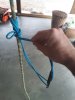
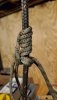
This is a knut tied with a loop. It is usually tied with an eye2eye or single cord. When I pull the loop flat there are 2 parallel ropes and I pretend like they are one.
20200828_082333.jpg
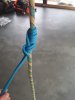
I dressed one side to be short and one to be long then put the long one thru the short one. It works pretty well. It's a sewn loop.
20200828_082352.jpg
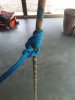
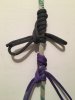
My theory is you could do this with any friction hitch. Here is the michoacan:
20200828_082000.jpg
 
@John RB is this a hunting application?
Yes, but has potential for other systems, but not likely for arborists, who are much more likely to invest in pro devices. We have people doing some crazy things with ropes and steps and DIY aiders and I am doing my part to introduce some safe techiques. In fact, I literally just got in an argument with a guy on Facebook when I told him that his Ropeman ascender (which is not rated for life support to begin with) needed a stopper knot... his logic being that his buddy uses it that way and it has never slipped. They all seem to forget that their dead friends don't post any more...
 
Dead men tell no tales. I would add the skill of footlocking to your teaching so in case someone ties a hitch wrong or can't get it to break they have a way of unweighting it to get back down. It can be a pretty fast way to get up too.
 
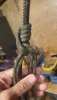
In parallel with some of the suggestions above, i was doing some experiments myself in the same direction and the one that seems the closest to the "sexy hitch" i am looking for is this one: its basically a Distel, tied with a loop, 3 turns instead of 4, and ya clip in on both sides. Its pouring rain right now, but I will climb it ASAP and check out some of the other similar suggestions. Thanks everyone. Appreciate all the help.
 

Attachments

  • 20200828_153157.jpg
    20200828_153157.jpg
    268.9 KB · Views: 21
Last edited:
Dead men tell no tales. I would add the skill of footlocking to your teaching so in case someone ties a hitch wrong or can't get it to break they have a way of unweighting it to get back down. It can be a pretty fast way to get up too.
NJDelaney, yes, great suggestion. i have already considered that failure mode and have to address it. Or literally frozen in place due to rain and ice.
 
What’s the hitch cord you’re using? 8mm Beeline is kinda camo-ish if that’s important to saddle hunters, and it’s really has some fantastic performance and durability. One of my favorites.
 
What’s the hitch cord you’re using? 8mm Beeline is kinda camo-ish if that’s important to saddle hunters, and it’s really has some fantastic performance and durability. One of my favorites.
Ok, so i have some 5, 7 and 8mm Sterling accessory cord and my newest climbing rope is a 9.5 mm Sterling Super Static. The Michoacan is very smooth with 7mm cord. The newest Creation below, Distel with a loop is tied with 5mm. Its thin but my body weight is on 8 strands, 4 per Distel and one on each side. I also have a whole spool of it, but I do appreciate the recommendation on that cord.
 
Something to watch for when having double the wraps with the loop hitches, is that all the slack is out of the wraps and both eyes are being loaded equally.
 
Rope a dope, I like your theory and was thinking along the same lines. Tonight, in the basement, I tied some of my favorite friction hitches simply treating my doubled loop as if it was a singe cord, so everything appears to have twice as many wraps. The key was that because of all the extra wraps and surface area changes, i had to drop the cord diameter to get the desired effect. So instead of tying onto a 9.5mm rope with a 7mm cord, I had to go down to 5mm (i don't have any 6). The bigger diameter 7 and 8 were just too much. And all of these knots held on my pull test in my basement, which uses an intentionally slippery primary rope:
A doubled Distel
A doubled Michoacan... although I had to go with 5 starting wraps instead of the standard 4 to match the distel
A doubled Blakes hitch, which of course has the problem of what to do with the tail.... now a loop, but not integral to the point at hand... it seems to hold.
The only thing I wanted to point out on your photos (which I greatly appreciate you taking the time to post) is with is your last photo where you said that was a michoacan. Although it is very similar to Blakes, unlike blakes, michoacan gets loaded on both ends of the line we tie it with. And so when we tie it with a loop, it needs to take load on all four strands exiting the hitch itself. And so, your knot can't be called a Michoacan, because the load is only on one side of the loop entering the hitch, and 2 strands total. Nevertheless, I tied and tested the knot you showed and it slipped under a good load. But if you are goofing off with it, try this: Given that Blakes and Mich are tied so similarly, think of it as a blakes instead, and when you are finishing it, bring the tail up thru 4 instead of two strands and leave the loop there. That knot seems to hold and binds tighter than the Distel of Mich, but for my application, I need them to really get nice and loose all by themselves when the load is removed... because I am manually tending two of them with one motion. I will do some climbs tomorrow. Thx man.

 
I climbed at least half a dozen times today on both the doubled distel and the doubled michoacan, meaning that i tied them with both sides of a doubled prussik loop, 5mm on 9.5mm rope, and the Michoacan was the winner. Easier to move up after loading removed and much easier to break under load to initiate the descent. She's sexy single or doubled! Ok, so does anyone make a mechanical device like a GriGri that works on 2 lines instead of just one? Because that's basically what I'm doing here with friction knots and cords.
 

Attachments

  • 20200829_170217.jpg
    20200829_170217.jpg
    310.6 KB · Views: 15
On sunday, i did a bunch more test climbs comparing a standard Michoacan to ANYTHING else, including Michoacan tied with a loop, and standard Michoacan is still the best. It's simply can't be tied with a factory sewn prusik Loop.
I do appreciate all the replies, as you guys are awesome!
I may start another thread about the use of a zeppelin bend in a prusik loop for life safety...
 
Had to try the loop Michoacán after you said you couldn’t get it to work. Tied it up, holds great, won’t even need to put on gloooooo......... Half a second later I’m sitting on the ground with hot hands. Something about it won’t allow it to grab again once it is compressed. Tried a few different things and found that the top wrap needs to be rotated down until a couple of braids are formed. The top hitch is how it’s normally tied, and loads up in about the same configuration. The bottom hitch is tied just like the top, but has the top wrap rotated down. It grab reliably, but started binding quickly on a fixed rope.
B6FCAEB4-A6FC-444C-B0D4-97980550A84E.jpeg
 
Had to try the loop Michoacán after you said you couldn’t get it to work. Tied it up, holds great, won’t even need to put on gloooooo......... Half a second later I’m sitting on the ground with hot hands. Something about it won’t allow it to grab again once it is compressed. Tried a few different things and found that the top wrap needs to be rotated down until a couple of braids are formed. The top hitch is how it’s normally tied, and loads up in about the same configuration. The bottom hitch is tied just like the top, but has the top wrap rotated down. It grab reliably, but started binding quickly on a fixed rope.
View attachment 70125
There's an old rule of thumb that prussik cords should be 60-80% of line diameter, however, we are inventing knots here and there are exceptions. Bachman is a friction hitch that works better at a 50% difference for example. My experience with Michoacán with a loop was similar: 50% worked much better than 80%. And nothing worked better than the standard Michoacan, tied with a cord or eye to eye, at a 75% ratio, or 7mm cord on a 9.5mm rope.
 

New threads New posts

Back
Top Bottom