TheTreeSpyder
Branched out member
- Location
- Florida>>> USA
There is something about holding the larger, heavier book while reading about controlling power. There are many, knot book pdfs..

Follow along with the video below to see how to install our site as a web app on your home screen.
Note: This feature may not be available in some browsers.




Hi Tony, can’t get my head around that statement, after all, there are more than two scenarios for a Bowline (and variation). Splitting the line between ‘climbing’ and ‘rigging’ will lead one down a short alley with no exit, not a way I do it or would choose to teach it. I sometimes wonder if it’s not fallacy to add extra friction into a running bowline with our soft double braid ropes, where did this line of thought come from? I can see it with a Bowline, but that is a very different type of termination. I always use a double loop variation with mine because of the aforementioned loading cycles, but I just got into a groove with it, no real logic me thinks.I always train climbers to use a Yosemite tie off for life support.
It’s not the added 8% in breaking strength, I just think knots we use for life support, just like the equipment we use should be separate from rigging.
I like the change in mind set. Adding that extra turn and tuck for a basal anchor shlould be different than tying a log on to your rigging. Different demands different applications.
Tony
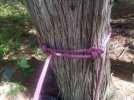
You can also tie that onto the vertical section and then cinch it down on the loop.I use basically the same thing that Benjo75 posted. Long tailed bowline, I finish it off with a Blake's hitch instead of a scaffold knot. Keeps that slack from working into the system, which can move your tie down OR up the stem on smooth bark
View attachment 72538

Not adding friction, just adding the extra turn to make the Yosemite tie off. (The increased breaking strength comes from having two parts of rope in the overhand loop of the bowline)Hi Tony, can’t get my head around that statement, after all, there are more than two scenarios for a Bowline (and variation). Splitting the line between ‘climbing’ and ‘rigging’ will lead one down a short alley with no exit, not a way I do it or would choose to teach it. I sometimes wonder if it’s not fallacy to add extra friction into a running bowline with our soft double braid ropes, where did this line of thought come from? I can see it with a Bowline, but that is a very different type of termination. I always use a double loop variation with mine because of the aforementioned loading cycles, but I just got into a groove with it, no real logic me thinks.
...
For climbing I like the simple elegance of it, and the extra ”effort” to tie serves as a reminder for as to the purpose...
The world needs more philosophical chaps like you. As a slight aside I have been interested in knowledge that we take for granted as rope workers, and how one can find new areas to explore. The time that we met in Augsberg I was hoping to see a big u-turn in climbers approach to rigging (rope work, Climbing/Rigging), just basic questions like: why are our ropes this diameter, why this length, why tied into this system etc etc. Scratching the surface is interesting, tracing history, and knowing where one can deviate or not. One can follow a logical thread from the 1940's to now, if the timeline was flipped on its head I'm sure that the old boy wouldn't too surprised. Well, maybe a little. But it is all there one way or another.Not adding friction, just adding the extra turn to make the Yosemite tie off. (The increased breaking strength comes from having two parts of rope in the overhand loop of the bowline)
I used to teach the bowline without regard to whether the tail ended inside or outside the formed loop. There really is no strength difference. But to from the Yosemite tie off it must be a “inside” version. So not I always teach it that way, because the step added to from the Yosemite is a natural progression.
For rigging I think the Yosemite is overly redundant And unnecessary. For climbing I like the simple elegance of it, and the extra ”effort” to tie serves as a reminder for as to the purpose.
Purely philosophical and idiosyncratic on my part, but I like the idea of one version for rigging, one for climbing. Both are perfectly secure in either situation.
Perhaps I read too much and let my philosophical background take over?
Tony
It is interesting when we look at the “evolution” of all the work we do. The passing of fad, the return of the best new thing, albeit with a new twist, new application. All necessary and good, but rhythmic and repeating at a base level.The world needs more philosophical chaps like you. As a slight aside I have been interested in knowledge that we take for granted as rope workers, and how one can find new areas to explore. The time that we met in Augsberg I was hoping to see a big u-turn in climbers approach to rigging (rope work, Climbing/Rigging), just basic questions like: why are our ropes this diameter, why this length, why tied into this system etc etc. Scratching the surface is interesting, tracing history, and knowing where one can deviate or not. One can follow a logical thread from the 1940's to now, if the timeline was flipped on its head I'm sure that the old boy wouldn't too surprised. Well, maybe a little. But it is all there one way or another.
Back to this thread, I would suggest that any one getting into Stationary Rope consider working with two main lines when possible. The anchoring and retrieve thing is not too difficult to work out and while it may seem a headache at first it positively develops safe and efficient work positioning.
Back to history, our timeline has brought us to a place where we have a massive discourse on Safe Work Positioning, on-going, ever developing, fraught with accidents and near misses. Just like never one handing a top handle saw, cutting with a main line and lanyard is a rule that must be followed 'to be safe', but how many can truthfully say that we do it every single time we cut a branch?
Starting the climb with two mainlines lets our minds and arms get to work cutting branches QUICKER and SAFER. And that the Work Positioning Lanyard is there to suspend us in 3-dimensional work positions is a great thing, allowing us to really get into the complex shapes of trees.
I couple of years ago I ran a workshop on symmetrical and reversible climbing systems, the aesthete in me was erect. I have mellowed a little since then !