Self tending climbing system

  • Thread starter Thread starter rich_h
  • Start date Start date
I had the chance to use the Anchor Bridge on a small prune job today. Nothing hard....just a straight hip thrust up 40 ft. or so then catch a few branches on the way down. I like this system. It tends real nice.


Although this adds a few things to an already somewhat cluttered saddle it seems to be worth it!


I just have to get used to a few different/changed moves!
 
Rich,
I have used the system now for a good number of climbs. In the middle of it all I received a New Tribe Pro-Gear saddle, with central anchor point, as it was cumbersome using the old buttstrap and having to connect and disconnect from two D rings every time I had a redirect. The system works well. My arms may not be as long as I thought, as the hitch (Vt) is practically out of reach when in extended mode (about two inches less might make a difference). When pulling down to ascend, the slack girth hitch 'relaxes' and opens a bit. Maybe I don't have it set up optimally. I seem to have to 'tend' the hitches a bit now and then. My Vt was problematic early on until i found a combination of length/wraps/braids that worked well with my weight and ropes.
I really like the system, and have used it exclusively for tree entry for trimming, especially enjoy it on the long hip thrust entries. It's a far sight better than the old tautline. I have not even reached for it for takedowns, as I keep things close and minimal while spiking.
I am interested in your updated design. Pictures?
 
Pat,

Thanks a ton for the great input. The actual length needed for the system will depend on what type of harness you are using matched with your arm length. The idea is to just barely be able to reach out and grab your knot if necessary. It sounds like you will need a shorter set up to match your new harness. PM me and we can take care of it.

The new design helps to cure that problem with the hitch "relaxing". I definitely recommend trying out different knot configurations until you find the one that works best. (I found that using 8mm beeline also helped a ton in keeping my knot from relaxing) The new pics hopefully will be up by thursday. I will do my best to answer any and all questions with the new design and welcome any changes that anyone else might have.

I will also have pics of the modified versions up by thursday, or friday at latest.

rich

ps

If anyone in the Pittsburgh area is interested in this system I am going out on Wednesday to meet some buzzers in the area to demonstrate and fine tune the system. PM me if you want to join us.
 
Just checked this thread out. Great pictures and a lot of thought gone into that system. But if I got the jist of it right, I think its a little more complicated than it needs to be.

The technique that I've been using the past few years goes like this (I'll try to take some pics today in the field - but it is raining):

1.Attach the end line karabiner to the harness as normal.
2.Reach up and tie a marlin spike at the length that suts you best.
3.Clip the hitch karabiner into the marlin spike.
4.Tension the system.
5.Use a small karabiner above the marlin spike and clip it to the hitch (elliminates slack).
6. Off you go
7.Get to destination, lanyard in, unclip hitch karabiner and clip back into normal position.
8. pull out marlin spike.
9.Carry on as normal.

Don't extend things so far that you can't reach your hitch to come down (although there is another system that helps).

A handled ascender can now be used to haul on the thin line, preventing hand fatigue (long term RSI injuries). It also prevents the system failure if the hitch collapses (a possibility if the hitch can't be reached to set properly).

Got to go to work!
 
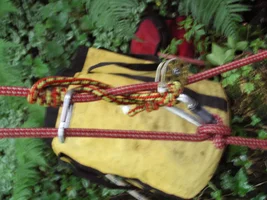
Shot off a couple of pics today, but we were down in the woods and its come out a little fuzzy. Should be enough to get the jist of it though. I showed this to quite a few instructors and climbers in the UK and its now pretty common place. You have to weight the line to stop any binding.

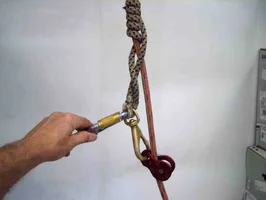
The mini krab free floats above the marlin spike, then clips around the opposite leg of climbing rope under the hitch. It won't work well without it.

Picture attached.
 

Attachments

  • 51067-KIF_1930.webp
    51067-KIF_1930.webp
    284.6 KB · Views: 336
Hey Paolo,

That looks like a really effective and clutter free set up, thanks for sharing it.

I think the part that looks so confusing in the anchor bridge set up is the extended left side anchor point. One of the biggest benefits of this feature is that it will protect the static part of the line (your anchor side usually takes the most abuse as it never moves) and therefore protects your spliced eye. Surprisingly once you get used to this system (and I admit there is a short learning curve) you will find it is very easy and quick to move between shortened and extended modes. It takes an average of around 4 seconds to go between modes and you have the added benefit of having the short bridge always attached to your hitch biner. If you were to fall during extension (you should ALWAYS be attached with safety lanyard during the switch) the most you would fall is the length of the short bridge.

Thanks again for sharing your set up. The less slack we have in our lines the better off we will all be.

rich
 
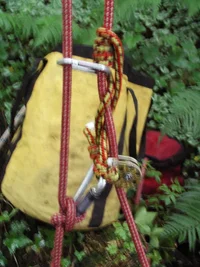
Was there an earthquake just as you snapped the pic? :)

Here's a 30%-sized rotated version for the dialupers, attached.
 

Attachments

  • 51104-kif_1930.webp
    51104-kif_1930.webp
    50.8 KB · Views: 244
We don't get many earthquakes in Wales!

I was just so nervous about doing the tree I was trembling all over (it was at least 50ft and 16" in diameter /forum/images/graemlins/smirk.gif )

It was dark and very wet, so I put the bag behind - but the auto focus didn't like it.

Thanks for resizing and turning the pic. I won't be so "ignorant and rude" next time. /forum/images/graemlins/grin.gif
 
first time on this site and couldnt help but notice this thread.
i too have been experimenting with self tending systems and have come up with somthing similar, except that on the life line (the rope attched to your harness)i fit a, Petzl hand ascender and then clip my biner that has my pulley wheel and hitch attached. when i'v body thrust up and what to change to a working system then i just put on my strop and take the biner of the ascender and fit it to my harness. its very quick to set up and change over, and i'v also seen small ascenders than the one i'm using that i reckon would be suitable.
 
Welcome to TreeBuzz! /forum/images/graemlins/smile.gif

Your system is another good way. A carefully set tibloc instead of the marlin spike would probably be as neat a way of doing it of all the ascenders.
 
I spent the better part of 3 hrs. with Rich H. this morning. We went over all the if's and an's of the Anchor Bridge and a few other things.

Rich H. was great at his demostrations and just a great guy all the way around!!!

Thanx Again, Rich!!!
 
Thanks Rich it was my pleasure and I learned a lot. I look forward to heading out to Pittsburgh again soon. Only next time I won't try that illegal left turn again. I think I had to cash in alot of my stored up karma to get out of that ticket.
 
[ QUOTE ]
Now if only I could climb like you!!!

[/ QUOTE ]


Just do it!
aaf_wink.gif
 
[ QUOTE ]
[ QUOTE ]
Now if only I could climb like you!!!

[/ QUOTE ]


Just do it!
aaf_wink.gif


[/ QUOTE ]


Thanx Butch...........I will do just that!!!
 
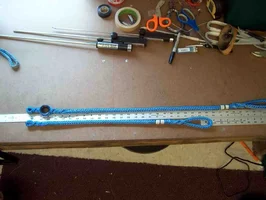
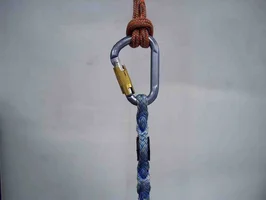
Here is the newest design for the anchor bridge climbing system. The main difference from the earlier model is the fact that the brass ring is now gone and a plastic thimble has been spliced directly into the cord. This change alters the profile of your anchor carabiner and help to alleviate the problem of your knot hitting the carabiner and opening up on you. A side benefit of this design is the fact that due to the fact that the thimble is spliced directly into the cord it technically could hold body weight if necessary. Not that it will be necessary, but I am a big fan of having options.

When the system is extended your # 3 swivel eye boat snap will connect directly to the thimble. The sizes are set so that the swivel will not be holding any body weight but those measurements will need to be matched to your harness and hitch configuration.

Currently I am using standard eyes splices to capture the thimble. I think I may change that to locking Brummells so that the thimble cannot move. It has also been mentioned that metal thimbles would serve the purpose better, but I am not too keen about the potential damage caused to the cord by rubbing against metal.

I am sure this all looks really confusing to everyone, but if you try the system out for about 10 minutes you will see that it is all really easy to get used to.
 

Attachments

  • 51403-anchorbridgenewdesign.webp
    51403-anchorbridgenewdesign.webp
    99.2 KB · Views: 289
The first step is to girth hitch both pieces to your attachment points. The long bridge will go on your anchor side and the short bridge goes on your hitch side. Depending on the type of harness you use your attachment points will vary. The lengths of the bridges are matched to the set up you see with the aluminum rings sliding on my bridge. If your connection points are further out than this you may need to alter the length of your anchor bridge parts.
 

Attachments

  • 51404-anchorbridgeattached.webp
    51404-anchorbridgeattached.webp
    39.3 KB · Views: 243
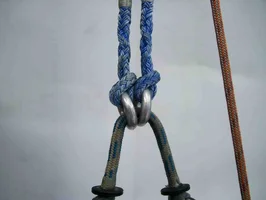
The next step is to attach your anchor side (long bridge) to your climbing line. I recommend hooking the crab on your bridge first and then onto the climbing line. This will ensure the smaller end of your crab is oriented on the anchor bridge and the bigger part of the crab is on your climbing line.
 

Attachments

  • 51406-crabsetupanchorside.webp
    51406-crabsetupanchorside.webp
    24.5 KB · Views: 239
Now tie your climbing hitch in the normal fashion. The only difference is that you will need to use a # 3 boat snap to connect to your slack tending pulley. The system is sized to use the # 3 snap so a # 2 will not achieve the proper results. I realize that the snap sort of gets in your way, but it will be necessary for this system. I have tried this system with every knot I have come across and have yet to find one that doesn’t work. The type of cord you use to tie your knot also is not important. That being said, a 5/1 VT using 8mm Beeline seems to achieve the best results for me.
 

Attachments

  • 51407-hitchsetupwithdogleash.webp
    51407-hitchsetupwithdogleash.webp
    36 KB · Views: 258

New threads New posts

Back
Top Bottom