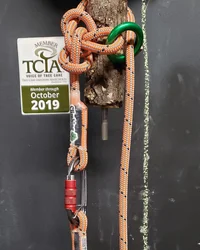
Secondary tie-in for spurring: choked split-tail climbing line -OR- running bowline -OR- ??

Gaffing stuff up that will eventually be taken down. Not taking them down yet - leaving up for practice for the time being.


I have trained spur climbing for many decades for a variety of applications. The need for "immediate" decent and preparation for it does not assist the acquisition of this skill. Many of my trainees don't progress above head high for days. As they consolidate the mini skills and solve the comfort issues so they progress. Before proceeding above head high they must practice self arrest until it is a nothing event.

The quote I am replying to shows you are on the right path however there are no shortcuts to learning these complex skills and some just don't get it. The height you are achieving would appear to be in excess of your skills. Combining the use of a chainsaw requires consolidation of that skill first.

In Victoria there was a period of arb training that mandated you were not allowed to climb on spurs without a "top line" in place. This is as ridiculous as now mandating that one of your flip lines must be a choked climbing line for the purpose of emergency decent. There may be some situations where it is prudent but must not be presented as a mandatory requirement.
We have a situation now where many trainees exit their training and remain incompetent with spur climbing or are grossly limited.
 
I have trained spur climbing for many decades for a variety of applications. The need for "immediate" decent and preparation for it does not assist the acquisition of this skill. Many of my trainees don't progress above head high for days. As they consolidate the mini skills and solve the comfort issues so they progress. Before proceeding above head high they must practice self arrest until it is a nothing event.

The quote I am replying to shows you are on the right path however there are no shortcuts to learning these complex skills and some just don't get it. The height you are achieving would appear to be in excess of your skills. Combining the use of a chainsaw requires consolidation of that skill first.

In Victoria there was a period of arb training that mandated you were not allowed to climb on spurs without a "top line" in place. This is as ridiculous as now mandating that one of your flip lines must be a choked climbing line for the purpose of emergency decent. There may be some situations where it is prudent but must not be presented as a mandatory requirement.
We have a situation now where many trainees exit their training and remain incompetent with spur climbing or are grossly limited.

So all you guys agree with this? That is, that it's generally ridiculous to have a cinched/choked TIP in place when spurring?

I thought that was what Z133 was recommending/requiring?
 
I do agree with it, not for the reason you stated but for the one Graeme stated. You have continually voiced that you want the second tie-in to stop you from sliding down the trunk if you gaff out. What that tells me is that you have not yet mastered how to climb with your spurs. If you had you would understand that that is not a concern. A gaff out is a non issue and will go nowhere when you take the time to learn how to respond. It will be no more dramatic than a slight stumble while you are walking. You just re-catch your balance and keep going.

There will be many times when having a choked climbing line will be appropriate and the smart thing to use. But you will be doing yourself a disservice if you are using it for the wrong reason.
 
Last edited:
I think it's unnecessary and time consuming to be constantly advancing a choked line like that as a way of ascending on spurs. Like Graeme said, use it when prudent and like Stan said, have a way to bail out ready to go and always be tied in when climbing and tied in twice when cutting.
The choked line absolutely has it's time and place, and that's usually gonna be when running a chainsaw when you don't/ can't have your climbing line in a higher TIP. Like when chunking down a spar or taking a top.
If you're climbing on spurs and using a hitchhiker on climbing line as a second lanyard, then you have a bailout that can be applied in seconds.

Are you gaffing out often? It shouldn't be common and it doesn't equate to a freefall. Have you set your rope with a throw line and weight yet?
 
The gaffout happened a time or two when I went out the first time, and once the second time. I am indeed not in the same universe as "mastered", when it comes to climbing on spurs. When this happened, I didn't even slide a foot or two, so being injured by it was/is more theoretical than close to anything I've experienced.

I understand what y'all are saying, I think. I tried advancing a choked TIP, and that is major pain, no argument there. The most pleasant experience I've had so far climbing is using the climb line and HH2 as lanyard, and advancing that along with a similarly-constructed rope lanyard, hands down. I didn't have any gaffouts with that, but I need WAY more practice.

I've practiced setting the climbing line with a rope, but haven't actually HH2'd-in and climbed that way yet (practiced with trees in the yard that I really don't want to dig spurs into).
 
Steel core failures:
http://www.treebuzz.com/forum/threads/flipline-failure.36713/#post-540645

http://www.treebuzz.com/forum/threads/steel-core-lanyard-failure.29907/

The two threads that point out the issues.

I’m always hesitant to use a carabiner as a cinch because I have seen them roll on the bark and open the gate. In particular a basil tie and a climb to 75’. Got down and the gate was open. If you must, make sure to orient the gate away from the tree in ALL situations.

I was one of the people that replied to the second thread. 25 - 30 years ago I was over 100' and the flip line broke unexpectedly. I was gone for all money but for the second. It was not thought to be cool or necessary then but I was prudent about "all my eggs in one basket".

My analysis at the time and the safety alert agreed. Two swages close together loaded and worked the core between them above normal. Inspections were more difficult or not possible. A swage to hold the sheath over a back spliced cable is superior. I am happy with this.
 
Last edited:
So all you guys agree with this? That is, that it's generally ridiculous to have a cinched/choked TIP in place when spurring?

I thought that was what Z133 was recommending/requiring?

For a novice you seem to be a fast learner and well read. The questions were raised so I will extend those two concepts “generally ridiculous and standards”. My context is only Victoria Australia. Some workplaces and "standards" here insist that a "qualified, equipped and ready" rescue climber must be present when a climber is aloft at all times.

One of the biggest proponents of this was working with me some years ago and was tasked with setting a block for my skyline system. He elected to climb the remotely located tree to 50' without the capability he publicly demanded. When I questioned him afterwards he said, “it wasn't worth it for that little climb." Naturally I agreed with the logic but not his rule he flouted.

Despite training and qualifying many tree rescue persons he later reassessed them to find most incompetent.

Sometimes standards are influenced by those gearing for the lowest common denominator or to suit their own agenda's. Spur climbing is no different. The problems of learning those important skills ought not to be confused with local industry practice or that across the world. One size doesn't fit all.

Whilst spur climbing is an element of tree rescue it is a great example of the problem. I accept that spur climbing ought to have an entry level as a minimal, tree rescue must be operational.

Do the standard to which you refer comment on the need for rescue climbers etc and if so how are you complying?

Mark, I hope this is not poor form and regarded as derailing a thread?
 
Always having an overhead climbing line is not necessary. It does save your knees and hips from always standing in spurs, which, unless you are tied in to another tree nearby, you will be forced into doing.

I'm looking at my climbing career as an ultra-marathon, not a 50 yard dash or 5k.


My current groundman has done trees for 5 years in the Pacific Northwest. I'm the first guy to not spike every, and use a climb line. Everyone else has always brought down firs in 16" rounds, or go crazy, and drop doubles and triples. They stand in spurs all day, everyday when climbing. His last boss had to have both hips replaced, on one of them, twice. That guy was overweight, too.


What gives me pause is when I'm sitting on my flipline, fidgeting with resetting a climb line or whatnot with the double-action steel snap. I give it lots of attention to not getting the safety pushed open by the rope, a branch, etc. Some people use the Triple Action ISC?? biners, but they had design issues. I haven't noticed any triple action steel snaps. I could cut the swivel snap off and attach a swivel biner, but I don't.
 
I read the post and am unsure of the context. Do you suggest there only needs to be one flipline?

was in a rush when writing that post - meant that he could use two lanyards as one by adding a twist or two so is more grippy but easier to advance than two separated lines...
 
I do agree with it, not for the reason you stated but for the one Graeme stated. You have continually voiced that you want the second tie-in to stop you from sliding down the trunk if you gaff out. What that tells me is that you have not yet mastered how to climb with your spurs. If you had you would understand that that is not a concern. A gaff out is a non issue and will go nowhere when you take the time to learn how to respond. It will be no more dramatic than a slight stumble while you are walking. You just re-catch your balance and keep going.

There will be many times when having a choked climbing line will be appropriate and the smart thing to use. But you will be doing yourself a disservice if you are using it for the wrong reason.

I essentially agree, however I often come across: lightning struck, dead, mostly dead, or previously topped tree whereby a branch is now the new curved leader scenario, and gaff out is a little easier in those outside the norm conditions - still not a safety issue just bites when you go for multiple slips on gaff outs. In these circumstances the advancing of a cinched lifeline makes life a little easier...
 
Absolutely, there will be trees, like you mentioned, that will be much harder to spur and special tactics will be the smart choice. It's just that I have seen far to many climbers, and I'm talking professionals here, that put every tree into that category.
 
Is Giorgio Fiori's material generally looked at as good stuff?

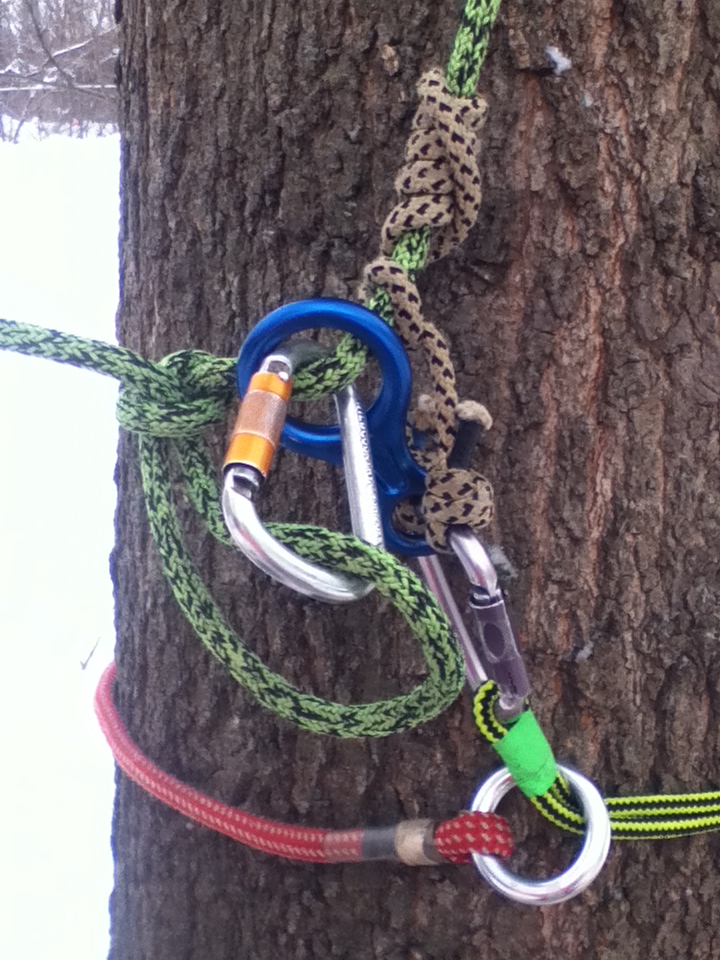
I got my hands on some DMM anchor rings and have been playing on the ground with using those to eliminate potential carabiner side-loading issues with choking anchors, according to some of his ideas and others I've seen around (countryboypa, SingleJack, Mumford, etc.). I've not gone down the path of caring about remote retrieval at this point, and some of the solutions involving anchor rings are beautifully simple (girth-hitching an anchor ring inside an alpine butterfly, then running one of the standing legs around the tree, putting the part's bight through the ring, and clipping a carabiner into the bight, which cannot then become cross loaded, for instance).

Has anyone evaluated these things for strength, or analyzed them for potential issues?
 
The DMM rings will deform if overloaded, rather than just snapping apart. One of the best manufacturing companies as well. Plus there is no danger of side loading. Anything in the tree that could cause side loading, size wise, would be too small to trust for life support.
 
The DMM rings will deform if overloaded, rather than just snapping apart. One of the best manufacturing companies as well. Plus there is no danger of side loading. Anything in the tree that could cause side loading, size wise, would be too small to trust for life support.

Sorry, I didn't mean the DMM rings. I meant the configurations that use them in the manner I gave an example of; namely, where a bight of rope is pulled through one, then a carabiner clipped on, such that just a small portion of the carabiner is experiencing any loading at all.

Example:
mac6.jpeg
 
The above isn't exactly what I was describing, but I just used that photo (first I could find on an image search) to show the carabiner being clipped into the bight pulled through the blue ring/eight.

Below is exactly what I'm talking about, at least as far as the anchor ring and biner are concerned (they use a scaffold directly on the anchor ring, instead of another method of joining it to the main line).

img_5761-jpg.30312
 
Last edited:
This is probably good fodder for a second thread, since this is only tangentially related to the original post's topic.

Edit: I can make this into another if anyone prefers.
 
Last edited:

New threads New posts

Kask Stihl NORTHEASTERN Arborists Wesspur TreeStuff.com Teufelberger Westminster X-Rigging Teufelberger
Back
Top Bottom