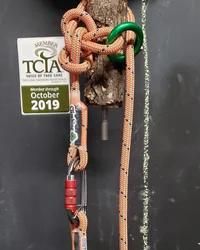
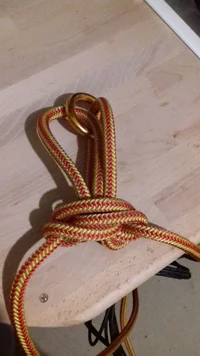
Secondary tie-in for spurring: choked split-tail climbing line -OR- running bowline -OR- ??

I don't see why that wouldn't work or be ok strength wise. I prefer a running bowline most of the time. I wouldn't worry too much about side loading a carabiner on a spare that's over a few inches. Especially a steel one.
 
If you want something boomproof that you can sideload all you want, try a Delta link. That's my canopy anchor of choice. Simple and stupid cheap.
 
If you want something boomproof that you can sideload all you want, try a Delta link. That's my canopy anchor of choice. Simple and stupid cheap.

Cool, got a couple of em actually. Do you tie into it with a scaffold knot, RB, AB, farmers loop, etc., or do you have an eye in the end of your climbing line, or something else?
 
Last edited:
One word of caution I have seen a few occasions where a choked tri lock biner has opened in a choked configuration. This severely reduces the breaking strength. There’s more that can go wrong than side loading

There is no connecting device that is "set and forget". Continual monitoring takes effort and time. Make it part of your processes.
 
A carabiner is definitely not a set and forget anchor. I wouldn't use one on a base anchor or a canopy anchor that you can't monitor. Spar work you should be fine though.
 
The above isn't exactly what I was describing, but I just used that photo (first I could find on an image search) to show the carabiner being clipped into the bight pulled through the blue ring/eight.

Below is exactly what I'm talking about, at least as far as the anchor ring and biner are concerned (they use a scaffold directly on the anchor ring, instead of another method of joining it to the main line).

img_5761-jpg.30312

IMG_20190125_044250_074.webp
 
I ain't the fastest with knots, but how on earth do you get the mainline through the ring without running the entire rest of the line through it?

Also, is that the tail of the climbing line on the downward-facing side of the carabiner, for retrieval?

1- Look up « tying alpine butterfly end of line ».

2- you can use your tail or another rope entirely - this would be a LOT easier
 
how on earth do you get the mainline through the ring without running the entire rest of the line through it?

Run the line through the ring before going over a crotch or around the stem, then tie the alpine butterfly into the ring. Richard has a good video about tying the running alpine butterfly and some verification considerations.
 
Cool. I can tie an AB in my sleep, but I use tricks to do it - the loops over the hand, or twisting and folding the one long loop. Not familiar with how to tie it without those methods, as seems to be required for this.

Thanks for the help, Mr. Mumford.
 
Okay - got that down, I believe.

A couple of questions on the HH2's stopper knots though, gentlement...

I played around with a couple of them after watching some of Mr. Mumford's videos, and he points out the similarities between the "Hitchhiker Knot", the anchor hitch/knot (depending on if it is tied around something else), and the double overhand knot. Namely, that they are all the same knot (hope I'm summarizing correctly), but in the case of the double overhand, just dressed differently.

I confirmed this for myself, but it made a few questions pop up for me.

1) Can the anchor and hitchhiker knots be loaded from either direction when used as stoppers? The hitchhiker knot, when used through the dog bone of the hitchhiker and tied as recommended, has the first of the two wraps sitting flush against the collar of the HH2's dog bone. Would it be equally as secure if being used upside down? That is, if it were tied in reverse order and the 'tail' - as it were - was the part that was against the collar of the dog bone?

HH/Anchor used as recommended (hand represents collar of dog bone):
aYu7F2e.jpg


HH/Anchor loaded from opposite direction:
ZAhmfzm.jpg


2) Is the anchor hitch of the same integrity when tied in either 'order' (i.e., when forming the double round turn first), or when forming the single round turn and then forming the two turns around it with the tail)? Examples below... (see 'Edit' at end of post...I think I reached a conclusion on this)

Traditional configuration - tail exiting with carabiner:
YTguz6Q.jpg


Reversed order - tail exiting 90deg to carabiner:
OBIyDjR.jpg


3) I've been tying the Hitchhiker knot as a stopper on both ends of the dog bone when using the HH2, but dressing them both as double overhands. Am I making this thing somehow less safe by doing that? By feel, the double overhand feels less slippy/rolly, more secure, etc., than the Hitchhiker knot.

Edit: examining the anchor hitches a little more, it appears that the standing part of the line needs to form the loops around the carabiner first, as this puts the load in line with the spine, and not trying to undo the loops. I think I've answered this one.

 
Last edited:
Cool. I can tie an AB in my sleep, but I use tricks to do it - the loops over the hand, or twisting and folding the one long loop. Not familiar with how to tie it without those methods, as seems to be required for this.

Thanks for the help, Mr. Mumford.
Another technique is to use the midline attachable butterfly/ring. Don't know the actual name for the knot.

Tried to upload a video here how it's tied, but it says it doesn't have an allowed extension. If anyone knows if it's possible to upload a video, let me know.

20190204_204439.webp
 
Thanks, CS. I gotta try that.

Also - I've found two ways to tie the Stevedore knot (online), and the two ways are again solely related to how the knot is dressed. Unsure which one is 'right'. Mumford says in one video that the double-overhand form is more what the knot 'naturally' wants to dress to, but I'm unsure what that means it does when a load is applied; will the hitchhiker/anchor form of the knot roll into the double-overhand form, or vice-versa??

Show the knot dressed like a double-overhand:
https://www.netknots.com/rope_knots/stevedore-stopper-knot
https://www.animatedknots.com/stevedore/index.php
http://www.101knots.com/stevedore-knot.html

Show the knot dressed like the Hitchhiker knot and anchor knot:
https://en.wikipedia.org/wiki/Stevedore_knot
http://www.handymariner.com/tie-knots-stevedore-knot/
 
I think a "bowline WITH a bight" could be used here, versus a "bowline ON a bight" (I think @evo or someone here coined that terminology, and I liked it), meaning, a regular bowline tied using a bight of rope, and the bight forming the tail of the bowline (which would normally be a single tail hanging down into the loop) would be clipped using a carabiner to the standing part of the line, just as a back-up for the knot deforming and working itself untied.

An alpine butterfly with a loop long enough to girth hitch around itself and a ring could also be used to make an arrangement similar to what you show, I believe. Saw a guy on youtube do this:

Does that look unsecure/crazy at all? Provided the ring was clipped to something else, there's not a way that the girth hitch would come out.

It seems like creating a cinched anchor point truly mid-line without access to either end of the rope, is trickier than creating one with access to an end, when eliminating loading concerns various devices have.

Come to think of it, the knot I showed wouldn't work here, because you have to pass that bight back over the ring.
 
I would recommend tying the stopper knots for the HH just as the instructions show. It works the best for what is needed, which is security and adjustability. It can be ajusted in both directions very easily once you get the knack for it. It is a big part of getting the most performance from the HH.
 

New threads New posts

Kask Stihl NORTHEASTERN Arborists Wesspur TreeStuff.com Teufelberger Westminster X-Rigging Teufelberger
Back
Top Bottom