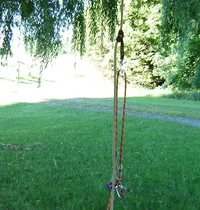
Secondary Climbing Line From an Access LIne

This was a technique that I had not seen until the ITCC in Nashville. It is something that I definatly want to incorporate into my bag of tricks. I saw a couple different ways of doing it. Several of the climbers used a piece of equipment that I do not know the name of. I think I heard someone call it the secret weapon. It consisted of two metal rings (such as on a cambium saver) spliced onto either end of a short piece of rope (not sure what length is best). With the access line set in position to foot lock on take wraps with the secret weapon or whatever it is called then with your climbing system set up on a seperate line run it through the two metal rings and attach to your harness. Now you are secured to footlock up to the height you need and will already be set up to move about in the tree on your secondary line. I am sure this is old news to many of you but it was certaily new to me.

Does anyone know what this "secret weapon" is called or where you can get one? Do you just have to know how to splice and make it yourself?
 
The 'secret weapon' was called so, just before the arbormaster boys were ready to display the tool. I think they currently just call it the 'weapon'. However the concept of having a DdRT sytem anchored off an SRT system, is widely known as a 'floating false crotch'. And there are a number of different ways to achieve the concept with different gear arrangements.
 
I was very impressed with the 'floating false crotch' at Nashville. First time I'd seen it used and almost every climber in the Masters used it.

Dan
 
Re: Secondary Climbing Line From an Access LIne

Would someone be gracious enough to explain the whole setup and purpose for those of us who couldn't make the conf. or if it's old news, maybe lead us to a thread to learn more.
Thanks.
 
Re: Secondary Climbing Line From an Access LIne

Charlie,

The climber footlocks up the rope pushing up the ascenders as they go. The climbing rope in the pulley is what they are tied in to and it is short at this stage. When they stop part way up the tree they climb in a traditional system off of the pulley on the bottom of the ascenders. They do their limb walk, come back to the ascenders, and footlock up further into the tree.

I have never used this system so take my description of it's use with a grain of salt.
 
Re: Secondary Climbing Line From an Access LIne

Thanks Treeco.
So is this correct-- They set a single line and footlock up it while tied in to a double rope that runs thru the pulley which is attached to the single rope w/ a prussik hitch or ascender? --I've never seen this at all so please bear w/ me. Is this like SRT'ing while having a working sys. tied in to your saddle which is not used until in the tree?

Like Jesse asked, do you or anyone know where we can get one or are they made up yourself?--I know someone mentioned the parts, but how are they configured or applied?

Thanks guys.
 
Re: Secondary Climbing Line From an Access LIne

They they all footlocked up a double line at ISA TCC Nashville. A single line would work too.

I think you have the basics Charlie but you need mentoring from someone who has experience with this system and it ain't me babe.
 
Re: Secondary Climbing Line From an Access LIne

The Floating False Crotch has been around for more than a decade. Nothing new. It's finally getting exposure now.

When I was in the climber's meeting on Friday night I kept hearing "secret weapon" and "marlinspike" or "full marlinspike" None of it made any sense. Why is our profession using words in this fashion? I had to ask a couple of people what was meant. How can the FFC be a "secret weapon"? The first time I saw it used was by Jeff Jepson at the MnTCC more than ten years ago. A marlinspike is a heavy, tapered fid used by sailors to work rope and knots. Occasionally it would be used to keep a knot from tighening down and make untieing impossible. In this latest configuration a slipped half-hitch is tied as a stopper below the FFC. A biner is then clipped through the eye of the slipped h-h. This is what is called a marlinspike. Then, if the biner is clipped around the standing part of the rope it becomes a full marlinspike. In my lexicon there is a better term for this configuration. Until I found out what this meant I had a vision of a brass or ivory fid poked through a knot. It was just waiting for a bump to push it out and bonk a precious groundie.

http://www.troop7.org/Knots/Marlinspike.html
 
Re: Secondary Climbing Line From an Access LIne

The term 'secret weapon' refers specifically to a FFC that employs two rings spliced to either end of an eye and eye split tail. The split tail is tied to the ascent line with a friction hitch and the climbing line is threaded through the two rings to form the FFC. As Mangoes said (BTW that was a good post), there are numerous other ways to form a FFC.

Since contestants can score points for innovative techniques, 'Secret weapon' was used to refer to this FFC system before Frank Chips first used it at the chapter TCC, and then before he used it again at the (2004(?)) ITCC. Now that the secret is out it's often just 'weapon'.

Tom is right about the marlingspike. The knot itself is called a marlingspike hitch, but this is often shortened to marlingspike.

The pic that Mangoes posted is a FFC on an ascent line using SRT. The marlingspike hitch has not yet been tied below the the Prusik.

FWIW, the marlingspike hitch was a source of constant problems at the arial rescue event at the ITCC. If the climber was going to climb off of the prusik cord/footlock tether then the marlingspike hitch had to be tied with the bottom part of the ascent line pulled through the loop so that if the prusik (or klemheist) slipped it would stop at the marlingspike hitch. If, however, the climber was going to climb off of the loop of the marlingspike hitch itself, then the marlingspike hitch had to be tied with the top part of the ascent line pulled through the loop, so that the loop would not slip. I was the the tech in the tree (for the first six or so groups) and had to know which system the climber was going to use before the climber started the event. Communication between the tech, the head judge, and the climber was often jumbled or incomplete, however, so there was sometimes confusion about which way the knot should be tied. Also, many of the climbers who climb off of the prusik/klemheist didn't know to capture the marlingspike hitch and the bottom of the ascent line with the carabiner and lost time when the tech instructed them to do so. Mark B. used a butterfly knot which could serve either purpose equally well.

After about half of the competitors had gone through the event the head judge decided to make everyone simply use an overhand knot. I was out of the tree at this point , but there didn't seem to be any further problems in the air. On the ground, before running the event, some climbers complained that this was a bulky knot and could be difficult to untie. They were right, but under the circumstances the overhand knot seemed to be the best solution.

 
Re: Secondary Climbing Line From an Access LIne

I had the third shift of the day, aloft at the AR event. At this point everyone was to use the overhand knot, I only saw one person begin to do the wrong knot, then correct themself. As an observation it really wasn't that difficult of a change for people.

On another note, why do we HAVE to place a marlingspike hitch below the prussic/Machard/ascenders? I know and understand some of the reasons to apply the knot on a double leg system. However I can't really find a real need in a single leg system, therefore I don't.

Comments?
 
Re: Secondary Climbing Line From an Access LIne

All I've ever seen/used is a slip knot under the prussic/footlock tether, with a carabiner through it. Has this been mentioned with a different name?

With the double Kong, couldn't you put a slip knot above the ascender, with a biner through it, and then tie into the ascender?
 
Re: Secondary Climbing Line From an Access LIne

Hey John, hope all is well.

When using the Kong setup you described, it might be tricky to put the marlingspike hitch in while your weight is on the rope, therefore you would have to ensure you have a landing.

You are right though, the marlingspike hitch looks just like a slip knot. However as Mahk pointed out, the slip is directional and must be applied in a manner that takes into account the direction of slip. And....the biner has to retain the fall of the rope as well.

Somebody aught to have some pics.
 
Re: Secondary Climbing Line From an Access LIne

There's so many options I just confuse myself. So you're thinking of helping out at our competition? Cool! Hope to see you there.
 
Re: Secondary Climbing Line From an Access LIne

[ QUOTE ]
On another note, why do we HAVE to place a marlingspike hitch below the prussic/Machard/ascenders? I know and understand some of the reasons to apply the knot on a double leg system. However I can't really find a real need in a single leg system, therefore I don't.

Comments?


[/ QUOTE ]

The Prusik seems secure, but if you watch someone climb off of a FFC there is a lot of movement of the ascent line and the Prusik could be loosened by being hit against a branch or by debris falling into the hitch.


If the Prusik in your pic slipped down the line while you were workng off of the block, the marlingspike hitch would stop the slide of the prusik and prevent you from taking a quick trip to the ground. A carabiner is placed in the loop of the MSH so that the MSH can't accidentally come undone (for example, the weight of the rope itself could pull out the loop, or a piece of debris could catch the rope and pull out the loop). It's very unlikely that the loop could be pulled out with the carabiner attached, but the 'biner is clipped to the ascent line for added security.
 
Re: Secondary Climbing Line From an Access LIne

Here's another boyscout page showing another use for the knot. I think it has promise for climbing competition...

http://www.scoutxing.com/knots/marlingspike_hitch/marlingspike_hitch.htm

marlin-2.gif
 
Re: Secondary Climbing Line From an Access LIne

In the #5 pic of Glen's the right leg would be the falling end of the rope. This would go to the ground and the biner would clip around it.

Adding some kind of backup is a good practice. Like Mahk said, when the FFC is pulled off-plumb there is a chance that it could be bumped. Nothing wrong with "belt and braces" climbing.

It might not be a bad practice to start to add stoppers of some sort to the falling part of a DdRT or trad system, especially for new climbers. We've been doing this for rec climbing for many years.

I realize that I was in a frumpy mood this afternoon when I was ranting about nomenclature :)
 
Re: Secondary Climbing Line From an Access LIne

This has turned into a very informative and interesting thread. Thanks to all.

From looking at Mangoes setup and looking at a picture of a FFC using a Harkin ratchet, I don't see why a pulley wouldn't work just as well.

Can someone explain what the advantages are over the use of a pulley? Is there a reason why the pulley wouldn't work?

Thanks,
Jim
 

New threads New posts

Back
Top Bottom