Secondary Climbing Line From an Access LIne

Re: Secondary Climbing Line From an Access LIne

I've not climbed on the ffc but I've climbed out of pulleys lots of times.

When walking out a limb a little friction on the climbing line makes it a little easier on the hand that is feeding rope through the climbing hitch. Most of our climbing hitches are not that good at metering out small increments of friction and we get friction from squeezing the hitch and or letting the rope run through our hands. Some friction is necessary to achieve the third point(feet are the other two points, usually) that makes balance easier. Without a third point for balance limb walking is similar to walking a tight rope or balance beam.

When walking back in any friction on the climbing line creates more work for the climber as they pull on their rope taking up slack.

I believe this is why a ratcheting pulley is an improvement over just a pulley.

Dan Nelson
 
Re: Secondary Climbing Line From an Access LIne

The bennefits of climbing off a pulley all depend on the climber. Some like a bit of friction others want no friction. I prefer no friction. Plus re-de's work better if the friction is equal on both sides of the rope.
 

Attachments

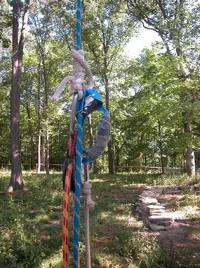
  • 29472-DSCN0008.webp
    29472-DSCN0008.webp
    181.3 KB · Views: 131
Hmmm... easy question, the answer is not so straighforward, in my opinion.

As others have remarked upon, floating false crotches, or in-line anchors as we call this technique in europe are being used more and more in TCC masters' challenges. I feel somewhat uneasy about this tendency. Why? Well, for starters it's not what I'd consider an everyday work technique, great for some situations, but these don't occur on a daily basis. People see - more or less - this method employed during a masters' climb and try to duplicate it back home.

At first glance it seems like a really easy thing to do. Tie an alpine butterfly, pop in a carabiner with a pulley and off you go. Smart? I'm not so sure. I've seen many configurations where I think the degree of technisation creates many potential weak links, such as the danger of crossloading the gate of the carabiner. And that's bad news.

Also, I've always found it really annoying pushing all that clobber up ahead of myself. In an work situation it's not ergonomic and tiring, in a masters' it makes it difficult to make a clean, flowing ascent losing you points.

So, how to configure? Nobody has ever defined a best practice configuration for in-line anchorpoints to my knowledge. So what should we be showing people?

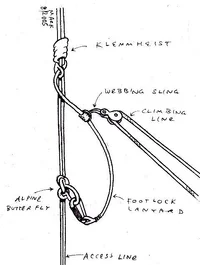
I used this version of the in-line anchor during the aerial rescue at the ITCC (see attachment). It has the advantage that you can footlock up in the normal way, attaching the pulley (a Petzl PO5) for example with you climbing system when you've reached the desired height. No risk of dropping the beaner you spike the back-up with as you use the one on the end of your footlock lanyard. You can reduce the risk of cross loading the carabiners by fixing them on the webbing sling and between the cheekplates of the pulley with a thick rubber band.

Works for me. Let's not over-complicate this issue. A safe system doesn't distigush itself with it's complexity but with intuitive handling and a high degree of passive safety, that is safety due to good configuring of the equipment. /forum/images/graemlins/icon3.gif
 

Attachments

  • 29474-in-lineanchor.webp
    29474-in-lineanchor.webp
    28.2 KB · Views: 155
... and there's so many questions. Tom Dunlap raised a good point at the ISA show for example: how far down the line should the back-up knot be placed? If your knot should slip, how much slippage is acceptable?

Many good points have been made so far in this discussion, which I find great. Let's keep this one rolling!
 
I'd rather see the back ups and the FFC be as close to a back up as possible. Not shaving-close but closer than I've seen in practice. If there were slippage the less acceleration the better. It doesn't seem cumbersome to move things a little closer.

Mark makes some really good points about over-gearing and making our systems too complicated. Without knowing all of the variables and limitations this could make for trouble.

At the ITCC-MC a couple of climbers were sitting next to me and discussed one of the FFC setups. One guy explained to the other what was going on. The fellow who had never seen the setup said that he was going to try it out. I had to lean over and talk about backups and some limitations. To their credit, they were open to what we talked about. In other discussions climbers have been closed down to learning the details and blow-off any other input. Dangerously closed-minded.
 
Yes, that kind of reflects my experiences. I'm not sure if it's close mindedness or just a happy-go-lucky attitude, whichever it is, it won't go well with complex, gear-intense techniques.

The way I see it, it's crucial to understand the qualities and limits - the up- and downsides - of the system you employ.

If you don't, you automatically increase the risk of an accidents. So many incidents, accident and/or near misses involve misconfiguration of gear. This is frustrating, as it's easily avoidable by getting clued up about the gear we use.

No manufacturer in his or her right mind will lauch an inherently dangerous piece of equipment. Accidents occur in the overlap between the pieces of gear and the users, the gear/person interface so to say: misconfiguration, overloading, cross-use or wrong applications to just name a few problematic areas one ought to be considering when assembling a system, be it for rigging or as PPE.
 
By the way fellows I know I've posted a lot in this thread for a rookie. If I need corrected, clarified or just plain slapped around a bit let it fly. It's what I'm here for.

Dan Nelson
 
If that refers to my last post, Dan, you misunderstood where I was coming from. Don't let anyone out-smart you. Rookie or experienced, I think we should all have our say here! I was just adding in my tupenny ha'penny worth on the subject. On the contrary, I thought the points you were contributing were fair.

'Twas good meeting you at the ISA trade show, a face to go with the name.
 
I agree simplicity is good. I do believe the set up I posted is rather simple and do use it at work at least 2-3 times a week. Also in my opinion footlocking a single rope with posted set up is much easier and more fluid for me than a doubled rope. I saw Beddes use the system you showed and it looks good. I still like the srt because of retrieval.
 
I hear you, Todd. There is a lot of personal preference involved, obviously. The point I was trying to make was just what one ought responsibly to be showing, what level of complexity and what might you demo as a basic in-line anchor set-up?

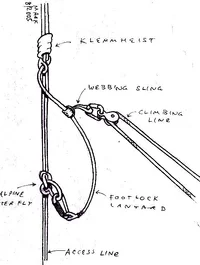
Just for the record, the attachment I posted before was not entirely correct, one carabiner missing between the webbing sling and the pulley. It's a nonsense otherwise, because you lose the option of quickly installing you climbing system onto your footlock sling.

This is how it should look...
 

Attachments

  • 29509-inlineanchor2.webp
    29509-inlineanchor2.webp
    32.5 KB · Views: 156
I just take seven wraps and clip it back in. And yes I do load the prusik and the cam they both share the load. I learned it from Mack C. a few years ago. Another reason I like to use a FFC is your ascent is not static, meaning if you got hurt you have a system to get down.
 
[ QUOTE ]
...The way I see it, it's crucial to understand the qualities and limits - the up- and downsides - of the system you employ.

If you don't, you automatically increase the risk of an accidents. So many incidents, accident and/or near misses involve misconfiguration of gear...

[/ QUOTE ]

As an example:

When I was in the tree at the AR someone used the same system that Todd just posted--single line with one handled ascender backed up up with a friction hitch above the ascender. But, this competitor was using a fairly stiff cord for the friction hitch, took only four wraps around the (single)ascent line, and didn't set the hitch before he switched to his DdRT system.

When he had finished his climb I checked his system by releasing the cam on the ascender, sliding the ascender up the ascent line and then quickly pulling down on the ascender to mimic a failure of the cam. I did this several times and the friction hitch never closed or tightened on the ascent line. The friction hitch provided absolutely no backup at all for the ascender. The whole system was sent down to the ground for the scoring judges to evaluate.

Although this climber was using a system that looked similar to what Todd showed, it wasn't configured correctly and could have resulted in a serious accident.

As our gear gets more complex we have to be more explicit when showing people how to use it and make sure that all of the components are set up and functioning properly.
 
We're reading about some things that I think of as "bad viruses" People are using systems that they don't know thoroughly thinking that they are "safe". Then, they go back to their companies or chapter competitions and continue to use the systems, not knowing that they are at risk. When the time comes the "virus" grows into a disaster.

Take a look at this article:

http://www.thebikezone.org.uk/therockzone/selfbelay.html

They give high marks to the Microcender as a self-belay tool. They also write about using stopper knots. These are things that arbos should be considering more.

In the case of use a FFC the procedure should be to tie, dress and set the backup then re-set the primary, usually an ascender. This would make the back-up more reliable. Or, have the climber show the tech judge on the ground what they are going to use before ascending.

I just read this line from Will Rodgers, it seems to fit really well here,

If you're riding' ahead of the herd, take a look back every now and then to make sure it's still there.
 
Thanks Tom, that was a very informative article.

[ QUOTE ]
They give high marks to the Microcender as a self-belay tool...These are things that arbos should be considering more.

[/ QUOTE ]


I'll refrain from my usual rant about the Microcender. /forum/images/graemlins/applaudit.gif But I will note that the article concludes:

[ QUOTE ]
A Microcender does give great confidence as a self belay device as it locks as soon as any weight comes on it but has its own shortcomings. ...A maximally safe system would probably use a Gri-Gri as the main device and a Rocker attached to a lanyard as a back up device on a second rope, though obviously this would make rope management more complex. For ground up soloing, should you really want to do such a thing, the Silent partner seems the only sane option...

[/ QUOTE ]

The 'Death Modified Gri Gri' looks like a good modification. But, I wonder why Petzl doesn't manufacture them that way.
 
Tom, Mahk, thank you. I couldn't have said it better.

I think it's memes, this way of inheriting and transmitting of information. Like passive learining, the apprentice to the sushi master spending months on end preparing the ingredients until the day the master tells him to make a piece himself. By passively - through observation - having absorbed all necessary knowledge to be able to do so the apprentice can so so without hesitation.

In our hectic byte-sized infotainment world mabye this transmission becomes increasingly fuzzy and blurred. We maybe tend to skip steps in the aqcuisition of knowledge and are maybe hasty in passing it on to others before having sufficient experience with it.
 
Mahk,

I know your concerns with the Micro. The Macro would be a good substitute. I've read about the modified GG for a while. In order to work properly it does have to be oriented correctly. If it gets jumbled or the rope loads it in an off-position it might not grab. This is a big concern of course and the rock climbers who've commented on it;s use generally put it in the fringes. Since arbos work in a much more cluttered environment I would be really concerned to see the crossover.

Mark,

Right again. Arbos are moving into some very complex systems. These systems require more variables to work the same all of the time in order to function. Can the variables be reduced? I think so. It;s going to take time and lots of teaching to get the complete message out.

One afternoon I was at the Vermeer/Sherrill store in Minneapolis chatting with Russ, the manager. A guy came in so I stepped aside for Russ to make the sale. The fellow said that he wanted one of those "knot things" for climbing trees. We were confused until he pointed to the Lockjack that was hanging on the rope. "That!" and a rope and the guy was out the door with a Visa receipt. Instead of starting with "The Tree Climbers Companion" he bought one of the most technical tools available at the time. Scary~~~
 
Mark B, i have a question on retrieval of the ffc system on a double rope. is your alpine butterfly tied on one side? if so how does it serve as a back-up? i have only used this set up in ar event and left the gear in the tree otherwise i have practiced(not fully comfortable with it yet) with it on a srt, whereas the retrieval is to untie the deadend.
 
Treebeard,

the butterfly includes both parts of the access line. In doing so it backs up the klemmheist/prussik.

It's a bit of a fiddle to tie, but like Mahk was describing the confusion surrounding the marlinspike hitch during AR at the ITCC earlier on I think the butterfly does have the advantage of loadability in both directions, making it suitable for a whole range of applications, such as the one described above or as an attachment for pulley based MA systems in rigging...
 

New threads New posts

Back
Top Bottom