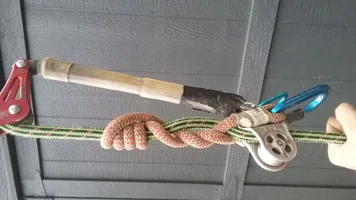
rope runner

...and my hitch is I think a mix of vt and coopers hitch, 3 wraps one braid 2 twists.

Just to be argumentative (why else would anyone post?) XT has a cross right after the wraps/coils so this hitch is different since the cross in the form of two twists is after the braids. XT always has a single cross in between the upper coils and the finishing braids. Cooper's is a braid-less twisty XT, different enough that it's unique and therefore a Coopers. I nominate JontreeHi's invention as a hitch with a unique signature wrapping/braiding/twisting pattern. I'd describe it as a standard VT with a Cooper's style finish after the braids, VTCoop or VTC.
-AJ
 
Just to be argumentative (why else would anyone post?) XT has a cross right after the wraps/coils so this hitch is different since the cross in the form of two twists is after the braids. XT always has a single cross in between the upper coils and the finishing braids. Cooper's is a braid-less twisty XT, different enough that it's unique and therefore a Coopers. I nominate JontreeHi's invention as a hitch with a unique signature wrapping/braiding/twisting pattern. I'd describe it as a standard VT with a Cooper's style finish after the braids, VTCoop or VTC.
-AJ
Small variations under a heading do not justify a renaming, IMO. A Valodtainn Tresse is a different beast than the Valdotain and the XT is different than both and the Cooper is a different beast (although derived from) the rest.


Reed Wortley
CA# SO-6953A
CTSP# 01739
 
Which reminds me, in the study of bird species and genetics it is well known that ornithologists/biologists are divided into two categories: lumpers and splitters. The lumpers describe very close but distinct populations as the same species with the variants as subspecies, the splitters like to describe variants as distinct species if genetic studies show significant differences.

Which is to say, Reed, you're a damn lumper!
-AJ
 
As an example how slight changes make different hitches, the first of three hitches that Reed shows above is a misdrawn French Prusik, as it doesn't show the two legs crossing when it gets loaded. If the leg coming from the top is short enough not cross, to form a braid, then it is an Autobloc Hitch. Just about an inch difference in one leg leads to two different hitches.
 
31470979615_63387171ea_z.jpg


And you FB'bookers know this already, I found a 120' length of Poison Ivy I forgot I had, ran the runner on it in the woods Sunday and on a prune today, f'ing awesome! Everything I'd hoped the runner would be. I'd been stubborn about it because I didn't want to buy another rope, everything happy now, wrench is on involuntary leave ;-)
-AJ

Hey, AJ! You appear to have a blue Rope Runner. Have you had it for very long, and just not been using it much for some reason? Just wondering because I don't see the Blue Rope Runners available at TreeStuff anymore. If it was a recent purchase, would you mind telling us where you got it from? Thanks in advance.

Tim
 
Hey, AJ! You appear to have a blue Rope Runner. Have you had it for very long, and just not been using it much for some reason? Just wondering because I don't see the Blue Rope Runners available at TreeStuff anymore. If it was a recent purchase, would you mind telling us where you got it from? Thanks in advance.

Tim

I bought it from Shelter Tree at the 2015 New England Grows conference/show. Shelter is a most excellent arborist gear supplier based in North Attleboro, Massachusetts. I wasn't using it because I was trying the runner with every rope except a Yale 11.7mm or Blaze/Bandit 11mm) and it sucked. My first rope as a newbie climber 11 years ago was Poison Ivy, I eventually moved on from it because it was heavy to carry (compared to the 11mm 24 strands) on my long jaunts in the woods looking for big trees. I had an irrational bias against it and was hoping to find a rope that wasn't a Yale 11.7mm. Recently I was going through a pile of old gear and other stuff in my basement and came across a bagged lightly used 120' length of Poison Ivy that I'd acquired in a trade approx. 5 years ago. I'd completely forgot I had it. Ba bam, I immediately tested my runner on it and realized the error of my ways up until that moment.

It looks to me that ropes that stay fairly round in mechanicals (like Tachyon) will not play friendly with the runner. The Yale 11.7 lines feel softer and flatten more in the runner, I think that makes the difference. I've been using the runner for work ever since except one day when my Poison Ivy got soaked in a downpour (runner doesn't seem to like wet ropes), I had to switch to another rope that wasn't compatible with the runner, so the wrench got some tree time.
-AJ
 
So... I'm not the only one who "finds" stuff that I forgot I had! Luckily, it's like have several birthdays a year... and I usually can't believe my good fortune... "Oh, cool! This is just what I need!" followed shortly by my wife mumbling something about signing those commitment papers or some such rubbish.
 
@moss; Thanks for the great answer. I had no idea before your post that rope selection was so critical with the Rope Runner. I knew people seemed to have their preferences, but was unaware for some reason of just how much of a "night and day" difference the choice of rope made. Thanks again for the response.

Tim
 
@moss; Thanks for the great answer. I had no idea before your post that rope selection was so critical with the Rope Runner. I knew people seemed to have their preferences, but was unaware for some reason of just how much of a "night and day" difference the choice of rope made. Thanks again for the response.

Tim

Of course, how broken in the rope runner is, how broken in the rope is, and the weight of the operator also make a difference.

I noticed on my super stiff samson static that if I had the ms 441 with a 25" bar on my saddle, it was really smooth (even right after the bollards were rotated) where the ride had been choppy and hard to control when I was 20 pounds lighter.
 
Of course, how broken in the rope runner is, how broken in the rope is, and the weight of the operator also make a difference.

I noticed on my super stiff samson static that if I had the ms 441 with a 25" bar on my saddle, it was really smooth (even right after the bollards were rotated) where the ride had been choppy and hard to control when I was 20 pounds lighter.

Yep, I'm awaiting 150' of Yale Aztec from The 'Stuff, will be interesting to see how the runner does on a new line. I'm anticipating goodness, the runner is pretty well broken in through innumerable attempts to make it work on the wrong ropes. As has been previously documented I weigh nothing and that's very not bad for tree climbing. So far on any rope not Yale 11.7mm or 11mm 24 strand I get super jumpy bird release. Will be interesting to see what happens with a Yale 11.7 on the rare occasion I have a bigger saw hanging on the harness.
-AJ
 
Just to throw a curve ball in there Moss, if you have a baby bump throw that into the mix as well. Sometimes that can be just that little extra you need. Or it can completely screw up the day.
 
@moss , Kevin told me this a while ago and it just didn't click until more recently. When you open the bird, you can control it from the "beak" side AND the "tether" side. Heck, you can even move by pulling hard enough on the tether side alone. Try it and you'll see what he was trying to teach me. There's a lot of nuance in that thing there called the Rope Runner!
 

New threads New posts

Kask Stihl NORTHEASTERN Arborists Wesspur TreeStuff.com Teufelberger Westminster X-Rigging Teufelberger
Back
Top Bottom