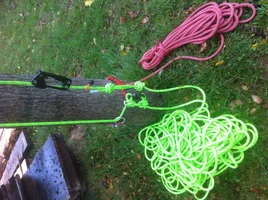
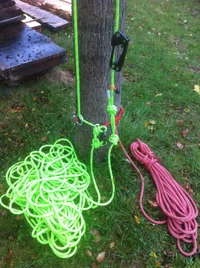
Releasable Trunk Anchor

SoftBankHawks

Branched out member
Location
Japan
Just put this little video up to start some conversation. These days I'm becoming rather entrenched that Trunk Anchored systems are Access systems and Crown Anchored ones are Work Positioning - and this runs across the board of single, doubled, tripled, twin line etc etc.
Does anybody use releasable trunk anchors? I'm curious to see what technique has been discovered?!

<iframe src="https://player.vimeo.com/video/142123704" width="500" height="281" frameborder="0" webkitallowfullscreen mozallowfullscreen allowfullscreen></iframe> <p><a href="
">Releasable Trunk Anchor</a> from <a href="https://vimeo.com/user21488796">Paul Poynter</a> on <a href="https://vimeo.com">Vimeo</a>.</p>
 
I've been using releasable trunk anchors for 3 years or so, but not so much for converting to work positioning, mainly for woods climbing when I want to make the most of my rope length. But if I did want to convert to a canopy anchor in a work situation and not expecting anyone handy to release my trunk anchor then I would use it. I started up experiments on releasable canopy anchors lower in the crown (to make the best use of redirect capabilities and protect the anchor from accidental disturbance by ground workers), but never finished with it, need to get back to working that out.

Slightly off topic but your mention of being entrenched with the idea that trunk anchors primarily for access and canopy anchors primarily for work positioning is interesting. I find that canopy anchors can defeat some of the advantages of SRT redirects and a base anchored system, of course it depends where you set you canopy anchor but if it's up too high centrally in the tree all the same side loading problems are there that can exist with DdRT work positioning.

For my releasable base anchor I use a 3-stage slip knot release with a couple different safeguards built in. All rope no hardware. It's released the same as in Paul's system, by pulling up the tail. It won't release when the climber's weight is on rope.

An example of the releasable anchor at 00:45, then releasing the anchor at 3:15 into the video.
-AJ
 
Last edited:
I set up a pretty slick system that is based on the same principle as a Rr Canopy Anchor, but set at the base of the tree. By creating an endless loop (tie both ends of rope together), you can pull up on the fall of line (below multiscender) and pull the stopper away from the small ring. Keep pulling until the knot gets to you, and untie it. Continue to pul in the same direction and your retrieval ball will eventually pull the trunk anchor up to you.

This is bomber, and just requires understanding of rope management during the process. Nice thing is the Base Anchor can then convert to a Canopy Anchored System.

I'll get a video of the system up as soon as I can, but perhaps a photo will do to begin with. I've posted it here before, but will have to dig it up...
 
Cool beans Eric, I'd like to see your process of anchor installation and how you use the 2 ropes, after release. Seems we have at least 2 things to talk about now !
Moss, I freaked out a little yesterday, I was shown a Japanese climbers video of him climbing on the Minty (releasable re-direct) but as a main anchor. Somehow I can trust you but I tend to shy away from things like that. Very cool non-the-less..... and I want to climb a redwood!! I am writing some stuff about access v's work position, I'll send it to you for perusal, please pm a mail address. Thanks.
 

Attachments

  • Oceans RTA.webp
    Oceans RTA.webp
    669.3 KB · Views: 72
Best I can do is make a video ASAP. I should be able to implement that into tomorrow's work plan.

In the mean time, imagine the possibilities of the system based on something many of you have already used; the Rr Canopy Anchor. A stopper knot will be against the small ring. To retrieve, you pull the knot away from the small ring and it retrieves identically as a DdRT Rr Friction Saver system. Now just apply that as a base anchor.

I'll post more soon as I can...
 
Love the preppy colors, lol. The large ring is spliced on the end of the rope. Is the small ring sewn on a loop of webbing?
 
Moss, I freaked out a little yesterday, I was shown a Japanese climbers video of him climbing on the Minty (releasable re-direct) but as a main anchor. Somehow I can trust you but I tend to shy away from things like that. Very cool non-the-less..... and I want to climb a redwood!! I am writing some stuff about access v's work position, I'll send it to you for perusal, please pm a mail address. Thanks.

Yep. I've hesitated to show my release system. It is rock solid, proven over many climbs but... has to be set up correctly. As Oceans mentioned, rope management is very important, you don't want anything to get hung up during the release process. It's not the worse thing though, it's easy enough to lock off the rope at the position you're in the tree and descend to clean up any rope problems below.
-AJ
 
Love the preppy colors, lol. The large ring is spliced on the end of the rope. Is the small ring sewn on a loop of webbing?
Preppy! Haha! I had my shirt collar popped when I took the photo.

The small ring is girthed on a web sling, which is then installed English Prusik style (symmetrical 3 wrap/6 coil). Web loops can work nicely this way. Very low profile.
 
Yep. I've hesitated to show my release system. It is rock solid, proven over many climbs but... has to be set up correctly. As Oceans mentioned, rope management is very important, you don't want anything to get hung up during the release process. It's not the worse thing though, it's easy enough to lock off the rope at the position you're in the tree and descend to clean up any rope problems below.
-AJ
Rope management. Yup. Imagine pulling 100' of line from the bottom of a coil that was laid on a mess of broken branches. Easy for things to get messed up in woods climbs. Best thing is to keep as much with you in the crown as possible. The challenge with this scenario is that you're letting line fall as you pull the other side up.
 
I've been using releasable trunk anchors for 3 years or so, but not so much for converting to work positioning, mainly for woods climbing when I want to make the most of my rope length. But if I did want to convert to a canopy anchor in a work situation and not expecting anyone handy to release my trunk anchor then I would use it. I started up experiments on releasable canopy anchors lower in the crown (to make the best use of redirect capabilities and protect the anchor from accidental disturbance by ground workers), but never finished with it, need to get back to working that out.

Slightly off topic but your mention of being entrenched with the idea that trunk anchors primarily for access and canopy anchors primarily for work positioning is interesting. I find that canopy anchors can defeat some of the advantages of SRT redirects and a base anchored system, of course it depends where you set you canopy anchor but if it's up too high centrally in the tree all the same side loading problems are there that can exist with DdRT work positioning.

For my releasable base anchor I use a 3-stage slip knot release with a couple different safeguards built in. All rope no hardware. It's released the same as in Paul's system, by pulling up the tail. It won't release when the climber's weight is on rope.

An example of the releasable anchor at 00:45, then releasing the anchor at 3:15 into the video.
-AJ
nice! sketchy trunk wood in my opinion above those damaged sections. I mostly work coast redwood and the second/third growth stuff is unbelievable weak. also was worried about your TIP on the transfer being as far away from the stem as it looked but once you got close and I realized that you had spread the trust, it seemed reasonable. redwood limbs are VERY easy to break.
 
Thx Flex, yeah Even though I was DdRT on the transfer I had the rope over at least 3 branches. The challenging part on young redwoods which I'm sure you've run into are all the downward sloping branches and super slick bark on them. Not as bad as a big white fir I was in once, dynamic rope takes on a whole new meaning, or should I say dynamic anchor point, always sliding down the branches away from the trunk. And yes, that small 90' or so redwood that I started with had a messed up top, I'm used to that from climbing white pine in the east, new growth very weak at the top, and lots of damage from winter ocean storms, always treading lightly and cautiously in those situations. As Oceans can tell you, I weigh absolutely nothing so... seriously though, I'm a very cautious climber, life is good, best to keep it that way.
-AJ
 
I'm probably overly cautious really. your judgment while climbing has always appeared solid. Just thought I would throw out the caution flag for anyone who might not know how weak redwood is.
Those slick deccurent limbs are probably the second reason, right after not having to isolate, that I'm so interested in SRT
 
Likewise,, started playing with the concept but with the same standard I set a canopy anchor, in fact I figured if I can make a canopy anchor retrievable why not a base anchor from above. It works well but needs further testing and measuring of loads,
Basically pear shaped links and Pinto pulleys.
 
One thing I'd like to add or remind people of is that a basal anchor does not have to be connected to the work tree. It can be set on a remote tree and when the climber gets to the tie in point they can lanyard in and unweight the basal leg of the system enough to generate the slack needed to add a midline attachable canopy anchor (I prefer the alpine butterfly/ pinto method). Now the anchored end is not life support and the tree can be worked like it's canopy anchored.

Sent from my SM-G920R4 using Tapatalk
 
One thing I'd like to add or remind people of is that a basal anchor does not have to be connected to the work tree. It can be set on a remote tree and when the climber gets to the tie in point they can lanyard in and unweight the basal leg of the system enough to generate the slack needed to add a midline attachable canopy anchor (I prefer the alpine butterfly/ pinto method). Now the anchored end is not life support and the tree can be worked like it's canopy anchored.

Sent from my SM-G920R4 using Tapatalk
Bunny ears too, useful for instant conversion to two ascent lines or added rescue line. Must be removed to get it back to recoverable from the ground.
 

New threads New posts

Back
Top Bottom