Reduction Pruning on Large Trees

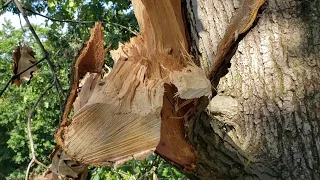
I count 12-15 growth increments in that knob. Hard to be accurate given the video limits

Taking lessons from Dr S about doing vertical dissections I'd collect samples while doing work. THe smalls would get cut off and taken back to my woodshop. The bandsaw makes a really nice cut. If the sample is big I'd do the dissection cut while the knob was still attached to the tree. The ground crew would be told to stash the samples in my van for cleanup at the shop. Using a power plane then various belt and dual action sanders with a splash of poly made up some studiable samples.

Lots to learn from samples.
 
Thank you Tom and Shigo for taking the time and energy to cut up these trees to unlock their inner secrets... I AM more interested in pointing out the more obvious and outwardly observable common sense take aways... that cone shaped new growth, enveloping the dry stub, adds more strength to the stem that the flatter callous growth that will grow over a target cut...

Seems pretty obvious and unarguable... I've split enough wood to know how unbreakable that cone shaped new wood is. The very size of the new growth is going to be stronger that the smaller growth over a target cut. That much should be obvious.
 
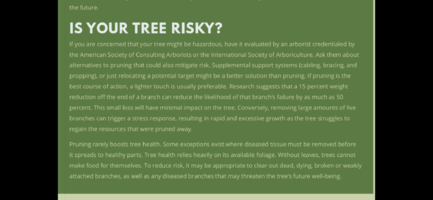
@Daniel your video talking about how reducing a limb by 15% can increase its strength by 50% has had me thinking about it for a few weeks now. It makes sense. I learned full-tree reduction in my first couple years in the trade, from an Englishman who was very good at it. So many of these trees in the city are hardier than we give them credit for. These blanket rules that are taught to new tree guys are just way too simplistic. Such is the way that most things are taught I suppose.
@Daniel
Hey Daniel, just curious where you got that 15% to 50% from? It makes sense to me and is sort of in line with some of Frank Rinn's work regarding canopy reductions and wind but have yet to find any research that states that in regard to individual limbs. I know one guy that made the same statement in a publication but he doesn't know where it came from either lol. Thanks
 
O'm going to make a guess at the source of these numbers.

When the understandings of statics were applied to trees it was found that load reductions could be applied to trees.

My first introduction to statics was when I met Erk Brudi at TCIA Expo one year. He was there selling Cobra. I spent a lot of time listening to Erk explain statics to people as they came tohis booth.

Using the pull test has validated, and is likely the source of, these numbers.
 
@Daniel
Hey Daniel, just curious where you got that 15% to 50% from? It makes sense to me and is sort of in line with some of Frank Rinn's work regarding canopy reductions and wind but have yet to find any research that states that in regard to individual limbs. I know one guy that made the same statement in a publication but he doesn't know where it came from either lol. Thanks
I don't recal ever making such an assertion.. Does 15% mean 15% of weight or of length off the tip? and how would anyone ever measure when a branch became 50% stronger.. While those numbers may sound good, they don't have much meaning in reality..

I know what works in reality... I have a pretty good handle on how much can come off a limb without significantly damaging the tree and how the newly shaped limb will stand up to future forces.

That 50% doesn't mean a thing to me.. I'm shooting for 100% survuval of the limb to any future stress for a period of time... which I'm usually thinking 5 years or more. Most of the limbs I prune can stand up to the worst ice storm that anyone can remember around here.
 
I don't recal ever making such an assertion.. Does 15% mean 15% of weight or of length off the tip? and how would anyone ever measure when a branch became 50% stronger.. While those numbers may sound good, they don't have much meaning in reality..

I know what works in reality... I have a pretty good handle on how much can come off a limb without significantly damaging the tree and how the newly shaped limb will stand up to future forces.

That 50% doesn't mean a thing to me.. I'm shooting for 100% survuval of the limb to any future stress for a period of time... which I'm usually thinking 5 years or more. Most of the limbs I prune can stand up to the worst ice storm that anyone can remember around here.
All good thanks, I wonder where Muggs heard it. Here's where I saw it, thought it was a strange coincidence as was wondering if there was something to it or if a rumor just got started somewhere. I get that it doesn't mean much in the real world up in the tree pruning but it doesn't hurt to have some research to back decisions and explain reasoning in a report or to a customer.
 

Attachments

  • Screenshot_20230929-223148.png
    Screenshot_20230929-223148.png
    126.3 KB · Views: 9
O'm going to make a guess at the source of these numbers.

When the understandings of statics were applied to trees it was found that load reductions could be applied to trees.

My first introduction to statics was when I met Erk Brudi at TCIA Expo one year. He was there selling Cobra. I spent a lot of time listening to Erk explain statics to people as they came tohis booth.

Using the pull test has validated, and is likely the source of, these numbers.
Interesting, thanks Tom!
 
O'm going to make a guess at the source of these numbers.

When the understandings of statics were applied to trees it was found that load reductions could be applied to trees.

My first introduction to statics was when I met Erk Brudi at TCIA Expo one year. He was there selling Cobra. I spent a lot of time listening to Erk explain statics to people as they came tohis booth.

Using the pull test has validated, and is likely the source of, these numbers.
Was googling Brudi and came across a study that says:

"The amount of branch reduction necessary is relatively small. The results of the test of
branch reduction under snow loading indicate that a reduction of 15% will reduce load-
induced stress in the Critical Fracture Zone by approximately 40%. This is significant.
However, the branch reduction testing done in this project was limited in scope. Simple
rules of thumb for branch reduction should be developed through an application of some
basic principles of mechanical engineering, and then validated by field-testing. It appears
very likely that a limited amount of reduction pruning of overhanging branches could
significantly reduce the risk of failure and subsequently the threat to reliability."

It looks like it was 15% of the length, but since foliage is typically more concentrated on the ends of branches, it's probably more than 15% of the total foliage on the branch.. it's called "Development of Risk Assessment Criteria for Branch Failures within the Crowns of Trees".
 
Was googling Brudi and came across a study that says:

"The amount of branch reduction necessary is relatively small. The results of the test of
branch reduction under snow loading indicate that a reduction of 15% will reduce load-
induced stress in the Critical Fracture Zone by approximately 40%. This is significant.
However, the branch reduction testing done in this project was limited in scope. Simple
rules of thumb for branch reduction should be developed through an application of some
basic principles of mechanical engineering, and then validated by field-testing. It appears
very likely that a limited amount of reduction pruning of overhanging branches could
significantly reduce the risk of failure and subsequently the threat to reliability."

It looks like it was 15% of the length, but since foliage is typically more concentrated on the ends of branches, it's probably more than 15% of the total foliage on the branch.. it's called "Development of Risk Assessment Criteria for Branch Failures within the Crowns of Trees".
Thanks for the clarification.
Those numbers have been in my head and I’ve used them as a guideline for a while. I think the numbers are less important than the general concept of reducing leveraging weight being an outsized benefit as to mitigating potential failures. That just makes sense to me and to everyone you mention it to.

It was a while back so I forget who was countering the benefits of tip weight on this thread- mentioning how a pine spar without its dampening branches is much more wobbly and that tip weight reduction actually makes a branch/tree less stable. I just had a thought a couple days ago about that- we need to think about years down the line when there is new growth, interior and maybe some at the terminal cut, which gets all those dampening forces back. What is the change in strength when you consider what the branch / tree will grow to become?
:musculoso:

I can imagine some studies to test how this would actually affect things over time but I’m not in a position to make that happen. Do we know anyone who is? :)
 
this is from the comments on one of my youtube videos about leaving a stub here

@bobbysolar7172

• 3 days ago
This is why it's extremely important to know tree biology. Leaving stubs increases the likelihood of decay, especially in Oak trees. This is terrible advice. A proper clean cut with a sharp saw back at the collar/branch bark ridge will allow better compartmentalization vs an eight inch stub. Leaving the stub to two twigs that might not support life to that size of the wood runs the risk of that stub dying because the small regrowth is too small to support life and then the tree has to spend it's energy trying to close that wound eight inches above the branch bark ridge which will take decades longer than a proper collar cut.
REPLY3 replies


mqdefault.webp

Leave That Stub (why the one third rule for pruning is complete nonsense)


@murphy4trees
@murphy4trees

• 2 days ago (edited)
Spoken like a human being... Don't even try to deny it .. YOU ARE A HUMAN BEING.... And not only are you a human being... YOU THINK LIKE A HUMAN BEING TOO! That's your problem... and it's always going to be your problem until you humble yourself enough to try thinking like a tree...Here's a tree that puts some sprouts out on a damaged limb below the break... Tree thinks.. the limb is mostly gone, but I can still use the remaining structure to pop out some new growth.... I might just be able to resurect this limb and use it to make some food, all the while keeping the limb alive and any decay well away from the core of my main stem. Tree thinks this could work out nicely..Human comes along and say "Fxk that". Shigo didn't say nothing about leaving stubs. I'm gonna make me this cut right about here. So he leaves a big white eye on the side of that tree and runs to the bank to cash the check. By the time anyone figures out that the tree simply cannot compartmentalize a cut that big, (even if a textbook target cut was made, which is a big if in this industry) no one is going to know who made the cut, and the guy who made it probably gave up climbing a decade or two ago. Tree now has a case of CIDs.. chainsaw induced decay.... and no one, no how, no way can stop that decay from eventually causing that entire stem above the cut to fail... time to say bye bye treeNext time you go for a walk in the woods, take a look at some of those big old monsters and ask yourdelf how did they ever make it without someone there to cut all those stubs off...
...Read more
REPLY


@bobbysolar7172
@bobbysolar7172

• 22 hours ago
@murphy4trees my passion is trees. I study them. I learn from them. I save them more than removing them. Did you not read the part where I said a sharp clean saw? It is absolutely FACTS that a clean proper cut will help aid in CODIT and reduce unnecessary decay in trees. It's biology 101. The adventitious growth that is put on by the tree is a reaction to make more food production leaves. The energy and time the tree will spend putting on weak growth while trying to grow uneven callous tissue around the breaks will weaken itself for more problems down the road. Trees have two modes, in that they grow to produce food or they defend against diseases and insects....they can't do both. Humble or not I'm tried of tree guys giving bad advice that think they know what they are talking about but don't. You have the freedom to do what you want to do paid by those that signed a blank check with their lives but you shouldn't be giving crap advice. My door is always open to meet new people and share one another's wisdom. Just did two classes last two weeks, one in Pennsylvania and one in Virginia. Open you mind to new ideas - it's a two way street.
REPLY


@murphy4trees
@murphy4trees

• 18 hours ago
I appreciate an honest ans respectful discourse. You sound like you care which is a plus. It takes love of the work and the trees to unlock their secrets. Yes.. it;s tree biology 101, but that just happens to be wrong... The industry has been so stuck on Shigo's teachings about target pruning, they have been doing trees a diservice pwe your perspective for 40 years. I switched my perspective after hear Guy Meilluer give a lecture on pruning after storm damage. I that there was no practical difference between a storm ripping a 30' limb in half and Mrs SMith wanting to remove a 30' limb to get more light on her garden. The concept that we must cut back to a lateral 1/3 the diameter of the parent stem is a completley mistaken teaching that still has legs decades after it was shown to be false... But the mindset continues Are you familiar with the European science showing that no live green cuts over 4" can fully compartmentalize? And that's on species that are excellent compartmentalizer. You seem to be of the thinking that quickly sealing over a large wound is desireable. Shigo showed that flush cuts were more damaging that target cuts, because even though t hey seale over the wound faster, they sealing did not stop the decay, but instead the flush cut actually had internal decay must faster than a target cut.It only mkaes sense to take it one step further and keep movining the cut out, further away from main stem. This offers the tree time to set up it's chemical defenses in the area before the deacay organisms can get past the BPZ. Even of you don't agree with that and instead believe the "Sugar stick" theory that suggests the organisms use the carb from the dead stub to build strength and attack the main stem, (which I disagree with), you cannot deny the practical fact that if you teach target pruning on such large cuts, there is bound to be human error or situations where the target is unclear. In such cases, there is absolutely going to be a large percentage of cuts that violate the BPZ. It makes more sense in real world (non-ivory tower) conditions to leave a small or large stub with the intentio of returniong in 4-8 years and either pruning the new growth to help the tree develop a better structure, or in many cases if will be better to remove the stub. By that time, the new callous growth around the dead or retarded limb will have formed a clear collar which can be used to determine the desired target. No more guessing.The advantitious new growth has more of a purpose than just prducing food. The new growth forms more new woo din the area of decay, which creates a bulbous physical structure that is much stronger than the new wood forming over a target cut. ANyone that has tried to split firewood whish contains a bulbous growth over a dead limb, knows for sure how strong the structure and fibers of this wound wood is. While I don't your sincerity, I have been where you are for decades. I have since learned better and seen the resutls with my own eyes for decades. There is nothing you or any PhD could ever say that would change my mind here. The "Science" behind tree work has major inherent flaws. None of Shigo's work ever followed pruning cuts through to failure, which is the ultimate outcome of signiifcance. He exrapolated his conclusions from looking at discoloration and decay, never realizing that there are certain types of discoloration and decay that a tree can easily handle long-term without failure and others that lead to rapid failure. Shigo never managed to undersrand that distinction and as a result the tree care industry has been thoroughly misguided ever since.You trying to tell me to keep an open mind to new views by telling me things I learned in 1982, would be like telling a world class climber on SRT to keep an open mind to using a tauntline hitch.
 
Watching the video on mute.
I’d think that tree could handle a collar cut just fine allowing for a full callus, probably close right up and decrease any decay when it becomes anaerobic.
OR
a heading cut back to the the latent buds that have activated. Aiming for good callus there.
Or
if this tree is in the back 40 leave it as is.
I don’t see any point of making a mountain out of a mole hill.

 
this is from the comments on one of my youtube videos about leaving a stub here
Great video and following discussion.
Best message I emphasize here is giving attention to what the tree is doing. Those little shoots. Clear sign from the tree of how it wants to repair.
I've been looking at pruning with a fresh eye in regards to this choice: leaving stubs to provide the "ground" for adventitious buds, or proper pruning cut at the trunk; when regarding limbs that are showing problems or hazard and require removal.

Lately most of the trees I've been in haven't seen any pruning at all. If I were to get rid of every branch with wounds, rubbing, too long for its width; there wouldn't be much left. Accepting heading cuts as a potential is surely better for me than being dogmatic about cutting back to the trunk.

I pruned three mature Tulips that were way over a roof, leaning down to touch it as well as dozens of feet up leaning way over. I made a few big heading cuts there, just beyond what appear to be hearty nodes. I can visualize a time where this tree isn't over the house anymore, and also isn't showing a bare naked trunk to the eastern light as if I had been set on cutting back to the trunk.

Of course it can look clunky, and I explained to the client what the rationale was. He understood easily and asked me to prune half a dozen more trees.

The realities we face call for as many concepts and approaches as possible, to meet the range of what we find. I am glad to know where to make a proper pruning cut at the trunk when that is the best choice. I'm also glad to watch for the unique signals of any given tree while I am there.
Touch Trees, as it's said.
 
Watching the video on mute.
I’d think that tree could handle a collar cut just fine allowing for a full callus, probably close right up and decrease any decay when it becomes anaerobic.
OR
a heading cut back to the the latent buds that have activated. Aiming for good callus there.
Or
if this tree is in the back 40 leave it as is.
I don’t see any point of making a mountain out of a mole hill.
I would generally agree that this tree could handle all three approaches, though no one of us is going to be around in another 50 years to see how the tree made out with compartmentalizing the decay on a target cut.

When someone sees the new sprouts and says. "I think that tree can handle a collar cut"... that's human centric thinking... So many of you want science to light the path, when simply tuning into the tree can yield far better results. But in order o do so you must meet the tree on its level, something that's not so easy for so many Americans...
 

New threads New posts

Kask Stihl NORTHEASTERN Arborists Wesspur TreeStuff.com Teufelberger Westminster X-Rigging Teufelberger
Back
Top Bottom