Daniel
Carpal tunnel level member
- Location
- Suburban Philadelphia (Wayne)
Follow along with the video below to see how to install our site as a web app on your home screen.
Note: This feature may not be available in some browsers.

I count 12-15 growth increments in that knob. Hard to be accurate given the video limits
@Daniel@Daniel your video talking about how reducing a limb by 15% can increase its strength by 50% has had me thinking about it for a few weeks now. It makes sense. I learned full-tree reduction in my first couple years in the trade, from an Englishman who was very good at it. So many of these trees in the city are hardier than we give them credit for. These blanket rules that are taught to new tree guys are just way too simplistic. Such is the way that most things are taught I suppose.
I don't recal ever making such an assertion.. Does 15% mean 15% of weight or of length off the tip? and how would anyone ever measure when a branch became 50% stronger.. While those numbers may sound good, they don't have much meaning in reality..@Daniel
Hey Daniel, just curious where you got that 15% to 50% from? It makes sense to me and is sort of in line with some of Frank Rinn's work regarding canopy reductions and wind but have yet to find any research that states that in regard to individual limbs. I know one guy that made the same statement in a publication but he doesn't know where it came from either lol. Thanks
All good thanks, I wonder where Muggs heard it. Here's where I saw it, thought it was a strange coincidence as was wondering if there was something to it or if a rumor just got started somewhere. I get that it doesn't mean much in the real world up in the tree pruning but it doesn't hurt to have some research to back decisions and explain reasoning in a report or to a customer.I don't recal ever making such an assertion.. Does 15% mean 15% of weight or of length off the tip? and how would anyone ever measure when a branch became 50% stronger.. While those numbers may sound good, they don't have much meaning in reality..
I know what works in reality... I have a pretty good handle on how much can come off a limb without significantly damaging the tree and how the newly shaped limb will stand up to future forces.
That 50% doesn't mean a thing to me.. I'm shooting for 100% survuval of the limb to any future stress for a period of time... which I'm usually thinking 5 years or more. Most of the limbs I prune can stand up to the worst ice storm that anyone can remember around here.
Interesting, thanks Tom!O'm going to make a guess at the source of these numbers.
When the understandings of statics were applied to trees it was found that load reductions could be applied to trees.
My first introduction to statics was when I met Erk Brudi at TCIA Expo one year. He was there selling Cobra. I spent a lot of time listening to Erk explain statics to people as they came tohis booth.
Using the pull test has validated, and is likely the source of, these numbers.
Was googling Brudi and came across a study that says:O'm going to make a guess at the source of these numbers.
When the understandings of statics were applied to trees it was found that load reductions could be applied to trees.
My first introduction to statics was when I met Erk Brudi at TCIA Expo one year. He was there selling Cobra. I spent a lot of time listening to Erk explain statics to people as they came tohis booth.
Using the pull test has validated, and is likely the source of, these numbers.

Thanks for the clarification.Was googling Brudi and came across a study that says:
"The amount of branch reduction necessary is relatively small. The results of the test of
branch reduction under snow loading indicate that a reduction of 15% will reduce load-
induced stress in the Critical Fracture Zone by approximately 40%. This is significant.
However, the branch reduction testing done in this project was limited in scope. Simple
rules of thumb for branch reduction should be developed through an application of some
basic principles of mechanical engineering, and then validated by field-testing. It appears
very likely that a limited amount of reduction pruning of overhanging branches could
significantly reduce the risk of failure and subsequently the threat to reliability."
It looks like it was 15% of the length, but since foliage is typically more concentrated on the ends of branches, it's probably more than 15% of the total foliage on the branch.. it's called "Development of Risk Assessment Criteria for Branch Failures within the Crowns of Trees".


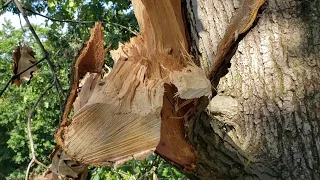


Great video and following discussion.this is from the comments on one of my youtube videos about leaving a stub here
I would generally agree that this tree could handle all three approaches, though no one of us is going to be around in another 50 years to see how the tree made out with compartmentalizing the decay on a target cut.Watching the video on mute.
I’d think that tree could handle a collar cut just fine allowing for a full callus, probably close right up and decrease any decay when it becomes anaerobic.
OR
a heading cut back to the the latent buds that have activated. Aiming for good callus there.
Or
if this tree is in the back 40 leave it as is.
I don’t see any point of making a mountain out of a mole hill.