Redirects

[ QUOTE ]
Hey Todd;

Any chance you could re-size that photo? My tired old computer can't process all of that information.

Thanks!

Mahk

[/ QUOTE ]
Don't need an old computer to appreciate that request. I endured the fetch and fixed it up for you and everyone else.

Glen
 

Attachments

  • 14499-13230-DSCN0953.webp
    14499-13230-DSCN0953.webp
    110 KB · Views: 406
Mark,

I use the command-line "convert" component of the package freely available at http://www.imagemagick.org/. Quite ironically, the interactive graphical "display" component has interface to all the suite functionality in the unix environments, but for the Windows build, "display" is quite meager (at least that's been the case historically). I guess that's mostly to do with the "small utilities that do one thing well and readily communicate with others that do their things similarly" ideology of unix, different from that of Windows. The software is basically designed to first be able to run non-interactively on servers or other capable boxes (like old 486s not running Windows, hahaha)

Anyway, the original image was:

Geometry: 1306x979
JPEG-Quality: 90
Filesize: 400kb

and became:

Geometry: 490x653
JPEG-Quality: 75
Filesize: 91kb

as a result of me issuing the command:

<font class="small">Code:</font><hr /><pre>convert 13230-DSCN0953.JPG -rotate 270 -resize 50% -sharpen 0x1 -quality 75 13230-DSCN0953.jpg</pre><hr />
I apologize for the long line. If you would enable HTML posting for me it would be most helpful to do more with formatting, etc. in a friendlier fashion.

It would maybe be almost trivial to have your server automatically shrink monstrous submitted images to reasonable size with this stuff. That would result in more friendliness with various visitors and less storage requirements on your end.

If you want to familiarize yourself with the stuff and would like some help, let me know.

Glen
 
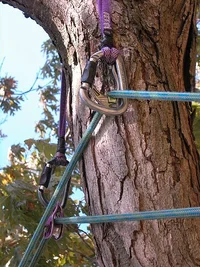
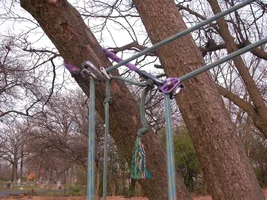
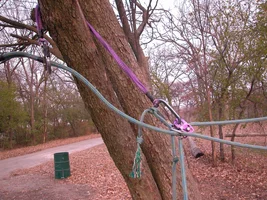
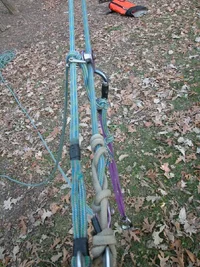
Can anyone tell me why use a locking biner to back up the biner w/ the pulley?
This is not Primary life support but a re-direct. Sure it could be essential on a long limb walk and if the re-direct should fail the climber could swing and be injured. BUT it is not Primary Life Support, so why the biner backup?
Frans
 
Frans,

I consider redi's as Primary Supports. If something were to comprimise most redis the climber would take a fall and most likely a swing. Is there a compelling reason not to use a locker?

The little extra expense sure seems worthwhile to me. I only carry one non-locker on my saddle. That's attached to a short cord and is used to hold odd pieces of gear. I never use non-lockers for any part of my support system.

When Dave and I were at Mountain Equipment Co-op in Toronto we wondered why people use screw gate biners when auto locks are so much easier and dependable. I know...not fool proof though :)

Petzl makes a plain, orange sheave that slips onto a biner to make a cheap pulley. It seems to me that this could be made into a redi pulley. When I've used mine the pulley moves around and sometimes the rope jumps off the sheave and gets balled up. I wonder if some kind of keeper could be fabricated to keep the rope in the tread of the sheave. Something along the lines of the leather, metal or innertube tabs that are made to keep ropes in the small end of the biner.
 
Even though i gots cable; and Glens takes some knocks about requesting picture resizing (elsewheres); i think that is another excellent tip; Thanks!

i carry 1 redirect 'loop runner' 1" not the newer Spectra/Dynema that Tom recomended(that are great, and light even make nice friction hitch for utility use to tension rig with Z-rig); i use those for rigging only. i have a locking carabiner on it, always. Sometimes i hangit on the backside of a smooth spar, then lace lifeline to front for main support. i make sure the line traces imperfections, the size of the spar itself, not to make a sharp bending line at the carabiner. Any doubts about degree of potential bend, i place another carabiner (or 2) as wider support for 'belly' of line.

A lot of times, i'll put a redirect in, just to work a local region, staying a few feet from the redirect, which is more at a supporting angle, and limits fall/sweep towards main tie in. Sometimes, i only place 1 line of DdRT in the redirect, and keep line tight. This makes ya trolley across dissipating force (i think, rather than drop and swing from pivot of redirect)if needing to use. The lines shuffling through connections 'frictionalize' to slow ya down more naturally. Especially i like it near power lines. Especially with tight line, redirect close, so you must carry horizontally away from lines, can't really drop or swing. Sometimes purposefully redirect, higher than TIP for this function.

When climbing above TIP; i'll strategically place legitimate redirect somewhere on the way up, then kinda cheat and use rigging loops/dynema; as i have a 'catch safety' about every body length. 1 could even fail, weak skinny spar could flex etc., and the string of redirects should catch me. This is where i got idea for plaicng only 1 line in carabiner of DdRT. So, if there was a probem, i would run past it and minimally load redirect, as it wouldn't be catching direct force, but what was left after the run on line - friction of spar and connections, and then me trying to catch self. On the way down, and sometimes on the way up, the sling positions make hand holds, foot holds, drink, hang saw and just take Silky up higher, rigging, speed line, handles to toss lengths etc.

Gotta try one of those fancies with roller in carabiner!

i redirct a lot of rigging lines with slings too, with sling/carabiner. The primary support giving strength, friction and keeps line from taking a sharp bend around carabiner/redirect by load. Also the delivery angle to redirect can pull down along it's spar for more strength if figured right. The redirect places the strength and friction of the main support to deliver to target zone on ground, or clear path to. As long as the point at redirect bend is flatter than 120deg. there is less than load force on the redirect support. Instead of a rescue pulley for redirect, simply through carabiner (if line won't bend to sharply)gives some friction to dissipate force on control side, rather than making matching legs of load like pulley, for less pull on support.

Or, something like that,
/forum/images/graemlins/propeller.gif

 
I agree with you Tom that should something go wrong with the redirect the results could be devestating. But I feel that we (arborists) often take the issue of redundancy to far. Is it a blind following of "safety" when the issue is maybe not that necessary?
I bring up the entire field of Rock Climbing where these devices originated . In this disipline non-locking biners as primary support are the norm (for how long have they been doing this? 50 years? or more?). Of course we (arborists) say it is sucicidal mainly because of the different conditions. But take the matter of a redirect. It is not really that much different.
Setting a non-locking biner on a quick draw with a "friend" set in a crack, for example, means the climber is climbing ABOVE the support. The rope is twisting and working in ways (as the climber ascends the crack) that I would think would be a great opportunity for the rope to work it's way out of the biner.
In a redirect as used by arbos the situation is nearly the same. Some difference in variables sure but nearly the same.
Are we 'safer' or just blindly following unnecessary safety rules?
What gets me is the almost universal trait of arbos in modifying their gear (like modifying the Positioner, or drilling holes in ascenders, or mating steel and aluminum parts, etc, etc), but then like the case of double locking biners on redi-rects, being so concerned with 'safety'.
I try to apply common sense with my personal safety. I try to stop when fatigued, keep an overall objective sense of what I am getting into, and talk things through with my ground support. These things are very important when climbing and IMO should be paid more attention to then doubling up a redirect.
Before you all jump down my throat let me insert a disclaimer:
Not all systems work for all situations, and any system may be changed, discarded or reinforced as the situation changes (as I see fit to tottally preserve my safety and the safety of my work site and the people involved)
Frans
 
[ QUOTE ]
Are we 'safer' or just blindly following unnecessary safety rules?...

...I try to apply common sense with my personal safety. I try to stop when fatigued, keep an overall objective sense of what I am getting into, and talk things through with my ground support. These things are very important when climbing and IMO should be paid more attention to then doubling up a redirect.
Frans

[/ QUOTE ]

I tried to follow the logic of your comments, but failed.

Safety rules should not necessarily be "blindly followed". It would be better to say "habitually followed".
Why can’t you both follow safety rules, and apply common sense to your personal safety?
Your argument seems to indicate that safety rules and common sense are mutually exclusive, when in fact, they should co-exist.
 
On the face of it maybe my logic does'nt make sense. But then again writing things down and making it make sense is an art in itself, not an art I am very good at.
Sooo, I'll make my case situational.
Climbing a Valley Oak with little or no brush on the interior main scaffolding branches means a very clean climbing environment, long nearly horizontal branches. In this case I wont bother with doubling up on a re-direct. I'll take my super light non-locking re-direct and go to work. When working in brushy trees with all kinds of stubs, suckers, etc I'll then go to super fail safe tooling.
By blind following of safety procedures, I mean not adjusting to different environments. Sure in training someone to climb I would not teach any other way but the safest. But as a climber with many many years of climbing I know what works and what does'nt.
Is my way foolish? Am I courting disaster? I think not. I just believe there are many ways to 'skin a cat'.
Most of the conversations on TreeBuzz and other sites are based on being tottally redundant with our equipment. Liability? I dont know.
Take two handed chain saw use for example. I say it is foolish but the 'industry' or insurance industry at least, wants to make it mandatory. What is 'safe',always two handed chain saw use, or using the best method for each situation?
I imagine cutting a branch with two hands, my foot slips, and I dont have a free hand to steady myself. What is safe operation then?

Frans
 
Frans and Mike make good points.

When I look at using lockers or not for redis I wonder why I wouldn't use a locker. For arbos weight is a non-factor. For rock climbers weight is an issue. The possibility of the rope crosssing back over a gate is a concern too. Brush could catch and shoehorn the gate open. I feel much more comfortable with lockers.

Tom
 
[ QUOTE ]
What gets me is the almost universal trait of arbos in modifying their gear (like modifying the Positioner, or drilling holes in ascenders, or mating steel and aluminum parts, etc, etc), but then like the case of double locking biners on redi-rects, being so concerned with 'safety'.


[/ QUOTE ]
Frans, you make it sound as if modifying equipment is a bad thing, you specifically mentioned my positioner mod, which hardly consists of anything but is still just as safe as before. So because I modify MY gear this is not safe? and because my redi is double autolocking, I am being overly concerned with safety?
So basically your saying the fact that someone uses redundancies in their systems for safety is pointless if they choose to modify their gear they are truely unsafe anyway so whats the point?
Who doesn't or hasent modded gear before? You Frans?
I bet you've got some gear that would be considered modified.
 
[/ QUOTE ]
Frans, you make it sound as if modifying equipment is a bad thing, you specifically mentioned my positioner mod, which hardly consists of anything but is still just as safe as before. So because I modify MY gear this is not safe? and because my redi is double autolocking, I am being overly concerned with safety?


[/ QUOTE ]
Good grief!
Look my point is, If you want to make a redi-rect that works for ALL situations then yours is a great device. My conversation points to MAYBE allowing a little leeway and using a nonlocking system where it is appropriate. I like your redirect I just think laying the revolver pulley next to the locking biner kinda defeats the ability of the pulley to revolve. So why not just use the revolver WHERE AND WHEN THE WORKING CONDITIONS ARE FREE OF POSSIBLE ENTANGLEMENTS?
When you mentioned the Positioner modification you stated that it occasionally "lockes up" This happens when the clevis gets twisted in the body of the positioner. The torque loading on the body of the Positioner is not what the manufacturer planned for in this case (IMO).For example: I have seen people using a large gibbs for their 5/8" flip line and had a small twisted clevis to attach it to the D ring of their saddle. The clevis would lock up and torque the aluminum cam part of the gibbs- NOT safe IMO.
And yes I AM a modifying freak, I think most arbos are and it has helped to bring our trade to new and better levals of technology- all this talk of mine is purely because of wanting to explore the trait of arbos to avoid using non-locking biners IN ANY SITUATION.
Now I have to go back to the shop and continue bolting together the different parts of a new experimental single line set up (with bolts and stuff bought at the hardware store)
No hard feelings, aright?
Frans
 
Snarf, because of the positioning of the revolver and the size the pulley runs free. I have been using it like it is shown for awhile and really like it. Very little resistance. Alright back on topic I mentioned a way to retrieve it while in the tree. Scott Profitt showed me the method, I am using different equipment but the result is the same. Take your tail and connect it to the biner that has the micro pulley. Now connect the clip to the opposite rope behind the revolver. Now you have a loop. You can pull your splice back to you and get back to work.
 

Attachments

  • 14630-DSCN0973.webp
    14630-DSCN0973.webp
    369.1 KB · Views: 464

New threads New posts

Back
Top Bottom